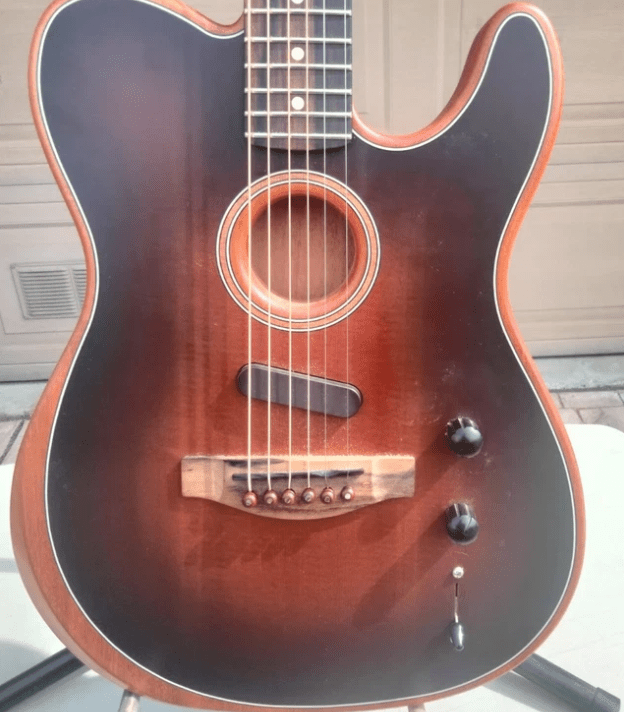
This entry is based, substantially, on watching guitar related YouTube videos, so Fact(mostly) as much as YouTube videos can be a source of facts.
Some revealing information about me.
A decade ago, I became fascinated with the History Channel’s Forged In Fire reality TV series. Watching real people turn raw materials into practical blades seemed incongruous in a world where Amazon.com customers put a premium in reducing price often at the cost of quality and authenticity. I also followed car restoration shows like Counting Cars, Bitchin’ Rides, Iron Resurrection and Texas Metal.
I started playing guitar again and hunted YouTube for guitar tutorials that I could actually master. Several luthiery videos popped up in the right hand column. The most interesting of these featured Chris Alvarado of Driftwood Guitars cutting a guitar in half as part of his review.
The right hand column also offers other gear reviews and informational videos. So, I must have viewed dozens if not hundreds of guitar related videos of all sorts. Add to this total, musician and music related documentaries, and there is the knowledge base for this blog entry.
What did Chris say?
Chris Alvarado of Driftwood Guitars is opinionated, sometimes unabashedly, but his opinions seem genuine and well informed from years of luthiery experience. In a review of a new Martin guitar, I thought I heard him say that no-one needs a Fender Acoustasonic. I owned an Acoustasonic, so I was taken aback about the statement. I went on a hunt to find a YouTube video where Chis shares his reasoning for such a statement.
Guitars on YouTube …
… come from tonnes of uploads and hundreds of contributors. I’ll refer to some of these, in the following sections, in perhaps familiar terms, like Chris, though all I know about them is from a few videos. Nonetheless, a cast of characters might be helpful.
Chis Alvarado and Matt Miller of Driftwood Guitars make dozens of luthiery videos and quite a few guitar industry and review videos. They review “Factory Tour” and other promotional videos from several brands like Taylor, Takamine and Breedlove. Most impressively, they buy guitars for review and cut them in half to examine their workmanship. Now that’s thorough.
Rhett Shull contributes on-line guitars lessons (haven’t checked them out) and YouTube product reviews. Chris and Matt gave him one of their Tidalcaster electric guitars and they accept his evaluations. They also reworked his “law suit era” Takamine dreadnought in part as an experiment to see if it was cost effective to buy a cheap used guitar and rework it. Initially, Rhett brought it in for a neck reset.
Paul Davids contributes product reviews, guitar tutorials, interviews and offers on-line guitar lessons (haven’t checked them out).
Mary Spender contributes informative videos, life experience videos, performance videos, product reviews and offers on-line guitar lessons (noticing a trend). She’s quite a good singer and I like her thumb thumping finger style guitar playing. She labels herself a “creative,” and I hope she writes a hit song. Since that is unlikely (her style of music has long passed from public popularity. Okay, so has Ed Sheeran’s, so anything is possible. ), it’s worth checking out her YouTube channel.
Messenger Guitars has only released one luthiery video which has any interesting premise, and it contains a wealth of good information. I don’t remember if the luthier introduced himself.
What Chris actually said.
My hunt for Chris’ review of Fender Acoustasonic guitars proved fruitless. I did find Rhett Shulls’ review of a Fender Acoustasonic Player Telecaster (FAPT) where he starts with, “I hate these guitars,” and concludes with, “Does anyone need this guitar.” Rhett and Chris are friends, or at least well acquainted. It makes sense that Chris would share Rhett’s opinion.
I went to find the video that sparked my concern, and couldn’t. I did find a video where they reviewed Martin’s promotional video of the GPCE Inception (https://www.youtube.com/watch?v=vFIYOxXfgFA&list=UUxCp0SN53j6SIx9z8uWbg-w&index=31). Near the end of the video, Chris says something about how the Martin GPCE should have stayed as a memo. Matt then includes Fender Acoustasonics in this category and Chris states that “no-one asked for an Acoustasonic,” a pointless phrase.
Aside: Common and useful products abound even though they were never explicitly asked for. I’m sure no one asked for a weak glue whose only virtue is that it doesn’t leave much residue, but once discovered, it became Post-its, a very useful product. There are many examples of innovations by accident including penicillin, microwave ovens, Velcro, Teflon, Kevlar, vulcanized rubber, chocolate chip cookies, Slinky, and safety glass. Many useful products result from the application of discovered entities which are not well understood even during product development. They are just a “cool” idea developers hope will pan out.
I think Chris meant to echo Rhett’s sentiment that Fender Acoustasonic guitars are not very useful guitars. While Chris chose the pointless, “no-one asked for,” form, Rhett chose the arrogant, “nobody needs” statement. And they are wrong, and must have known so. They both follow the guitar industry. They should have known that Fender Acoustasonics posted impressive sales and has signature versions for Finneas and Jack White (admittedly, they likely receive financial compensation). Just after making his “nobody asked for” comment, Chris seemed to realized that he overstated his opinion. He reaffirmed that he stating an opinion, but did not apologize for the statement. Somehow, discussing the statement lead to Matt saying, “You can’t kill me because I’m already dead inside.” That seems like an odd acknowledgment of expected backlash to an outlandish opinion.
I’m FAAT. I’m FAST! I’m FAPJM?
Before discussing why I think Matt, Chris and Rhett are wrong, it would be nice for readers unfamiliar with the guitar industry to know what a Fender Acoustasonic (FA)is.
It is an acoustic guitar, mostly, that depends on electronics to achieve its potential. Fender achieves this by routing out a hunk of mahogany to form the guitar body’s back and sides as well as pockets for electronics. They fit and glue in a braced Sitka spruce top (soundboard) with a sound hole in the traditional place, under the strings and between the bridge and end of the fretboard. There is an odd cylindrical piece of wood on the back of the soundboard down about an inch or so, but there is gap between the cylinder’s bottom and guitars back. The cylinder, bracing and chambered body form what Fender call the Stringed Instrument Resonance System (SIRS) which, to a large extent (not a great or complete extent) works.
Unplugged, my FAAT produces a distinct resonant sound with good sustain. Almost all reviews I have seen criticize its unplugged sound. The other reviews say it’s good enough for practice, or it’s a good couch guitar. I bought the guitar for its unplugged performance, but more about that later.
FAs come in three body styles based on their popular electric guitars: Telecaster (T), Stratocaster (S) and Jazz Master (JM). They also come in three trim levels based both on features and place of manufacture: The American(A) is made in Corona Californian and has 10 tone models; the Player(P) is made in Ensenada Mexico and has 6 tone models; and the Standard(S) is made in Indonesia and only has 2 tone models. Fender suggests that the naming order is always Fender Acoustasonic (FA, like its own brand name), Level (A,P,S), Body style (T,S,JM). I own a Fender Acoustasonic American Telecaster or FAAT which I bought used at a local Guitar Center for under $1000. Rhett Shull reviews a FAPT, Mary Spender reviewed both a FAAT and FAAS, Paul Davids has reviewed several models, but I will be writing, mostly, about his FAAJM review. Several giging musicians reviewed the FAST.
There is more to say about the differences. Only the American level has the body sensor pickup. All levels have an under-saddle piezo pickup. The Tele/Stratocaster have a “noiseless” single coil pickup, while the Jazz Master has a dual coil humbucker style pickup. The Standard version uses nyatoh for the chambered body instead of mahogany.
A Fishman “Acoustic Engine” takes input from the pickups and models them to different guitar models, both acoustic models like a Spruce/Rosewood dreadnought, and electric guitar like a Telecaster. The tone models come in pairs. Musicians select tone pairs using a blade switch. Within a tone model pair, a blend knob allows, well, blending between the two tone models. Since the Standard level only has two tone models, there is no blade switch.
So, what, exactly, is it?
Even with all the details above, that is a very good question. And there are several approaches to the answer.
An Alamo Guitars video comparing a FAAJM to a Taylor T5z (https://www.youtube.com/watch?v=nP8rjODOY3s) provides a useful first step. They characterize both guitars as hybrids which can produce both acoustic and electric guitar tones. Their comparison summarizes to something like
| FAAJM | Taylor T5Z | |
| Looks | Like an Electric | Like an Acoustic |
| Sounds | Mostly like an Acoustic | Mostly like an Electric |
| Strings | Acoustic | Electric |
| Intended for | Electric Players looking to add acoustic sounds to their performance | Acoustic players looking to add electric sounds to their performance. |
To restate their observations: Fender, known mostly for their electric guitars, developed a hybrid guitar focusing on acoustic sounds but looking and feeling like an electric guitar and targeted to electric players; Taylor, known for their acoustic guitars, developed a hybrid guitar focusing on electric sounds which looks like a flattened archtop acoustic guitar and feels like a hybrid.
From the video’s I’ve seen, The T5Z’s electric tones are more desirable than the FA’s, and some reviewers prefer it’s acoustic tones to the FA’s.
I think Alamo might have got it wrong. The FA may seem like a hybrid, but it operates on a different philosophy, or at least it tries to.
What’s that sound, tell me what’s a happening.
Sorry for mixing up the lyrics, but copyright law is somewhat vague, so directly using song lyrics for section heads might get me in trouble.
To better understand hybrid guitars, a basic knowledge of guitars might benefit readers who are not guitarists. In particular, it is important to know where the sound comes from for both acoustic and electric guitars.
On both styles of guitar, string vibration generates the guitar’s tonal output. On acoustic guitars, tapping, knocking, slapping and otherwise hitting guitars produce percussive sounds. There is a style of playing known as “percussive guitar” and Mike Dawes describes his style of percussive guitar pretty well but this is a subject for another blog entry. This entry is concerned with tonal output.
Acoustic guitars are the more interesting of the two. It produces tonal sounds several ways. The primary source of sound is the top of the guitar also known as the soundboard. Strings vibrate against the saddle which rests in a slot on the bridge which is glued onto the soundboard. To be clear, string tension holds the saddle in it’s place not just firmly, but forms a solid connection (not much energy loss there). There is, of course, more to it than that.
While playing my steel string acoustic guitar, I can feel vibrations where the upper bout presses against my chest; the neck feels lively. In fact, the whole guitar feels alive. It isn’t, but many pars of an acoustic guitar contribute to its sound. String vibrations transmit to the nut and cause the neck to vibrate. Well constructed guitars transmit these vibrations through the neck joint to the guitar’s body. The soundboard doesn’t just project sound waves out, but it also produces sound waves inside the body. Lastly, the sound board is braced to handle over 220 pounds of string tension (light acoustic steel strings generate 160 pounds; heavy 220 pounds. Nylon string guitars produce 60 – 100 pounds of tension.) The braces transfer vibrational energy to sides; the sides transfer energy to the back which produces sound waves as well.
All of the activity inside the body creates resonance which gives acoustic guitars their rich and complex tone. Although sound waves are echoing and interacting inside a guitar’s body, the guitar top’s and back’s role are more like large trampolines with lots of people jumping on it as opposed a sonic mirror reflecting sound waves.
For electric guitars, strings vibrate in the pickup’s magnetic fields creating induction waves in the pickups’ coils and the electricity goes to the electronics, usually a pre-amp, effects pedals, amplifier and, finally, speakers.
Acoustic electric guitars typically have an under saddle piezo pickup which reacts to pressure in much the same way as old record player needles translate bumps in records grooves to produce sound. Basically, it captures string vibration and some resonance. More advanced acoustic/electric guitars add pickups. The most common is a body sensor usually attached to the soundboard. My favorite is the L.R. Baggs HiFi Duet which combines under bridge transducers to pick up string and soundboard vibrations and a small microphone which captures internal resonance.
Most acoustic/electric guitars have built in pre-amps which allow musicians to shape a desirable tone from their guitars. More input sources allow them to find good combinations.
FAA level guitars have an under-saddle piezo pickup, a body sensor and a magnetic pickup. The Player and Standard levels do not have the body sensor.
String me up.
Since FAs come with acoustic strings, specifically Fender coated phosphor bronze, it’s a bit of a wonder that the magnetic pickup works at all.
The thinner guitar strings (high E and B) are made of high carbon steel. The G string on electric guitars are high carbon steel as well, but acoustic G strings are made with a steel core and wound with another type of wire, typically bronze. The thicker D, A and E strings are also wound: Acoustics primarily with bronze, electrics nickel.
The choice of material (bronze or nickel) is to solve different problems. Acoustic guitars need more vibrational energy transfer, which bronze based strings provide. They tend to be higher tensioned. Bronze in non ferrous and does not interact with magnets well. On the guitar, they are harder to bend. Nickel strings react better with magnetic pickups giving them better performance on electric guitars.
Cole Clark, an Australian guitar company, came up with a solution to this problem for their hybrid guitar. De-power the pickups on the E and B strings. At normal power, unwound strings dominate the sound. To balance the sound across all strings, they toned down the unwound string magnets. I guess Fender did something similar. The pickups still get some, though far from optimal, reaction to the ferrous string cores.
You mock me.
In a promotional video, a Taylor Guitars representative states that the Taylor T5z is not a modeling guitar, but its tone controls, which allow guitarists to either boost or cut trebles and basses, give the guitar an ability to mimic other guitars. He demonstrated this by putting the guitar into acoustic mode and boosted both the treble and bass and mentioned that dreadnoughts tend to have a scooped mid sound he displayed a graph that looked like a “U.” He played a bit to demonstrate the dreadnought sound before cutting both the treble and bass, showed a frown looking graph and explained that parlor shaped guitars have pronounced mid-range and a very articulate sound. That is how a Taylor T5z can mimic typical acoustic guitars. It is even better mimicking electric guitars like the Telecaster (position 3 – bridge pickup, boost treble 75 to 100 percent), Stratocaster (position 4, same boost options as Telecaster) or Les Paul.
Fender claims that the FA uses Fishman designed “Acoustic Engine” to produce 10 tone models. A five position blade switch lets musicians choose between paired tone models (FAAT choices):
5 – Core Acoustics – Sitka spruce/Rosewood Dreadnought & Alpine Spruce/Rosewood Auditorium
4 – Alternate Acoustics – Englemann Spruce/Rosewood Small Body & Sitka Spruce/Mahogany Dreadnought.
3 – Percussion and Enhanced Harmonics – Sitka Spruce and Brazilian Rosewood Dreadnought & the same thing but with added body sensor input to allow percussive body sounds.
2 – Acoustic/Electric Blend – Sitka Spruce/ Mahogany Dreadnought & the same but with a semi-clean electric bridge pickup.
1 – Electric – Fender Clean Electric & Fender Fat, not-so-clean, electric sound.
Since FAs target specific models of guitars (Engelmann Spruce/Rosewood parlor), many count FAs as modeling guitars.
This Year’s Model.
In a documentary, Rick Wakeman described playing a Mellotron, a keyboard that drags an eight second magnetic tape samples of instruments across a magnetic tape head (reader) when a corresponding key (think piano key) is pressed. When the key is released, a spring brings the tape back to it’s starting position. Rick Wakeman stated that when he held the key too long, he had to wait for the tape to reset.
Initially, they recorded orchestral strings (violins, cello’s and the like). Tape, being tape, can record anything. Keyboardists could model any instrument, practically any sonic combination. Mellotron sold two units to the BBS Radiophonic Workshop for sound effects.
In the late 1980’s, an apartment mate had a Korg synthesizer. Each key had 16 levels of sensitivity (it might have been 32, but I think it was 16). Each level of each key sampled a different sound. Most often, the levels of sensitivity utilized samples of the same instrument just played a little harder. Like the Mellotron, sound libraries were not limited to musical instruments. My apartmentmate enjoyed waking me up with screaming roosters. When I inquired, he invited me to his room and played his newly composed “Barnyard Sonata.”
Solid state electronics continued to shrink circuitry. Though Casio keyboards used tone control to approximate other instruments like flutes and guitars in the 1980’s, they switched to PCM which utilized digital sampling. In 2002, Line 6 (known for guitar pedals featuring solid state amp modeling and effects) released their first Variax guitars. By turning a knob, musicians can choose to emulate several different guitar models from electrics like Telecasters and Les Pauls to acoustics like Martin D28s and Gibson J200s. They could even choose banjo and sitar.
The Variax uses individual piezo pickups on each string known as a hexaphonic pickup to feed information to onboard modeling electronics. Later models also had standard pickups, but the modeling was based on the piezo pickups.
Line 6, owned by Yamaha since 2014, canceled the Variax guitar in 2023. A year before Rhett Shull’s review of a FAPT. I could not find a Rhett Shull review of a Variax, though he does have an upload (unwatched) about a Line 6 Helix pedal.
The Thick and Thin of it.
In the mid 1990’s, Object oriented programming was taking root and many companies were developing core business applications for use over the internet. Telephone modems had seen a dramatic rise in speed from 9.6k baud to 28.8k in just a few years. Many business leased fractional T1 lines to speed things up, and with the added speed, computer applications were no longer completely text bound. Visual objects like buttons, sliders and icons were new and cool. Although a company’s data remained on servers, the application, in particular the presentation layer with which end users actually interacted, could reside on the server as well. Transmitting graphics (buttons and icons and the like) slowed down presentation.
Computer systems designers debated whether their applications should be thick-client (the code for the user interface resides on and runs on the end users PC) or thin-client (the code resides on the company’s server and mostly runs on the server as well). Thick-clients ran much quicker. Only the data needed to travel back and forth. Thin-clients could be easily updated and upgraded (almost on the fly) without work interruptions. They required much less user support. With thick-clients, not all workstations would update or upgrade at the same time. Many workstations ran old/incompatible versions of the program causing support staff nightmares until each individual users’ PC based thick-client software updates.
If all of a company’s workstations are on an Ethernet connection, thin-client applications were an easy choice. Companies relying on phone based telecommunications, leaned toward thick-client based applications.
Thick-client systems are, now, nearly extinct. Broadband telecommunications like DSL, Cable and 5G gradually became ubiquitous.
In computer terms, the Line 6 Variax is a thick-client modeling guitar. FAs also adopt a thick-client approach. I do not think Yamaha canceled the Line 6 Variax because it is an old tech approach. Most electric guitars are based on 1950’s technology. The ¼ inch jack is ubiquitous still today. Almost every electric guitar on the market today has a ¼ jack as their only connection. A ¼ inch cable does not carry enough information for true modeling.
Thinking of the Taylor T5z again. It takes a thin-client approach to approximating tones of guitar models. Musicians need to select the best pickup configuration and then set the tone equalization knobs. For example: A quick Google search returns that the best settings for a T5z to emulate a Fender Telecaster is switch position three boosting treble EQ around 75 percent and cut the bass a little. The same EQ settings but switch position four should emulate a Fender Stratocaster. Google searches return T5z setting suggestions for several makes and models of guitars.
However interesting, the point is that FAs take a thick-client approach to emulating different types of guitar tones. Other hybrid guitars accomplish the similar, some say better, results, but through a thin-client approach
CADGAD.
FAs do not have adaptive modeling. Very few modeling instruments do. I followed another YouTube experiment by changing the Fender coated phosphor bronze strings with D’Addario coated phosphor bronze strings. The D’Addario strings felt livelier and easier to play. I liked them; the FA acoustic engine, not so much. Plugged in, they did not produce tonal qualities as well as Fender strings.
In a YouTube review of the Variax, a musician was thoroughly unimpressed with the guitar modeling. Another control on the upper bout did impress him. It allowed 11 alternate tunings on-the-fly including Open D, Blues Open G, Drop D, One Down and DADGAD.
You’ve seen the concert videos where a guitarist slings off his guitar and holds it out. A roadie (sometimes called “the guitar tech”) delivers another guitar, and the guitarist gets back to performing. Guitarists can change their guitars for many reasons, but changing to alternate tuning is a key one.
Joni Mitchel had a preference for Open D tuning. Brian Jones of the Rolling Stones taught Kieth Richards Open E and Open G tunings (source: the film Brian Jones and the Rolling Stones). Many Rolling Stones songs are played in Open G.
In a YouTube interview with Paul Davids, Mike Dawes stated his preference for DADGAD tuning (standard tuning is EADGBE) He likes DADGAD because it is already a chord and new chords are easier to play. He demonstrated how he came up with version of Gotye’s Someone I Used to Know. He started in DADGAD and worked out some of the percussives, bass and rhythm. He plays most of the melody with right hand fretboard fingering (the bass and rhythm are produced by hammering his left hand fingering onto the fretboard). He needed a C note and the easiest way to achieve it was to detune the lower E string another full note, now CADGAD, and using the twelfth fret harmonic.
I wonder how the Variax would handle CADGAD. Unlike a FA, the Vairax knows where on the fretboard a guitarist is. The hexaphonic pickup can tell what string is being played and an algorithm can determine the fret from the note played. Since Mike Dawes gets his C note from the harmonic, no actual fret is played. The DADGAD modeling may simply translate the D note (E string tuned down one step) to a C, or it may figure out that it was the twelfth fret and force the note to D.
The main thing here is that FAs are not true modeling guitars, or they are, at best, modeling lite. They do not care what string guitarists are playing. The Fender/Fishman acoustic engine is most likely a DSP (Digital Signal Processor) similar to a solid state multi effects pedal. In this case the pedal would have several selectable voice pairs and a voice blend capability. Each voice has preset equalization (think of the Taylor T5z’s bass and treble controls) and some preset effects like reverb, chorus and sustain to emulate resonance characteristics of different types of guitars.
A better description of FA might read something like: A slimline, SIRS chambered, acoustic, DSP with selectable tone model pairs and the ability to blend between selected tone models.
Musicians
For the next point, it will be useful to make some arbitrary distinctions about types of musicians. Remember that Rhett Shull and Chris Alvarado seemed to express that no-one needs a FA. Most people don’t play or own a guitar, so I’m pretty sure, all the ones who would be interested in a FA would be a musician.
There is an old philosophy joke that goes, “There are two types of people: Those who categorize others into two types of people, and those who don’t.”
Okay, for the purpose of showing why Rhett and Chris are wrong, here are the categories.
Home Musician – The vast majority of guitarists only play at home, They may get together with other musicians and play at one of their homes (think garage).
Local Musician – Will travel an hour or two by car to play in a public venue. Think of a home musician, with or without his garage friends, going to a local bar for an open mic night or to their church, perhaps a high school auditorium. The main distinction is that these musicians can easily transport gear in private transportation. I noticed a bass player every Friday night on the bus. He’s still a local musician, so the private transportation is not a true requirement. It just shouldn’t be a tour bus. A band-mate’s van is a bit of a gray area, but if a musician or a band buys a van or large vehicle, they upgrade to “Touring” status.
Giging Musician – Like a local musician but travels more. Giging musicians can not rely on private transportation to get to their performances. Really good gigging musicians travel from gig to gig before coming home.
Touring Musician – travel from concert to concert for extended times. Although many giging musicians tour extensively, they only count as “touring” if roadies take care of their instruments from performance to performance.
Studio Musician – records music at a recording studio. Most studio musicians live where their work is, so, like local musicians, they can load up their personal vehicle with gear they need. Even when a studio musician needs to travel to a recording studio, they, most likely, do not need to bring their guitar. Most recording studios keep a selection of guitars.
Traveling with your guitar …
… is harder than you may think. Jeff McErlain, a giging musician, offers some good advice (https://www.youtube.com/watch?v=EUHzhndH_r4). His first rule is no acoustic guitars. Acoustic guitars are, in general, more prone to critical damage. The second rule is no Gibsons. Gibson guitar necks are also susceptible to critical damage. A few luthiers on YouTube remark that repairing Gibson necks provides pretty steady income.
Other advice is that a well padded or styrofoamed gig bag is preferable to a hard case. Chris Alvarado and Matt Miller admit in a video that their prejudice against gig bags (actually it was expressed more as pro hard case) was ill founded. Initially, they shipped their Tidalcaster electric guitars in hard cases and many of them were damaged in transit. Mono gig bags performed much better, Mono manufactures some of the best gig bags, and they are some of the priciest ones. Many musicians swear by them. A well made gig bag is not only easier to carry, but is likely safer for your guitar.
Many gig bags fit in the overhead storage area if you get there first. That’s a risk. A gigging musician might end up missing the flight, and a paying gig.
Musicians can buy another ticket for their guitar and put it in the seat next to them. It’s more expensive. Unfortunately, flight crews can forbid carrying your instrument on the plane even if it has it’s own assigned seat. Jeff considers this a smaller, but significant risk.
The only sure way to fly with your guitar is to put it in an ATA approved instrument case. These tend to be heavier, bulkier and less pleasant to carry than hard cases.
Many electric guitars have bolt on necks which are easily removed and put back on. Some musicians put inserts into the necks which allows them to use machine screws, as opposed to the wood screws manufacturers used. They quickly disassemble and re-assemble their guitars. They may need to shim the neck or adjust the truss bar, but this is a reliable hack. With the neck detached, a guitar can easily fit into a standard suitcase or bag and fit into the overhead storage. A sturdier suitcase can be used for checked-in luggage.
Journey Instruments (journeyinstruments.com) makes several guitar models with easily detachable necks. They come with cases designed to fit in airline overhead compartments. They also sell their cases separately. Although their carbon guitars are more expensive, carbon guitars are less susceptible to rapid climate changes.
FAs have bolt-on-detachable necks. They are very sturdy and feel solid. Paul Davids remarked that they can take a beating. I think Jeff McErlain might make FAs an exception to the no-acoustics rule for FAs.
It’s in the engineering
Apparently, it is hard to mic an acoustic guitar correctly. Microphones often need tone equalization, and the overall sonic presentation benefits from a little reverb effect or some chorus. Amp and pedal makers often refer to these added effects as “acoustic reverb” and “acoustic chorus.” I think they either don’t want to scare away acoustic players looking only to enhance their guitar’s tone a little, or they don’t returns from electric guitar players who won’t get the hard rock sounds they seek with effects designed for acoustic guitars.
Acoustic guitars are naturally resonant. Electric guitars, much less so. Some musicians acquire specific amplifiers and pedals to help their guitar achieve a specific sound.
Some local musicians often load up their vehicles their equipment, arrive early, set up a bunch of equipment, make adjustments for the space and then perform. Some venues, however, have their own PA system, so unlike an outdoor birthday party at some kids home, much less equipment is necessary.
Giging musicians may take along a few pedals arranged on a pedal board, but some gigs don’t allow much set-up time. They often rely on a venue’s PA system and in-house sound engineer.
Touring musicians have roadies to setup all the equipment. At least one of these roadies is a sound engineer who knows how to mic the guitars and configure all the amps, pedals, soundboard and other equipment.
Sound engineers understand how microphone and amplification systems work. They know how to produce tones and sounds out of various equipment. In recording studios, producers rely on their expertise to get the “right sound” for each track. For live events, they can tune all the equipment to match the venue.
As a teenager, I attended my first concert. Many groups formed that day. I remember Foghat and was impressed by The J. Geils Band (bought a few of their albums the next night). Most of the day, however, reinforced why I waited so long to go to a rock concert. It was a large arena event and the PA system blared, very harsh tones.
Peter Frampton headlined. The day already turned dark, but I doubt that the night air made the PA system sound better. Foghat’s encore sounded just as harsh as previous bacnds well after sundown. I thought that the sound system was tuned for Frampton and everyone previous turned up their amps too high, but it makes more sense that the headliner had better sound engineers. The long gap in time before Frampton came on stage wasn’t due to his arrogance or taking a few more totes of his favorite intoxicant. His sound engineers needed the time to set everything up just right. Where the other performer’s amplifies yelled their music at us, Frampton’s sound sang.
The reviews are in.
Rhett Shull starts out his review with “I hate these guitars.” He’s in a guitar shop and buys a used FAPT. He plays it and makes it sound pretty good. Admittedly, the FAPT’s electric tones suffer. Rhett A/B demo shows an FA’s electric tones don’t even come close to a real Telecaster. He does not bother to mention that the FA has acoustic strings and has to try to accommodate for that.
Other YouTubers string their FAs with nice electric guitar strings and demonstrate that it improves the electric performance, but not nearly enough. The N4 pickup was designed ( probably by weakening B and high E string pickups) for working with acoustic strings. They go on to show how FA’s acoustic performance diminishes with electric strings.
These YouTube reviews do not explain why, but it is pretty easy. In the Messenger Guitars video, the luthier explains that acoustic guitars need to find a good balance between using high string tension to produce sound and support of the bridge to structurally handle the tension. Light tension strings produce about 160 pounds of tension, heavy strings 220 pounds or more. To increase sound production, luthiers sand down soundboards and shave away some of the bracing. They risk making the guitar too weak to handle string tension.
Luthiers struggle with this balance point. Thinner materials produce bigger sound unless they require more bracing which deadens that sound. Major guitar manufacturers, like Fender, don’t struggle. According to Chris Alvarado, they overbuild their guitars at the expense of sound because warranty returns eventually eat too much profit.
Paul Davids also demonstrated the poor electric performance of a FAAJM. He made the guitar sound mostly great by adding loops of all the different tone models to the loop and showing how they, mostly, work well together. Even the electric tone modes fit into the mix except the distorted electric part.
Paul went on the A/B demo the Spruce/Rosewood tone model against a real Spruce/Rosewood guitar, and the FAAJM paled. Paul did say that it would be an unfair comparison as the real S/R guitar costs over $4k implying that a $2k S/R guitar would pale as well. He then A/B another of the acoustic tone model against a comparably priced real guitar and the FA fared much better.
For the electric tone models, Paul demonstrated that the distorted tone model suffers even more with distortion pedals. He did not show how the clean electric tone model benefits from distortion effects. It does. I’ve done it.
Paul Davids is a musician who probably did not follow the 1990’s client/server debates, so I doubt that he was thinking in terms of thick vs. thin client applications. FAs are thick client DSP modeling (modeling lite to be honest) acoustic guitars. It figures that their worst application would be a heavy metal lead guitar gig.
I’ve seen two of his FA reviews: the FAAJM and an FAAS unboxing and preliminary review. He concludes each of them by saying that he would not but the guitar. He points the multitudinous guitars hanging on his wall and states that if he wants different tones in a mix, he pulls them off his wall. To his credit, Paul does not say anything dumb in these reviews. Since he is not a luthier, he probably doesn’t put much thought into the challenge of making an acoustic modeling guitar. I am a bit surprised that he did not compare the FA to alternate hybrid guitars like the Taylor T5z.
Mary Spender considers herself a “creative.” Like Rhett and Paul, she offers online music lessons. She is also a gigging musician and she recently completed a documentary on Dire Straights. Her YouTube channel features musical performances, product reviews and personal observations. I like her performances. Mary’s review of the Lava ME has surpassed five million reviews. She liked the Lava ME and still plays it.
Mary also looped her FAs (so far, I’ve seen her reviews of a FAAT and FAAS). At the end, she crinkled her nose and declared, “Not for me.” In another upload, Paul Davids challenges Mary to perform with a busker (https://www.youtube.com/watch?v=6kFqlrnsjak). She met one in Barcelona and sang Isn’t She Lovely. Not only did she generate some tips, she gave the struggling busker what looks like a FAST (possibly a FAPT).
Two things of note:
I.) It seems that many YouTube guitar critics seem to know each other.
2.) Fender gives equipment to these YouTubers in hopes that they will upload positive reviews.
Obviously Paul Davids and Mary Spender did not give very positive reviews. Paul’s review was balanced and only slightly negative. Mary’s review was non-committal before it became dismissive. I’m not sure why Rhett Shull did not review a free FA. Chris Alvarado, whose reviews include cutting the guitar in half to reveal any workmanship issues, opts for integrity. He never accepts manufacturer supplied equipment. Chris uses money from his Patreon subscriptions to buy guitars, usually from Sweetwater (a good choice). Perhaps Rhett also opts to maintain his integrity.
The guys at Casino Guitars provided an interesting perspective. In the five-years-later review, they admitted their initial distaste for the FA might have been unfair. By this time, FAS guitars were available, and FAs had become a useful tool for gigging guitarists. They then introduced a gigging guitarists (Zooming in from Memphis, but I’m not sure where he was). The guest played a FAST and explained that he liked it for gigs because he can plug into just about any PA system and sound good. Although the FAST allows a blend between acoustic and electric tone models, he said he doesn’t even bother with the electric tones.
Other gigging guitarists on YouTube relay similar sentiments. They prefer the FAST for it’s lower price point. They praise the guitars plug and play ability, and they stay in the acoustic tone model.
After Rhett posted his upload on the FAPT, several gigging guitarists left comments that they like and use their FAs. FAS guitars were not available at that time.
I looked for the Casino Guitars negative reviews of FAs, but could not find them, so I do not know know the basis of their apologetic tone. I did find one where they A/B tested a FAAT against a Taylor 814. The 814 sounded much better. Paul Davids would call this an unfair comparison as the Taylor 814 costs nearly twice as much. A Taylor 414 would be a better comparison and would, probably, also sound much better than the FA.
One of the more interesting comments the guys at Casino Guitars made was that they should have realized that FAs should not be directly compared to other guitars, like the Taylor 814, they are a thing on their own. They still hate these things, but they tell us they still have a good relationship with Fender. Even though they do not carry any FAs in their current stock, they’d be happy if FA seekers ordered one through them (A dumb thing to say).
The reason that’s a dumb thing to say is that FAs are usually in stock at your local Guitar Center. My local Guitar Center has over 20 FAs for sale including new and used ones. I bought a used FAAT there. If, for some reason, someone doesn’t live near a Guitar Center, Sweetwater is usually the smarter website to order a guitar.
Despite their proclaimed dislike for FAs, Casino Guitars’ video tells us that every time they get some for sale, they sell out quickly. In 2019, their first shipments sold out before they could even get a model into the sales room.
The pace of sales has slowed considerably. There are lots of FAs on sale on Ebay and Guitar Center has several used FAs on sale at very affordable prices (used FASs are not discounted much, but used FAPs and FAAs can be found at good prices).
Casino Guitars’ conflict over FAs and their notion that FAs should be looked at in their own way leads me to ask again …
What are these things?
Fender promotes FAs as a ground breaking acoustic electric hybrid featuring the Stringed Instruments Resonance System (SIRS) and an acoustic engine that uses classic analog and “future” technologies (quotes added). They also tout it’s comfort (arm and rib-cage bevels), the electric Telecaster style neck and the three pickups noting that “The Acoustasonic Noiseless pickup is designed for hum-free Fender electric tone and can be played solo…” A typical webpage is: https://www.fender.com/articles/instruments/5-key-features-of-the-fender-acoustasonic-telecaster-you-need-to-know
On the web page they are careful to avoid the word “model” opting for the more accurate “digital signal processing.” On other pages where they describe the effects of each blade position setting, they use, “tone models,” but fall short of outright declaring the FAs to be modeling guitars. Google search results for modeling guitars does bring up FAAs and FAPs, and there are several sources.
Before discussing whether FAs live up to their hype, I feel compelled to tell my FAAT story.
A Condo guitar.
I started playing guitar again after twenty-plus years of not playing. I am that old. I prefer nylon string acoustic guitars. I replaced my old Alvarez guitar with a Cordoba C9 crossover (long boring story) with the intent of playing both nylon and steel string guitars. I planned on buying an Ovation because a college friend had one (in the late ‘70’s) and I liked playing it.
As with most plans, life got in the way. Contemplating old age, yard work became an issue. We moved to a condo. In our own house, I could play, fully, at 3:00 in the morning in the back room with the doors closed and not wake up my wife. Cool. I doubt my condo neighbors would appreciate my Oh Dark Hundreds creative explorations. As soon as escrow closed on our old house, I bought my first condo guitar, an Ibanez TOD10N. I then started looking for a condo safe steel string guitar.
The TOD10N played loud enough unplugged to satisfy me. It shines plugged in. I bought a small 10 W practice amp which filled the back bedroom/study just fine. I still use the Positive Grid Spark Mini, but I also have a Fender Champion II 50W.
Ovation makes their guitars in several depths. Their mid depth bowl is their most popular, though the deeper bowls sound better unplugged. Ovation also makes a SSB (super shallow bowl) which would have been a candidate for a condo guitar.
My local Guitar Center did not have any SSB Ovations, but they had a used FAAT for under $1000. I had hoped for a FAAS, but they were at full price. I played the FAAT and the SIRS sounded passable. People playing other acoustic guitars drowned it out, normally a bad sign but great for a condo guitar. The lithium-ion battery was drained, so all attempts at playing it electronically failed. Guitar Center has pretty good warranty and return policies, so I figured I could come back should anything be seriously wrong.
One video from a guitar sales site (I forget which, but it may have been Sweetwater) stated that a FA would make a good campfire guitar. I doubt that. A good campfire guitar drowns out enough of the bad singing to make singing songs around the campfire enjoyable for everyone there. Other videos (note multiple) characterize FAs as good couch guitars, guitars that give enough sound for practicing, working our riffs and songwriting without waking up the kids sleeping in their bedrooms.
FAs ultra slim-line design and low, but sufficient, unplugged output make them good couch guitars and excellent condo guitars.
The four guitar problem.
Our condo has over fifty percent more area than out house did. Had we stayed in the house I would own two guitars (1 nylon string acoustic, 1 steel string acoustic) stored in hard cases in the living room and played in the bedroom behind closed doors. I have space in the condo for a small guitar rack. The rack could hold three full bodied (five inch depth) acoustic guitars or two acoustics and two electrics.
FAs fit into an electric slot, so did the Ibanez TOD10N though I replaced the TOD10N with a Takemine TSP148NC (long boring story). The Takemine, at a depth of two and a half inches easily fits into an electric guitar slot. The Cordoba C9 crossover is four inches.
This winter, Breedlove sold their Oregon and Premier series guitars at fire sale prices. I chose the Oregon Concert Thinline, in great part, for it’s mere 3.62 inch depth. I regret this choice, somewhat, a full concert shaped body is only three quarters deeper. I think I could even fit a concerto shaped both at five inches deep.
Researching guitars for this blog entry lead me to look at carbon fiber guitars. I wanted to write about innovations in guitar building. Although Rainsong were well revered, they ceased production in 2023. The McPherson Sable is an all carbon fiber guitar made by a well respected boutique guitar manufacturer.
I saw a YouTube video that tried to answer whether carbon guitars could sound as good as wooden guitars. The video featured a McPherson Sable (roughly $4000), a McPherson wooden guitar (roughly $10-12,000) and an Emerald X30 (roughly $3-5,000). I was surprised that the Sable fared so poorly to the wooden guitar, but the X30 not only held it’s own, it often sounded better than the McPherson wooden guitar.
I decided to get an Emerald guitar and see for myself. It would have to replace one of my existing guitars, but which one. The logical choice would be the Breedlove that I bought just a month before. Although I may regret the Breedlove I bought, I really like the guitar. Once I put D’Daddario silk and steel strings on it, it played well. It is made of Myrtlewood and I like the idea of a guitar made, primarily, of locally sourced and sustainable woods.
The Takemine TSP148NC was, and still is, my least favorite guitar. The replacement would have been an Emerald X10 Slimline Nylon, but that model was discontinued a couple of months before. There was still a couple in stock, but they used post tuners. Since nylon strings stretch way more than steel strings, it seems more likely than possible that the strings would come off the posts or, at best, double wrap (slippage problems included). By the time I discovered that locking tuners could be a solution to the nylon-strings-on-post-tuners problem, all X10 Slimline nylon guitars were sold.
Two options remained: Replace my favorite guitar (Cordoba C9 cross) or replace my FAAT.
When I looked at the FAAT, I saw the only steel string guitar that I really needed. Among it’s many good qualities, the neck’s comfortable feel stands out. The Breedlove and my nylon string guitars, however, had me desiring a wider nut. I had already researched a custom 1.75 inch nut neck from Warmoth. I had planned on having a luthier install inserts on both necks so I could easily switch between the necks, or just make it more of a travel guitar.
Emerald had an X30 nylon on sale. I think it was returned. The X30 nylon, like the X10 Slimline nylon, had been discontinued. When they re-added it to their shop inventory, they may not have been able to add it as a nylon guitar. Had I found it under nylon guitars, I would have risked spending thousands on a guitar that may not have performed as well as my Cordoba.
Spared that decision, I opted for an Emerald Virtuo which would replace my FAAT. I was concerned. Virtuos are made from the same body as the X10 slimline. The main difference being that the Virtuo, like the Taylor T5z, is intended to be an electric guitar, and they, both, ship with electric guitar strings. I was afraid that the Virtuo may be too loud, unplugged, to be a condo guitar.
The guitar rack, mentioned above, replaced a three level guitar stand which my house cleaners completely misunderstood. It seems that every time they cleaned, at least one guitar fell on our tile floor. My FAAT took several falls, but FAATs, and all FAs, are sturdy and easily survive all sorts of abuse. They are rugged. Had the new Virtuo proved too loud, I would violate the four guitar rule and keep my FAAT.
No worries. My new Virtuo is way quieter that my FAAT. Fender’s SIRS is real. Adding higher tension electric strings helped the Virtuo. I still have not played a Taylor T5z for comparison, but Fender’s unplugged performance, considered a weak point by many reviewers, remains impressive in hybrid guitar comparisons.
So are Fender Acoustasonics marketing hype?
I’ve already discovered good reasons to believe the SIRS is real and deserves some credit. Unplugged, it is a good couch guitar and a good condo guitar. It’s unplugged performance would be insufficient for small coffee houses and even accompanying campfire singalongs may be a stretch.
All claims that the guitar is groundbreaking/revolutionary should be treated as hype. Godin had been making hybrid guitars decades before the FAAT and the Taylor T5 series beat the FAAT to market by fifteen years. Even the T5z came out five years prior to the FAAT. More importantly, the Line 6 Variax was in production and then discontinued long before Fender launched their Acoustasonics. Most of these guitars took a distinctively electric guitar route, but both Godin and Line 6 offered their guitars with acoustic strings. Line 6 offered acoustic Variax’s. Godin Multiacs even offered nylon string hybrids, some with hexaphonic pickups.
Fender’s thick client, DSP, Acoustic focus does offer some market differentiation, but not enough to justify and ground breaking or revolutionary claims. These are hype.
It is hard to evaluate any claims about FAs advanced or future technologies in regards to its application of Fishman/Fender’s acoustic engine. The acoustic engine is what makes FAs thick-client guitars. DSP seems like a step backwards compared to the Line 6 Variax. Many FA reviewers point out the acoustic engine output rarely matches the output of actual wooden acoustic guitars. This leads to a more important discussion of the role of tonewoods in acoustic guitars (below).
In general, I think FAs fail to meet up with Fender’s marketing, so this is hype. Remember, gigging professionals seem to prefer FAS guitars which utilize minimal modeling, and they seem to not even bother with the electric tone models. So, for what is looking like the primary user group, the hype does not matter.
The N4 noiseless pickup seems, at best, to be a bad idea poorly implemented. This may be overstated. The acoustic engine relies mostly on the piezo pickup. Big mistake. Better modeling makes use of multiple signals. The L.R. Baggs HiFi Duet pick system in the LR Baggs AEG1 is a good example of getting good acoustic sounds out of slimline guitar. FAAs have a body sensor pickup, but only uses it in one tone mode. Again, big mistake. The worst decision is expecting to get good electric performance from acoustic strings. It seems the best way to do this is to de-power magnetic fields for the B and treble E strings. Moreover, acoustic strings don’t bend as well as electric strings.
Fender does tout FAs comfort and low weight. FAs come with a highly touted gig bag and they are very transportable.
Everybody Wants to Rule the World
I used to believe the answer to all life’s problems could be found in the lyrics of popular songs. That belief did not extend to believing that all lyrics were true, so Stevie Nicks, thunder can happen independent of precipitation. More over, Tears for Fears, I never wanted to rule the world, at least not for very long. After just a little thought, ruling the world just seems like a lot of work. Moreover, there’s no room for slack. A tonne of effort would be required to maintain that rule since a lot of people may also desire to rule the world and put some effort into wresting the reign away.
“Everybody wants to rule the world” falls into the category of universal generalization. Most of us have been warned against universal generalizations since middle school. More often than not, they are downgraded to overgeneralizations and their purveyors downgraded to grandiose simpletons or just plain jerkwads.
In my more common role of reviewing novels, I could have written about the intentional use of overgeneralizations in character development, and I would be sure to point out instances where the payoff would be insufficient to justify their usage. In those cases, the overgeneralization would come off as author intrusion and call into question the author’s writing.
There is a well known academic anecdote I first heard in freshman philosophy class. In the version I heard, a well known linguist (sometimes J. L. Austin is identified, but not when I heard it) is presenting a paper at an academic conference in Philadelphia. A philosopher known for coming up with great counter examples (Google says Sidney Morgenbesser though, in truth, I had forgotten the name), decides to sit in on the lecture.
The linguist says:
In English, a double negative forms a positive. In some languages, such as Russian, a double negative is still a negative. However, there is no language wherein a double positive can form a negative.
The philosopher stands and says “Yeah, right.” In a loud, sarcastic tone. The audience erupts in laughter, and the linguist is floored.
The power of this counter-example, beyond its wit, is that it comes from the linguist’s native language which highlights the linguists lack of thoughtfulness.
Rhett Shull doesn’t just state his opinion, he gets it wrong in a way that a person as knowledgeable of the music industry, as he purports to be, should not. In his video, he acknowledges that FAs are popular and have many proponents. He does not criticize these proponents as Fender’s paid mouthpieces. I might.
Many, like Casino Guitars, have a financial interest in promoting Fender products. I became aware of FAs at the time Finneas was promoting his signature version of the guitar. I saw a video where a music producer (I don’t remember the guy looking like Finneas) touts the FA for its ability to dial in the acoustic tone he looks for without a sound engineer. This guy purports to be q major producer working with major talent. With a little thought, his claim seems dubious. In the majors, sound engineers would be de rigueur. His narrative would make more sense if he claimed FAs were valuable when he is working on smaller projects that could not afford a sound engineer.
Most of the rebuttal comments on Rhett’s upload come from self-proclaimed gigging musicians, though I suspect many of them are local musicians in my categorization. Their motto might be something like, “show up, play, get paid and move on.” FAs thick-client approach and ease of transporting support this motto.
Were Rhett Shull a gigging professional or in the sector of the music industry where he’d come in contact with gigging musicians, he would understand that, or at least mention that. Paul Davids mentions it in his review, and he, obviously spends a lot of time in his own studio and has all the guitar tones he needs hanging on his wall, as Mr. Davids points out in his FAAJM review.
My best guess is the Rhett felt to need to make a controversial video. He makes a point of spending his own money for the guitar, but this point is disingenuous for at least two reasons. First, as his review of the Fender Triplecaster shows, he could easily request a FA for review and Fender would supply it, Second, he buys enough guitars to know that they are easily returned. Basically, he reviewed the guitar for free just as he did with the Triplecaster.
A few times in the review, Rhett states that he, “just does not understand” the FA while acknowledging that many other people seem to. Rhett doesn’t seem to understand that, in saying this, he supports the logical conclusion that he’s probably not that good at understanding things in general. It’s another dumb thing to say and it calls into question Rhett’s general intelligence. Keep saying dumb things, and it’s fair to call you dumb.
I do not think Rhett is all that stupid. I think he makes a series of videos in the “I hate this guitar, so I bought one” category without really thinking through what he is saying, but fully understanding his YouTube audience enough that he keeps getting enough hits and sells enough advertising to supplement his income.
I could not find the video where Chris Alvarado states his reasons for his dislike of FAs. The video I saw was about a guitar Martin promotes as innovative. Chris was making a point that innovation without actually advancing performance of acoustic guitars results in a product that is more hype and more profit but not a good consumer option.
There is a lot to fault Fender with in their FAs, but before doing so, there are a couple more guitar and economic concepts that should be addressed.
Are Tonewoods Important?
In July of 2024 Paul Reed Smith, luthier and owner of eponymous guitar company, declared that tonewoods are important to solid body electric guitars. PRS electric guitars can be expensive, so critics decried that Mr. Smith was just trying to justify the price of his guitars. Their main point is that solid body guitars make their sound via magnetic pickups, so acoustic properties of the solid body do not matter. Smith’s declaration sparked another round of the tonewoods debate.
At the start of another luthiery YouTube upload, the uploader mentioned the incident and made his position clear. Of course the construction materials of solid bodies matter, just not that much. He then proceed to demonstrate a few guitar repair techniques.
The importance of his statement highlights something non-luthiers, like myself, tend to take for granted. Sound/tone/music is made from vibrations. Anything about a guitar that vibrates or effects vibrations will alter the instrument’s tone for better or worse.
In the case of solid body electric guitars, the sound is, indeed, sourced from strings vibrating in the pickup’s magnetic field. The pickups are mounted, one way or another to the guitar’s body. Most modern electric guitars feature direct mounted pickups which means the pickups vibrate as string vibrations are transmitted though the bridge and nut to the wooden body.
In acoustic guitars, tonal properties are more important.
As a teenager, while waiting for a neck setup on my Fender Mustang, I eyed an Alvarez “tree of life” acoustic steel string guitar. The shop owner came over. In the discussion, the owner said he likes to have two of each guitar model because people will choose one over the other and would likely make a purchase. With only one guitar available, people tended to walk away.
The shop owner was coming from a proprietor’s point of view.
In the Messenger Guitar’s video, the luthier sets out to see if tonewoods are a myth. He builds two guitars in the same shape. One guitar is built with traditional tonewoods: Sitka spruce top and Indian rosewood back and sides. He makes the other guitar from “bad” woods: Wormy chestnut and barn door oak. While preparing tops, he shows how he uses a formula from luthier Sam Guidry to sand the soundboards to their best thickness. He will also brace the soundboards differently so that each soundboard will perform at its best.
Many YouTube luthiers point out variance in tonal performance not only from different tree species, but also from board to board even if the boards were cut from the same tree. Major manufacturers tend to think in assembly lines and treat each piece of wood as a swappable component. This is why many guitarists prefer guitars from boutique builders and why many boutique made guitars cost more than factory built guitars.
Some luthiers, including Chris (I believe), liken guitar shopping as looking for the manufactured instance (in this case a factory made guitar) where, by chance, the process produced an exceptional performing guitar.
The luthiers may not be entirely correct here. Major manufacturers do not produce fine sounding instruments by random chance. They have learned over the years which manufacturing process work well and which do not. They have geared their processes to likely produce good guitars, and, indeed, modern guitars perform pretty well. Chris would say that they are, all of them, overbuilt, and do not sound anywhere as good as they could. This would include Taylor guitars who are known for leveraging Computer Numerical Control (CNC) machinery to a greater extent than everyone else. They are also known for a more shimmering sound.
Variance, however, still plagues major guitar manufacturers. The exception would have been Breedlove guitars, but their American made guitars should be counted as boutique built. Despite the overall good build qualities available today, major guitar manufacturers think of tonewoods as a commodity while boutique manufacturers seek to optimize each piece of wood as an individual challenge. Each top and back are sanded to their best thickness. Boutique builders test the boards throughout the building process.
Some manufactures like to confuse hand-braced with hand-voiced. FAs are hand-braced.
Rewind.
Acoustic guitars need to balance several factors. String tension is a major factor in sound generations. String tension, unchecked, could rip the bridge off a guitar, destroying it. Braces add some strength back into the soundboard with the trade-off of sound.
Note: A lot of guitar enthusiasts, some of them luthiers, like to make videos to answer their own questions. The Messenger Guitars upload answers the question, “Are tonewoods a myth?” Answer, no.
In one video, a guitar enthusiast explores whether bracing is necessary. He compares two guitars: Taylor 812ce versus a Taylor 812ce-N nylon with an added tailpiece and steel strings. The tailpiece transfers some string tension away from the bridge and onto the end block. Nylon guitars, including Taylor 812’s, use fan bracing as opposed to steel string guitars X bracing (or Taylor’s V bracing). Nylon strings exert far less tension, so nylon guitars are braced much lighter than steel string guitars.
All the same, the guy could have omitted the tailpiece. The body would have distorted, but the bridge would probably hold for a week or two.
The result of the sound test was predictable. The lesser braced guitar produced much louder sound. The guitarist was proud of his cleverness.
To my ears, the sound from the steel stringed nylon guitar was horrible. It sounded muddled and confused. It was not well voiced.
All bracing affect tone. Some braces are known as tone bars. They add some strength, but their main purpose is to voice the guitar. Most tone bars are added to the treble side of the sound board. In theory, higher pitched notes travel along the treble side of the soundboard more than they travel along the bass side, visa versa for lower pitch notes. Higher pitches benefit from a tighter soundboard and lower pitches benefit from a looser soundboard.
The main point, however, is that a luthier can voice the soundboard by adding tone bars. Another luthier control is to lighten braces (structural and tone bars) by shaving away some of the braces. Lighter braces loosen the soundboard which improves bass notes, but also allows greater flexibility which, in turn, lets the soundboard vibrate more increasing the guitar’s amplitude.
Back to our point (already in progress)
Many braces are lightened by “scalloping,” removing sections on the ends and middle making the brace resemble a suspension bridge. Major manufactures often feature scalloped braces, but these braces are pre-cut. Boutique guitar builders will scallop their braces based on testing, usually tap testing. Major manufactures may scallop their bracing by hand either before or after gluing them into their guitars. They often advertise their guitars as “hand-braced.” Boutique builders often claim guitars are “hand-voiced.” Boutique made guitars often out perform major factory made guitars even they are made of the same woods and have scalloped bracing because hand-voicing gets more performance out of each soundboard.
Breedlove guitars built in Bend, Oregon are hand voiced. They tap test their boards, but use microphones to measure the frequencies the board produces as opposed to Chris Alvarado who uses his ears and years of experience to voice his sound boards.
The guitar back also benefits from hand-voicing. String vibrations can travel from the neck to neck-joint to the sideboards and guitar back. Everything that can vibrate or absorbs vibrations effects a guitar’s tone. When the soundboard vibrates, some of those vibrations produce sound waves inside the guitar. Those sound waves produce vibrations in the back and sides which, in turn, produces sound waves which, in turn, vibrates the soundboard. Everything that can vibrate or kills vibrations effects a guitar’s tone. And so on …
Kasha ain’t no side dish.
Michael Kasha was a physical chemist at Florida State University. In the early 1960’s he bought his son a cheap classical guitar. He was appalled/fascinated with how inefficiently the instrument transferred string vibrations to sound. In collaboration with luthier Richard Schneider he redesigned the classical guitar.
They made several modifications. Most notable of these was moving the soundhole to the treble side of the upper bout. The discovered that this was the least productive part of the sound board. Many of today’s guitars feature either a Venetian (rounded) or Florentine (pointy) cutaway. Taking, or cutting away, a section of the treble side of the sideboard loses little, if any, sonic performance.
Kasha/Schneider addressed their soundboard asymmetrically. They sounded the bass side of the soundboard thinner tham the treble side. This loosened the bass side more. They also made their bridges asymmetrical with greater mass on the bass side. They also designed the bridge to move different.
Most of their work involved a radically different bracing system. They employed a more radial design. “Flying” braces are, perhaps, the most striking feature. Most braces are glued in and shaved. Kasha braces arch, barely touching the soundboard. This allows the soundboard to react to vibrational energy more.
Another aspect of the Kasha guitar is the treatment of the back. Almost all luthiers sand down backboards and voice their bracing. Most guitars are made with the backs and sides of the same material. This is not anywhere near universal. Often guitar backs are made from solid wood and the sides are made of laminate wood.
Chris Alvarado seems to have two minds on the guitar sides. At times he sides with Torres who in 1862 made a guitar’s back and sides out of Papier Mache to demonstrate the relative unimportance of their contribution to the guitar’s sound. At other times, he is critical of the materials he finds in a guitar’s back and especially sides. In particular, Martin guitars have made the use of HPL (High Pressure Laminate) in guitars like their GPCE Inception. Chris calls this material “plastic.” It was during their reaction to Martin’s promotional video that they made their comments about FAs.
This is highly reminiscent of the tonewoods-in-solid-body-electric-guitars debate, and the answer is much the same. Yes, the materials in guitar backs and sides matter. Everything in a guitar that either vibrates or absorbs vibrations has an effect. The magnitude of that effect should be measured, and I do not know what those measures are.
The Kasha design flies in the face of the Torres assertion. Luthiers have known of the Torres experiment for almost a hundred of years before Kasha started his redesign. I believe the dominant theory of the backs and sides were that they reflected internal sound waves creating resonance. Kasha’s designs treat the back more like a drum skin.
LR Baggs is now known as a major provider of acoustic guitar pickup systems, but he started out as luthier. He recently announced his own line of guitars called the AEG1 (Acoustic Electric Guitar one). They are made by South Korean factory. In his promotional video, he relays his story of making a guitar for Ry Cooder. When Ry went to Japan, Takamine offered to remake his guitar but with their electronics. Takamine was, as is, well known for the integration of electronics in their acoustic guitars. LR complained, and Takamine offered to sell LR pickup kits so he could make better guitars. Ironic, huh?
While discussing the AEG1’s design, Baggs makes a point that thinline guitars, such as the AEG1, benefit, almost need, a back that vibrates as much as much as the soundboard. This reflects Kasha’s thinking. AEG1 backs are thinner and braced in much the same way soundboards on conventional guitars. Although all guitar makers voice their backboards, they seem to do so in the reflection manner, using much denser woods.
Points, lines, curves and contours.
It’s an oversimplification, but people tend to think in terms of points, lines, curves or contours of the Mandlebrot set.
The point mentality are people who prefer to “stay in the moment.” Although good for actors playing out scenes, this is bad investment advise. It is also a, somewhat, false understanding. Humans get sensory data at different speeds. Auditory information is the quickest. This is why alarm clocks are so effective. Taste and smell information hit the brain much later. We are always processing sensory data. Our brains put it all together for us into seemingly coordinated experiences, but that is mental trick.
The next time you are in a conversation, take a moment to observe what you are doing. Most of us form responses to what we hear while the other person is still finishing their sentences. An actor, “in the moment,” recalls and shapes his next line, or response, well before the other actor finishes his line or action. Making it seem to an audience that their character’s responses are in the moment is a skill few of us master.
Most of us think in terms of lines. If A happens followed by B, we predict C will happen on the linear path determined by A and B. When analyzing data, we tend to draw a best fit line and determine where the line will lead us.
Economists tend to think in terms of curves. Freshman econ courses usually include supply/price and price/demand curves. Other famous econ curves include the Lorenz curve, the Kuznets curve, the Phillips curve and the misused Laffer curve during the Reagan Administration.
In sophomore econ classes, students learn that curves are rarely smooth. There are curly ends to the price demand curve. At higher prices some commodities (like automobiles, art, wine and musical instruments) experience higher demand. In economics, this is often referred to as “the snob factor.” At the other end of the curve, reduced price leads to less demand, or said in practical terms, at a low enough point reduced price indicates fakery, forgery or worthlessness. Consider the story:
The man as a real smooth talker. He got me to but a diamond ring for only ten cents. Too bad the diamond ain’t worth a dime,
Further looks into the shape of these popular curves reveal bumps and steps and general irregularities.
In his book, Chaos, James Gleick recounts an encounter of Benoit Mandlebrot observing a chart of historic cotton prices in Harvard economy professor Hendrick Houthakker’s office. Mandlebrot recognized the shape of the (not so curve shaped) curve as a contour of the Mandlebrot set. The dominant theory, at the time, characterized the actual price of cotton as random. Mandlebrot saw the prices as merely chaotic and that they tend to follow the contour of the Mandlebrot set, which means, if they can be mapped onto the right contour, they should be predictable.
Many day-to-day stock trading algorithms apply chaos theory to stock trading. If they correctly map a stocks trading pattern to a contour of the Mandlebrot set, they can make predictive profits by either making short-term (day trade) purchases and sales. They can also predict when to sell a stock short.
Mapping a sales graph to the a useful contour of the Mandlebrot set is not an easy task. The Mandlebrot set yields very complex contours, the complexity increases the closer you look at it. I once bought a video of a journey of Mandlebrot contours set to Moody Blues music.
My reason for bringing all this up is that guitar manufacturers seem to think in terms of lines. Ibanez released their TOD10N (an ultra slimline nylon string electric/acoustic guitar) in 2022. It sold out quickly. To meet high demand for ultra slimline nylon string guitars, they released the FRH10N in 2023. I saw one in March (long boring story). I moved into our condo in May, 2024. At that time, there were no TOD10Ns or FRH10Ns to be found except some damaged ones on eBay. By July 2024, Ibanez shipped new batches of TOD10Ns and FRH10Ns. Ever since then, there is always more than one TOD10N and FRH10N at my local Guitar Center and plenty more on-line. I bought mine from Guitar Center on-line.
Although Ibanez still sells a lot of these guitars, they seem overproduced to me. In economic terms, these guitars have achieved market saturation. There was a pent up demand for them, but once that demand is satisfied, sales flatten out. A large part of that demand was from local and gigging musicians who wanted to add nylon sounds with a light, durable, affordable plug-and-play guitar.
FAATs experienced a similar fate in 2019-2020. The FAAS met a saturated market in 2020. Despite, in my opinion, better acoustic modeling, it did not sell nearly as well. Fender had ramped up production. They later added the Player versions which were more affordable and less feature rich. Fender has since introduced the Standard series with even less features and a much lower price.
As I write now, there are dozens of used FAAs available on line at less than a $1000 and hundreds of used FAAs available at less than $1500. It is amazing that any new FAAs sell at all. The FA market seems well saturated.
Takamine’s release strategy seems better. They release new models in limited runs. When I decided to replace my TOD10N, I decided to try the Takamine TSP148NC. It was introduced in 2019 and the last production run was in 2022. When I wanted one in late 2025, there were only a few available online, and most of those were in Japan.
Five Things I would change if I were Fender.
I saw a video listing five changes the uploader would do to improve FAAs. He had figured out a way to holster an external battery to his guitar strap, and offered to sell his invention to anyone interested.
Unlike the lower FA series, FAAs have an internal lithium-ion battery. Many reviewers who like their FAAs urge Fender to update the micro usb charging port to USB-C, a good recommendation.
The YouTube uploader with the guitar strap battery holster wants Fender to drop the internal battery and go back to a 9 volt transistor battery. I disagree. To me, the 9 volt battery is 1950’s technology and should be designed out of guitars. I feel the same way about ¼ inch plugs and jacks.
Needless to say, I do not agree with his other recommendations as well, but I do share the YouTubers concern that FAs will soon be filling up bargain bins at guitar shops around the world.
First, Fender must address the Acoustic Engine. Most gigging musicians on YouTube don’t care about FAAs or even FAPs versatility. Casino Guitars seems to get it right; FAs are a thing on their own. Most positive reviewers on YouTube seem to pick their favorite tone model and stick with that selection. Since there are, now, several ultra slimline (body depth less than two inches) acoustic/electric hybrids available, keeping the Acoustic Engine might offer a degree of market differentiation. Should Fender decide to keep the Acoustic Engine, they should solve some of its problems.
The first problem is that the Acoustic Engine is a non-adaptive DSP. The Acoustic Engine’s performance could be improved by making the body out of carbon fiber. Wood has a noticeable degree of variance from instrument to instrument. Carbon fiber can produce much more consistency which will allow for better modeling. Alternatively, use a process like Breedlove’s Sound Optimization to achieve more consistency in FA’s soundboards. Between the two, carbon fiber offers a better platform for non-adaptive DSP modeling.
Switching from a standard piezo pickup to something like a Graph Tech Ghost system which produces individual string responses. This allows for real modeling and would let Fender include on-the-fly nonstandard tunings such as Open-G, Open-D and DADGAD. With the Line 6 Variax out of production, this would all FAs to dominate thick-client modeling. Okay, with the Line 6 Variax out of production, FAs already dominate thick-client modeling, but smart guitars like the LAVA Me and Yamaha TransAcoustic are competitors, and Mary Spender kept and still uses her LAVA ME.
Another advantage to a hexaphonic pickup system is that Fender could incorporate a 13-pin “MIDI” port. This would be somewhat contradictory because the best thing to do with 13-pin cable is to plug it in to a Roland GR-55 or Boss SY-1000. Allowing 13-pin output might relegate FAs to thin-client guitars. Since most gigging musicians do not care about FA’s thick-client modeling, just the thick-client ability to plug and play into just about any PA system, decoupling the modeling capability would be a good marketing feature. Fender could also develop a MIDI processing pedal for FAs.
Add pickups. LR Baggs Hifi Duet gets great performance by blending underbridge transducer pickups with a silo microphone. Taylor T5Zs get nice performance out of an underneck humbucker and a body sensor. Many YouTubers prefer FAAT tones with the piezo combined with the body sensor. Imagine blending in a LR Baggs style microphone with the piezo and body sensor. The additional input sources would allow the Acoustic Engine to produce much better acoustic tones.
Make hybrid strings. Fender makes many, some say all, of the strings sold under their brand. They should be able to develop hybrid strings, strings with enough tension for acoustic performance and enough ferrous content for good magnetic response. GHS markets their White Bronze strings as hybrid strings. They outperformed Fenders phosphor bronze strings in position 1 (electric tone models) and did not loose much in the acoustic tone models. All the same, GHS WB could use a little more of each. Most electric strings use nickle or nickle plating. Fender, or anyone else wanting to capture the hybrid guitar string market, could come out with high tension nickle strings with something like Elixir’s nanocoating.
With better strings, use a better electric pickup. Some reviewers say the FAxJM’s Shawbucker pickup is better than N4 pickups in FAxTs and FAxSs. With higher ferrous content, or other method for increased magnetic response, true electric pickups can be used.
Add a second electric pickup. I understand that adding another pickup to the soundboard would decrease acoustic performance, a possible reason Taylor placed their second pickup under the neck. Like Taylor, FAs would benefit from more electric performance.
Put the lithium-ion battery in every level of FA. I can’t believe guitars are still reliant on 1950’s technology. Yes, I am also against the ¼ inch plug technology which is also from the 50’s. I can’t believe we are not having guitars produce a digital signal and connecting with USB-C cables. That said, ditch the USB-micro and start using the USB-C. It’s the connector almost everyone uses for their cell phones, it’s what FAAs should be made with.
FA sound holes are in one of the more productive places on soundboards. FAs performance, both plugged and unplugged, would benefit from moving the soundhole to upper bout, perhaps the bass side of the upper bout like McPherson guitars.
Add inserts to the necks. By making the guitar easy to split and put into a case that easily fits into airline overhead compartments, FAs can capitalize on their ease of transporting feature. It will also allow guitarists to choose which neck they want. It woiuld be great if Fender made several neck profiles, nut width and radius combinations. I was willing to buy a second neck for my FA, I’m sure there is a market for replaceable necks. Adding inserts to these necks would facilitate that market. There are enough FAs out there now to justify it.
My biggest problem with my FAAT was that the volume knob was right in my strumming stroke. It may be just me, but I like where the Taylor T5z’s first generation knobs were located, bass side upper bout.
FA bodies are routed out of a solid mahogany block. This accounts for FAs’ sturdiness, but it may hamper the sound. Both the Kasha guitar and the LR Baggs AEG1 open up the back and gain much more volume and tone. Fender should make a much more vibrant back much like the AEG1.
Some parting comments.
Rhett Shull’s overgeneralized criticism of the FAPT could have been addressed as another example of a common mistake people make when attempting to communicate. They end up sounding both ignorant and arrogant, but I wanted to write about guitars, so I went much further afield than my usual novel reviews.
In particular, Rhett seemed ignorant of gigging musicians needs, which FAs satisfy well. He also seemed ignorant of the market response to other similar guitars like the Taylor T5z and Ibanez TOD10N/FRH10N. There are now even more competitors like the LR Baggs AEG1 and Emerald Guitars X10 and Virtuo. Most importantly, he failed to take into account that many people do not have in home studios. A lot of us live in condos and apartments. We really like a guitar we can play late at night, as hard as we want and without headphones.
Paul Davids seemed to like playing his FAAJM, but he mostly plays at home in his own studio. I think Rhett does much the same. It makes sense for them to not care much for a FA. They have all the guitars and tones they need at home where they record their guitar lessons. Paul Davids acknowledges that FAs would be good for gigging musicians. It was surprising that Rhett, and for that matter Chris, did not, though, as mentioned previously, I could not find the exact reason Chris dismisses FAs.
I imagine that Fender might respond to several of my suggestions with something like, “Fender Acoustasonics were designed and developed with an acoustic priority.” I would add a sarcastic, “hence the name ‘Acoustasonic.’” This approach explains why they did not develop hybrid strings. Most hybrid guitars, like the Taylor T5z, focus on the electric side of hybrids. Notable exceptions are the LR Baggs AEG1 and Emerald Guitars X10 and X10 Slimline.
Fender went out of their way to make FAAs versatile, FAPs somewhat affordable and FASs more affordable. Each new series stripped away versatility and gained a wider audience.
Thinking of studio musicians, I came up with a potential saying: Studio musicians need a FA like master chefs need a Swiss Army Knife.
A Swiss Army knife can be a handy tool, but it is almost never the best knife in a kitchen for any cooking task. FAs can be a handy guitar, but their versatility I not their strength. Strangely, their thick-client approach makes them more of a plug-and-play guitar than many other hybrid guitars which require more setup time. FAs ruggedness and transportability add to its usefulness as a gigging guitar. All the same, I think Fender should consider FA versions that sacrifice some ruggedness for better tone as an acoustic guitar.
Should Fender pursue versatility, I think they should achieve that as an add-on. By switching to a hexaphonic pickup system and introducing a modeling pedal, they can let consumers purchase a base guitar, expand its capabilities and still keep set up time low.
.
 Fact(mostly), Fiction and Opinion