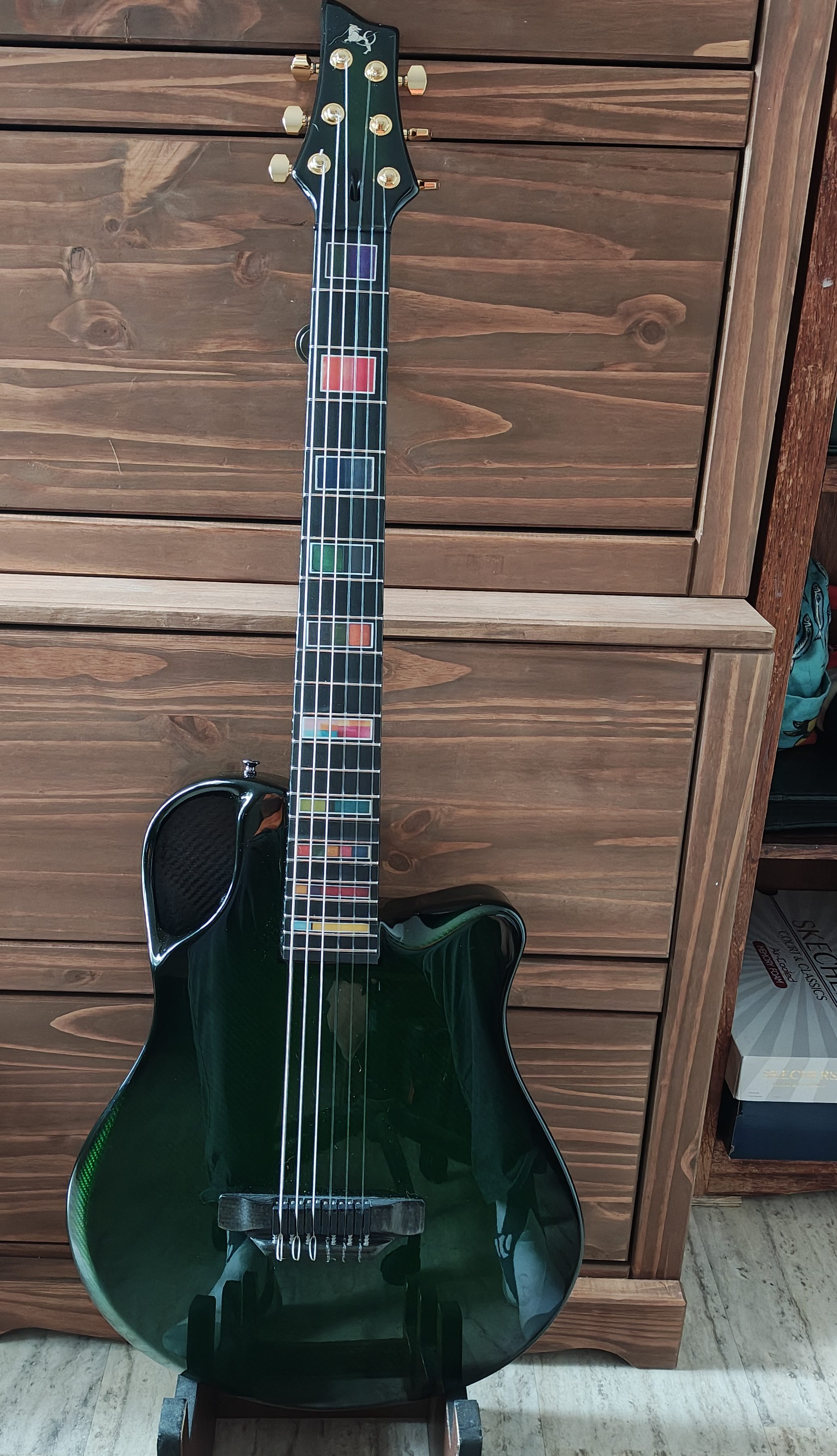
Many people think logic follows linear reasoning when, in my experience, it’s more akin to unraveling a tangle of chains of non-standardized links, and, so, this essay attempts to untangle how fret marker stickers are a result of my admiration for my Breedlove Oregon series guitar.
Feeling Jumpy.
This is going to be a long piece, so here is annotated table of sections with jump links.
- Why I admire my Breedlove Oregon series guitar.
- Self explanatory.
- There are fewer fish in the sea.
- How diminishing availability of desirable tonewoods affects guitar building.
- Is this really a problem?
- A review of some luthiery responses to tonewood scarcity.
- Can I see your papers.
- CITES passports as a counter argument.
- Emerald Guitars.
- Discussion of carbon fiber guitars as an alternative to wooden acoustic guitars.
- Ch-ch-ch-ch-changes.
- Discussion and definitions of differing levels of change.
- CU@^ (or See You At The Top)
- Introduction and discussion of zenith events.
- Market Acceptance.
- How market acceptance hinders evolutionary changes and later allows for incremental changes.
- Limitations.
- Another factor in evolutionary change.
- Expectations.
- Yet another hindrance to evolutionary change.
- The Snob Factor.
- Enough with factors limiting evolutionary change already. Actually, like expectations, it reveals how market acceptance influences products.
- Advancements.
- A nice change of mood, don’t you think.
- Carbon Fiber.
- A discussion of how carbon fiber overcomes limitations of other materials.
- The Tesla of Carbon Fiber Guitars.
- A discussion of carbon fiber acoustic guitar makers, their position and a major market threat.
- Limitations, revisited.
- Just can’t leave this topic alone.
- Timber!
- Discussion of an outlier in the carbon fiber acoustic guitar market.
- Buying an Emerald.
- My experience of buying a Emerald guitar and some advice.
- Fret Markers.
- Experience playing a guitar for which I actually needed fret markers,
- Sticking on Stickers.
- Experiences using fret marker stickers on guitars.
- My Fret marker Inlay Sticker Reviews.
- A more formal review of three fret marker stickers makers.
Why I admire my Breedlove Oregon series guitar.
As explained in Breedlove Happenings, Tom Bedell era Breedlove guitars were made from certified sustainable woods. Breedlove made their Oregon series guitars from locally sourced Mytrlewood, which distinguished those guitars. Most guitars are made spruce, Sitka spruce is common, and dark wood backs and sides. Brazilian rosewood is highly desired, but it had been over harvested and became endangered. Many other hardwoods are also endangered. This makes Tom Bedel’s efforts to guarantee and certify each of his guitars’ tonewoods admirable.
There are other examples of locally sourced tonewoods in luthiery. I saw a video featuring Showalter Guitars made from Osage Orange which is, for them, a locally grown hard/tone wood. Perhaps the most relevant case is Taylor Guitars urban ash series which are made from ash trees that city governments need to remove due to age or damage. Talyor arranged to have the trees cut down and claimed the wood. The trees were planted, mostly, in southern California after World War II by real estate developers desiring fast growing shade trees.
Although Taylor guitars are highly rated, they are not hand voiced. Breedlove guitars, mostly, are, They use a sound optimization process which is like voicing. The difference is that guitars voiced by boutique builders, like Dana Bourgeois, are tuned to the luthier’s ear while Breedlove uses technology to tune their guitars to measured frequencies.
There are fewer fish in the sea.
I’ve noticed that many guitar manufacturers are using different tonewoods. I’ve seen an increase of guitar listings featuring backs and sides made of Indian Rosewood, Sapele, Okoume and Nyatoh. Although these might seem like more locally sourced for Asian production alternatives, they are mostly replacements woods for mahogany which has been over harvested and is slipping onto endangered lists.
This reminds me of fish choices at restaurants. Growing up, tuna, salmon and swordfish dominated menus. There was also Mahi Mahi (not endangered) and Whitefish. As governments limited their harvesting, Orange Roughy debuted on restaurant menus. Previously, it was considered a “trash fish.” Other previously undesirable fish like Pollack, Devil Fish, Skate Wing and Lionfish populate modern menus. No governments restrict harvesting many popular tonewood trees and luthiers are adapting to “trash” woods.
I really don’t care about what fish are on menus. Growing up, my older brother loved sea food, and I hated my brother, so I avoided sea food to the point I never acquired a taste for it. He played trumpet, so I picked up the guitar, and I enjoyed playing guitar. I care about the instruments I play, so I care how they are made. I want to make responsible guitar acquisitions. If I had to replace my Breedlove, I would probably choose between a Taylor Urban Ash five hundred series or an Emerald X20.
Is this really a problem?
In a Youtube video, a pair of classical and flamenco guitar luthiers (father and son) claim that there is so little actual wood in an acoustic guitar, that making one, even from exotic tonewoods, causes little to no environmental impact. They discussed consumer focus on locally sourced tonewoods from a historical prospective. Spanish luthiers used Spanish Cypress, Spanish Ceder (actually a mahogany) and European spruce for the majority of their instruments especially for flamenco guitars, guitars for working local musicians. For their wealthier clientele, theses luthiers would import more desirable tonewoods such as Brazilian rosewood and African ebony.
That was then, this is now. (or that was thoughtless, this is cliché). Today, over a million new guitars are produced each year. The world’s economy has produced enough surplus cash that guitar manufacturer’s can sell the majority of these guitars.
Post American Civil War, guitar making shifted from Europe, mostly Spain, to America. After the second World War, manufacturing shifted, again, from America to Asia. Japan started early, Yamaha, Takamine, Ibanez and Alvarez were common brands when I started playing. I find it amazing that many Japanese brands utilized Spanish sounding names. They are not alone. I bought a Cordoba C9 Crossover. Cordoba is based in Florida, but manufactured my guitar in China. In fact, many well known guitar brands make their guitars in China and Indonesia. Many Chinese made guitars use Sitka spruce (from the United States West Coast) Engleman spruce (again from the American West) and Indian rosewood (yep, from India; also Sri Lanka and Indonesia). The odds of buying a guitar made from locally sourced, sustainable woods is pretty low.
To be fair, most products available today, and several of their components, travel great distances. There really is little good reason to expect guitars to be any different. All the same, Tom Bedel era Breedloves stand out for actually making the effort to produce more environmentally responsible guitars (but still shipping them to their distributors).
The father and son luthiers offered another justification: guitars don’t use much wood. A typical acoustic guitar weighs about five pounds including tuning machines and strings. Solid body electric guitars are eight or so pounds. Multiply a guitar’s weight by a million, that’s five to eight million pounds, or, approximately, 1500 to 3000 trees per year.
Although luthiers, like most wood workers, endeavor to get the most out of each piece of wood. Guitar makers are particular about what wood goes into their guitars. They require quarter sewn cuts which yields twenty percent less wood per tree than flat sewn cuts. Much of this wood looses more mass through torrefaction, or drying out, which is needed to produce stable wood. Otherwise, the wood would shrink as it ages and guitars would suffer cracks and distortions. As with most wood working. Pieces are cut larger than needed and trimmed to fit.
In a video on sanding techniques, Chris Alvarado, of Driftwood Guitars, said that the statement, “ninety percent of guitar making is sanding,” is a lie. “It’s more like ninety-five percent,” he declared. While watching luthiery videos, I am often impressed by their efforts to re-purpose scraps. Chris often uses them for intricate inlays, back straps, neck heel caps and the like. Still, a significant amount of wood is lost on the way to make a five pound acoustic guitar.
I don’t watch many electric guitar making videos. In the few I’ve seen, pockets are routed out of the solid body to make room for electric components. Many electric guitars feature “chambered” bodies to lower their weight. Chambered electric guitar makers rout out guitar body insides and then add a new sound board like face. Some of these faces actually have braces like an acoustic guitar. Driftwood Guitars’ Tidalcaster features a chambered body.
Can I see your papers.
Despite a concerted effort to build guitars from sustainably sourced tonewoods, Breedlove makes limited numbers of guitars from Brazilian rosewood. My favorite is the Myrzilian commissioned, and sold by, Sweetwater Music (sweetwater.com). It features a Myrtlewood top and Brazilian rosewood backs and sides. It also comes with CITES documentation which allows the owner to carry his instrument across international borders.
Breedlove acquired a large stash of legal Brazilian rosewood in 2013. A Spanish church ornament supplier harvested the wood in the 1950’s and early 1960’s before any export bans (See this link). This is considered “guilt-free” rosewood. The wood is well documented, so Breedlove has no trouble obtaining CITES certificates.
In a video where Chris Alvarado, of Driftwood Guitars, describes a recent build as his most beautiful guitar to date, Chris’s choice of Ziricote was driven by his client’s location, Austalia. Chris’s Brazilian rosewood came from a bedroom set he bought from a private person in New Jersey. Unlike Breedlove, Chris has not, perhaps can not, certify his Brazilian rosewood, so he can not sell it to someone overseas.
Many luthiers go to great lengths to procure precious tonewoods. They aim to acquire a lifetime supply. Since furniture makers also use these same woods, luthiers often salvage wood from furniture. Tom Bedell acquired mahogany wood from “The Tree” by buying a large office table. The species, Swietenia macrophylla, is a CITES protected, but “The Tree” fell long before its species was put on the endangered list. When it fell, it slipped into a ravine and loggers could not get it out. Two decades later, loggers brought it out of the ravine in sections. Since the legend of “The Tree” was well known, it’s wood could be sold even though, by then, “The Tree”’s species could no longer be harvested. StewMac has several back and side sets available on its website.
The main point is, that highly desirable tonewoods are becoming scarce. “Trash” tonewoods are becoming more and more common in guitar builds, but these woods, like “trash” fish, can be over harvested as well. Some species grow in plantations. These include Honduran mahogany, Indian rosewood, Sitka spruce and maple. The appetite for guitars has grown dramatically the the last few decades, experienced a pandemic boom as people needed something to do when locked down, and has since leveled off a bit. The average guitarist owns four guitars, but many older guitarists tend to buy more. A friend owns over thirty guitars. He’s not a professional guitarist though he plays as well as any I’ve heard.
I previously limited myself to four guitars, ukulele and a bass. I donated the non-guitars to musicians who lost their instruments in a fire. Not an act of generosity. I made space for a fifth guitar, perhaps a sixth. Still limited. The proposition is: what I would replace my Breedlove with should I need to. The answer was either a Taylor Urban Ash guitar or an Emerald.
Emerald Guitars.
Emerald Guitars makes carbon fiber guitars. They are located in County Donegal Ireland.
While researching innovations in guitar making for a section of A Dumb Thing 2 Say that never made the page. Carbon fiber guitars was one of the innovations I was interested in along with sound modeling processors.
I saw a Youtube video comparing three guitars: McPherson wood guitar, McPherson Sable and an Emerald X30. Both the Sable and X30 are carbon fiber guitars. I was surprised that the Sable performed poorly compared to its wood counterpart. The X30 held its own and sounded better than the wood McPherson in many playing styles. The takeaway, however, is that both $4K carbon guitars were in the same performance class as a $10-15K wood guitar.
It’s hard to say which guitar is more innovative. McPherson guitars, both carbon fiber and wooden, feature offset sound ports and cantilevered fretboards (the end of the neck floats above the soundboard much like a violin’s neck). His innovations, though similar to the Kasha/Schneider classical guitar, were derived independently. Perhaps McPherson’s luthiery background influenced the Sable’s design. The guitar still has a neck heel and internal bracing. In many ways, a Sable is designed like Mcpherson’s wooden guitars.
Emerald guitars do not have a cantilevered neck. Like most guitars, the end of Emerald’s fretboards rests on the guitar body. Emerald guitars makes their guitar and neck in one molding. The joint is strong enough, that they do not need, nor have, a neck heel. They also layer their carbon fiber such that braces are not needed to add strength to their soundboards, nor for voicing.
When Chris Alvarado, of Driftwood Guitars, cut open a Taylor GS Mini for one of his reviews, he was surprised that the GS Mini did not have much internal bracing. Chris believes that the lack of traditional bracing allows GS Minis to produce far more sound than other guitars of its size.
To understand carbon fiber and its potential importance to guitars in a world where tonewoods become scarcer. It is important to discuss ….
Ch-ch-ch-ch-changes.
Changes are usually categorized into four levels: Revolutionary, Transformational, Evolutionary and Incremental.
The airplane was a revolutionary change. They are really nothing like hot air balloons, or automobiles, or bicycles or motorcycles or any other form of transportation.
Jet engines transformed airplane travel allowing greater non-stop distances, larger size fuselages and higher altitudes.
Larger diameter engines allowing jets to fly just as fast and far with fewer engines and greater fuel efficiency can be seen as an evolutionary change.
Raked wing ends on the Boeing 787 is an incremental change.
Antonio de Torres Jurado helped define the modern guitar in the 1850’s. Though six string guitars existed, he added fan bracing which allowed for larger bodies, flatter backs and more resonant sound. This revolutionized the guitar. Thaddeus McHugh’s invention of the truss rod transformed the guitar by allowing for steel strings extra tension. For acoustic guitars, piezo pickups let them evolve from mic dependent stage performers to more independent performers (the electric guitar was another transformational change). Incremental improvements in acoustic pickups systems are, well, incremental changes.
CU@^ (or See You At The Top)
A good reason to advocate for carbon fiber acoustic guitars is that wooden acoustic guitars have probably underwent their zenith event where carbon fiber acoustic guitars probably haven’t.
For the most part, I am coining the term “zenith event.” Google searches immediately go off target, so let’s zero in on a definition.
Zenith Event refers to the occurrence of an object’s (or subject’s?) reaching it’s optimal form. Well, not exactly. The absolute highest form is not necessary, incremental changes can still occur, but no more evolutionary changes are foreseeable. So there can be refinements, but no substantial change.
Since many people believe that Stadivarius violins represent the pinnacle of violins, those people would say that violin making (note: violin makers are called luthiers, the same term for guitar makers) has seen its zenith event in the early to mid 18th century.
There are at least two problems with the 18th century violin making zenith event assertion. First, violin making has seen at least two innovations. Stradivari glued his necks to violins’ bodies. Most of the prized surviving Stradivarius violins have been modified to have longer, cantilevered finger boards. This was done, in part, to adapt to higher tension strings. Although lengthening the fingerboard should be seen as an incremental change, cantilevering the neck and redesigning the neck joint are evolutionary changes. So did violin making’s zenith event occur later in the 18th century, perhaps early 19th century? That is an intriguing proposition.
Several double blind tests revealed both violinists and audiences prefer modern instruments to 18th/19th century Italian violins including Stradivarius. I do not know enough about violins to say if modern violins incorporate any evolutionary changes. My guess is modern violins benefit from incremental changes, refinements, but violins’ zenith event occurred in the nineteenth century.
Truss rods, transformational in guitars, are not used in violins because violins’ shorter, thicker neck can handle string tension, roughly fifty pounds. Violin bodies can not handle much more pressure. There are carbon fiber violins, but I could not find any made to handle higher tension strings. Should high tension strings become a feature of new violins, that would mark an evolutionary change.
For violins, an incremental change is in tuning machines. Currently, most violins are made with tuning pegs which rely on friction to hold strings in tune. Some violins are made with machine heads, used on guitars, but they are rare and looked down upon by many violinists. There are tuners known as machine pegs, or geared pegs, which look like traditional pegs, but they contain mechanical gears internally, which have been better received, but remain uncommon.
Market Acceptance.
Evolution and refinement are a common and easily explained pattern. It takes a while for evolutionary changes to gain acceptance in markets. It is easier to market products that resemble similar products especially those the evolutionary, or transformational, product intends to replace, or disrupt.
Think of electric vehicles. Tesla is the market leader. Even though they have a distinctive curvy form, they still follow the Engine Compartment/Passenger Compartment/Trunk design. Since the engines are integrated with the axles, and electric engines do not require an air source (except for a little cooling), there is no need for an engine compartment. EVs benefit from aerodynamics to enhance range, especially highway/freeway range. The most aerodynamic shape is a teardrop (rounded front tapering to a rear endpoint). For ground vehicles a half teardrop with ground effects would produce enhanced range for EVs. Currently, the closest we’ve seen has be the VW ID Buzz which was inspired by the VW Type 2 Micro Bus, not aerodynamics.
Market acceptance helps explain why EVs haven’t taken a more aerodynamic shape by eliminating the unnecessary front engine compartment. Some vehicles, like the Chevy Blazer, put the engine in the engine compartment and utilize a more conventional transmission. Chevy might do this to leverage existing models (like the gas powered Blazer) rather than completely redesign a vehicle for EVs. Other manufacturers opt for either a frunk or, since frunks are mostly pointless, nothing in the front other than mechanical access to battery packs.
Basically, the market wants already known products, but with a competitive advantage. So, if you build a better mouse trap, the world will not beat a path to your door, but marketing managers will ask you to make it look like all the other mousetraps. Once the evolutionary (or transformational, or even revolutionary) change catches on, then incremental changes start. Restated: Once an evolutionary change gains market acceptance, competitors will offer similar products with refinements.
Limitations.
Limitations often set boundaries requiring evolutionary or transformational changes in order to be crossed.
Let’s go back to the violin for an example.
Unlike guitars, violins do not incorporate truss rods in their fingerboards. In guitars, the truss rod allowed guitars to handle higher, steel-string tensions and this transformed the acoustic guitar and paved the way to electric guitars.
Violins do not need truss bars because their bodies, not their necks, provide the limitation. String pressure, communicated through the bridge, to the body can produce overbearing force and damage a violin’s soundboard.
Guitar bodies also had difficulty with increased string tension. Guitars evolved from fan bracing in Spanish style gut string guitars (now nylon string guitars) to X bracing in steel string guitars. Some luthiers tried ladder style bracing, but X bracing produced better sounding instruments, especially in flat top, as opposed to arched top, guitars.
There are carbon fiber violins, and they have some acceptance, but they have not been widely seen. I’d say, they are less accepted than carbon fiber guitars. From looking around the internet, carbon fiber violins still use wooden, independent bridges. So, even if carbon fiber bodies can be made to produce a good sound with higher tension strings, it is doubtful traditional bridges can handle much more tension.
So, if we define a violin as an instrument with produces sound by transferring string vibrational energy to a small body via a bridge. Note selection is from bowing, sometimes picking, a string or strings (double stops) and varied by shortening the string by pressing on it on the fingerboard. This is basically the violins we see today. A main requirement is that it should be bow-able. Which means that there must be a waist in the middle so a bow can access any of the strings. Another requirement is that must produce concert level volume without electronics.
So, imagine a series of evolutionary changes.
1. With carbon fiber, the body can be structured to handle three times the current string tension or about 150 pounds. The three-to-one ratio is based on the truss rod’s impact on guitars. Nylon strings on guitars produce about 80 pounds of string tension. Steel strings are generally 160 pounds, but can go up to 260 pounds.
2. A carbon fiber bridge designed to transfer string vibrational energy up to 160 pounds. Unlike current bridges, carbon fiber bridges will probably be molded into the body.
3. A longer neck supported by a truss rod. This neck will increase the range of notes on each string.
4. Asymmetrical design. Different areas of guitar soundboards react to string vibration frequencies differently. Some areas are more productive, some barely make any sound. Many guitars, like the McPherson, already make better use of the sound board by offsetting the sound port. Many guitars also feature cutaways to enhance access to upper frets.
5. Move the sound ports. Traditional f-hole sound ports came from a period of discovery in the seventeenth and eighteenth century. Once they found a good size and shape, they pretty much stuck to it. The “f” shape works because of its interaction with wood grain directions. Carbon fiber weave is different, so different shapes and placements should yield superior results.
6. Higher tension strings would reek havoc on horsehair bowstrings. Carbon fiber bowstrings are, already, available. Higher string tension might require more durable carbon fiber bowstrings.
The resulting instrument would be an evolution of the current violin. As far as I know, there are no such instruments, mostly due to a lack of demand. There is not a swelling chorus of musicians demanding a more versatile, higher volume violin.
Although there may be more violinists alive today than in prior history, they account for about one percent of the global population. Guitarists are five to ten times as many. More importantly, popular music focuses on guitars (bass included), keyboards and drums. String sections are hard to deal with and expensive to bring on tour. Some popular acts work with local orchestras for each performance, but many more simply allocate string parts to a keyboard and modeling software. I can emulate a string section with my Roland GR-55 driven by my Emerald Virtuo. Keyboards/synthesizers can often do a better job at taking on string section pieces.
Most musical instrument innovations benefited from musical compositions written for them. Although, via population expansion, there are probably more compositions written for violin now, than ever, these compositions do not gain wide acceptance/marketability in the general population. Once again, most popular music, the type of music to propel a new instrument to popularity, is written for keyboards, drums and guitars. So, a new, improved violin would have a hard time gaining market acceptance and would likely drift from novelty to obscurity rapidly, living on, mostly, in infrequently visited wikipedia pages.
Expectations.
Should our high tension violin meet some success, it would likely target existing violin players which means that initial models would aim to sound like existing violins just louder, and it would likely fail to meet expectations.
This is similar to what is happening, now, with carbon fiber guitars. Many reviewers point out that carbon fiber guitars sound different. The most common differences, in the reviews, are, they have more of a shimmery sound, or that they are more balanced.
The latter comment is the most interesting. Acoustic guitars are mostly defined by the 1940’s era Martin dreadnought style guitars. In particular, the D18 and D28 guitars which are still in production. Compared to previous guitars (Note: nylon strings came over a decade later, so 1940’s era classical guitars had animal gut strings), Martin dreadnoughts were known, still are, for their scooped mids tone. Dreadnoughts have a large bodies with less pronounced waists. They produce deeper bass notes and crisper high end treble tones. The middle tones tend to get drowned out. Martin, and other brand’s, dreadnought guitars defined much of the sound of folk music, country/western and much of the popular music generations of Americans grew up with. They were louder than most other styles of guitars, so they were popular. In recording studios, sound engineers endeavored to cut down the bass and trebles, so recorded music offered a more balanced sound.
When comparing Martins to Taylors, reviewers frequently remark that Taylors have a shimmery sound, while Martins have a darker tone. An off hand coincidence, and perhaps nothing more.
The main point is that prior instruments attained their sound in a combination of trial and error, and pure accident. Sometimes, tone is sacrificed for volume and projection. Sometimes, volume is sacrificed for tone or range. Innovations are often marketed by misleading comments playing to customer’s perceived preference for change without real change or difference.
That is an odd conclusion. I’ve seen it in business, so let’s look at that. Often Information Technology directors describe a proposed new computer system as just like the old system, but faster. Inattentive business executives buy that kind of proposal. Business executives can be, and often are, stupid. Smart business executives, some do exist, know implementing a new business software will change the way they do business. They ask the question: How do we want to do business? What business process changes do we want to make? Can we buy or build software that supports the way we want to do business?
SAP, a well known business software supplier, offers a better approach. They market their software, in part, on their practice of only supporting “best practices.” They actually tell prospective clients, that if they do business in a way SAP does not support, they need to change the way they do business. SAP has a Best Practices committee that reviews business processes. If a business has a practice they want SAP to support, they can submit that practice to SAP’s committee. I witnessed one case that got their business practice past the SAP committee. I have also witnessed another enterprise insist on using SAP software without changing practices, make headlines as their problems lead to financial difficulties, and endured SAPs public statements that they are using SAP software incorrectly and should adopt best practices instead of continuing with ill conceived business practices.
Musical instruments design seems to progress more by applying new technologies to existing designs rather than asking how people really want to make music. The Saxophone was designed to hybridize woodwinds and brass, basically, the tonal qualities of reeded woodwinds with the projection of brass instruments. The tin drum, perhaps the last non digital instrument, was, initially, fashioned from 55 gallon barrels. More of leveraging a readily available material than sonic design.
Sorry for going far off field. The major points I wanted to get across is that violins and wood acoustic guitars have seen their zenith events: Violins in the mid 19th century, wooden acoustic guitars in the mid 20th century. Carbon fiber guitars, probably, have not seen their zenith event, but we will have to see. The main factors of material limitation and acceptance play a role.
The point of proposing a violin nobody wants was to show how musical instruments can still have evolutionary changes, but circumstances dictate whether evolutionary changes will gain acceptance. A lack of popular music written for violins and the use of modeling synthesizers (keyboards) to replace string section roles in popular music limit demand for violins to classical music most of which was written over a hundred years ago.
Although most popular music produced today use keyboards and electric guitars, a noticeable amount of new music features acoustic guitars, by and large wooden. There is still room for evolutionary advancement, but decreasing tonewood availability and well, snobbery, limit wooden acoustic guitar development.
The Snob Factor.
For once, this is not my favorite topic in sophomore economics regarding anomalies at the ends of the price/demand curve. This has more to do with wine.
For centuries, France dominated wine production, but not continuously. French viticulturists realized wars, weather and insects could wipe out centuries of advancements. As a precaution, they sent grafts to other wine producing areas, in particular, northern California. French vines flourished in several northern California climates. A hundred years later, Napa Valley wines out performed French wines in several competitions and published reviews.
French wines were marketed (labeled) by a complex appellation system, which I know of, but can’t explain too well. Basically, it is by region and producer. So, a wine labeled as Bordeaux has to be made of grapes in the Bordeaux region. There are also requirements for it the be Chateaux Lafitte, for example. Centuries of producing wines in the Bordeaux chateauxs lead to the chateuax’s wine having a certain, desirable, taste. A major part of the art of French wine making involved blending the wine with components of several grapes. The art and taste of each chateaux was passed from winemaker to winemaker. Each house had a notable taste year in and year out. Many connoisseurs could tell what chateaux he was drinking even though the label was covered.
California wines were marketed (labeled) on the varietal system. The species of the grape became more important than the house/chateaux where they were made. In California, seventy-five percent of the wine must be of the grape species to get a varietal label. The American Viticulture Association requires eighty-five percent of the wine be from the designated grape variety. Other producer associations have varying requirements.
Because of the prestige California wines gained over French wines, many french wines are now marketed by their grape species. The French rule is eighty-five percent. Many people who follow the industry often remark that batches of wine vary from pressing to pressing. Often a batch will benefit from more blending, but winemakers will stick their association’s rule rather than risk lowered market value by going under the varietal requirement.
In the case of wines, snobbery (expressed as insisting on varietal labeling) often leads to inferior product. In the case of wooden acoustic guitars, “solid wood” takes the place of “varietal” in wines.
Many bargain guitar brands laminated high quality tonewood veneers to lower quality woods for guitar backs and sides (especially sides). Although guitar backs (and especially the sides) do not have nearly the sonic impact of soundboards (tops) – lookup the Torres papier mache guitar, anything on a guitar that vibrates or suppresses vibrations has sonic impact, though perhaps not that much. High quality guitars were made with solid wood bodies. Over decades, the word “laminate” in guitars came to mean cheap and inferior.
While documenting the making of his 3000 year old guitar, Chris Alvarado staunchly defends his use of doubled sides. Technically, gluing any two or more pieces of wood together is considered a laminate. Chris explains that the doubled sides gives his guitars improved tone. The extra stiffness and strength helps the sides transfer soundboard energy to the back. Doubling the sides also replaces side braces which also transfer energy, but more importantly, reduce/prevent cracks in the sides.
Double siding is technically laminating the sides, but it is a high grade technique. Similarly, many classical guitars feature “double tops.” Like Chris Alvarado’s double sides, double tops are two thin, high quality tonewoods sandwiching a lighter material such as Nomex, a space age synthetic. Double top classical guitars often project much louder than solid top soundboards.
Advancements.
It is hard to say whether McPherson’s designs represent incremental or evolutionary advancements to guitar. It depends on adoption. Many luthiers have some models incorporating offset sound ports, though, as mentioned before, the Kasha/Schneider guitar predated McPherson’s usage. Driftwood Guitars (Chris Alvarado) offers a Da Vinci model that has a cantilever neck and takes the offset even further by moving much of the sound port to the side wall. All the same, most, and by a large margin, guitar models follow established designs. Greater adoption would establish the creation of the first McPhersons with these advanced features as a probable zenith event for wooden acoustic guitars.
Further advancements might include greater reliance on technology. Breedlove’s sound optimization process uses metrics and an algorithm programmed into a computer to aid their luthiers to voice soundboards and backs. Adding modeling into the algorithm would identify which pieces of wood would make laminates, or doubles, that outperform solid components.
However much media malign artificial intelligence (AI), I have seen documentaries where AI outperforms human experts. In simulated dog fights, human pilots fair poorly against AI, and it’s not just because AI does not blackout in high G maneuvers. Pilots interviewed in the documentary claimed AI used tactics they would never have thought of using, in part, because AI doesn’t worry about survivability as much as humans.
AI’s capacity to plumb previously unexplored solutions gives it a competitive advantage over humans experience and tradition. Both the Kasha/Schneider guitars and McPherson independently determined that traditional sound port placement underperforms offset sound ports. Ancient aesthetics emphasized symmetry which explains early musical instrument design and, in turn, became traditional instrument construction architecture. Modern analysis (including K/S and McPherson) shows that guitars, and many other instruments are naturally more asymmetrical. So far, guitars have taken greater advantage of asymmetric adaptations than most musical instruments. This is most evident in the cutaways developed in the 20th century and popular today. Of course many stringed instruments have asymmetrical bracing under the top such as the violin’s bass bar.
With AI’s proclivity to produce unconventional designs, it could utilize computer modeling to produce radically different wooden acoustic guitars. Should those designs, or even techniques, gain market acceptance, wooden acoustic guitars could experience a new zenith event, but I doubt it will.
Carbon Fiber.
Carbon fiber and wood have a lot in common. They both are strands of carbon threads (micro cellulose fibrils in wood) bound together by resins (lignin in wood). They both gain strength by layering fibrous material and resins. Trees add layers as they grow and form rings. Carbon fiber comes in sheets, but this is where differences between the two become distinct. Wooden objects, like musical instruments, get their shape by cutting, carving and sanding. Basically, by removing wood. Particular wood characteristics, such as grain, are selected and worked into the design, like using quarter sawn cuts for musical instruments. Carbon fiber is deliberately build up sheet by sheet. Different weave patterns can be selected and combined to achieve design parameters.
The main difference between carbon fiber and wood is that wood has to be worked while carbon fiber can be engineered.
Cyclists, such as myself, became fans of carbon fiber in the 1980s and 1990s. Early applications used carbon fiber tubing glued into aluminum bottom brackets junctions, head tube junctions and seatpost junctions. These tended to fail frequently. Road vibrations, shocks from striking/rolling over small objects and cement lips to driveways and such caused frays and small cracks. When carbon fiber weaves are compromised, they can fail catastrophically. In an on-line cycling forum, a rider reported an incident with a motor vehicle where the only damage was a deep scratch in the carbon fiber fork. Since the fork was not severely damaged (“It’s just a scratch”), the motorist refused to pay for it. The cyclist wondered if he should keep riding on it instead of shelling out ($500 at the time) for a new fork. The common response was something like “It’s your face, not mine. I wouldn’t do it.” Some went to explain about how compromised carbon fiber can fail completely and without warning.
Not long after these failed attempts, monocoque designs were developed, and shortly after that computer modeling helped refine the shape. Over a decade later, monocoque carbon fiber frames dominated Le Tour de France and has ever since. Another decade later, Pinarello introduced asymmetric frames which better adapt to uneven forces cyclists put on frames mainly due to the drive train having to be on one side or another (typically the right side).
Although metal bikes, in particular aluminum, adapted some of enhanced designs brought on by carbon fiber designs. One, in particular, proved difficult. Pirandello found asymmetric force being applied to the top tube. They lightened part of the top tube in areas and strengthened it others. The result, the bike rode straighter than symmetric top tubes. In cycling, if force does not propel bicycles forward, then it inhibits forward progress and is wasted energy.
Though there have been some changes in competitive road bikes. The zenith event was probably 2010’s introduction of Pinarello’s Dogma 60.1. This bike ushered in carbon monocoque’s dominance. Incremental changes since then include better aerodynamics and weight savings. Many frames now weigh less than two pounds.
The main limitation to road cycle development is a 6.8kg, roughly fifteen pound, minimum weight requirement imposed by Union Cyclste International, the governing body for road races and Olympic cycling events.
The main problem for road cycle designers was/is what to do with carbon fiber’s weight savings. In the early days, some riders preferred adding weight to the bottom bracket and chain stays to give the bike a lower center of gravity. Since riders, themselves, comprise most of the weight of a bicycle going down roads, an extra pound or two probably did not make much difference. Deeper rimmed wheels took up some of the weight and gave riders improved aerodynamics. Hydraulic disc brakes is another way to spend about 500 grams.
Many analysts consider cycling’s adoption of hydraulic disc brakes as bicycles last evolutionary change, and it may be. Disc brake systems now dominate new road bike production with 75-85 percent of new bicycles. About ten percent of new bicycles feature mechanical/cable disc brake systems. The remainder are rim brakes.
Some professional riders, and riders like me, still prefer rim brakes. Rim brakes can be tucked away behind front forks and just above chain stays. In these positions they loose a little stopping power, but who cares. Unlike F1 cars, bikes, for most corners, do not need to brake. Some high-speed, sharp corners may need braking and riders need to stop at the end of the race, but stopping is not a major concern, going fast is. Cyclists lean into corners. The idea is to not spill too much momentum.
Disc brakes have a minor aerodynamic disadvantage. Since road bikes have to spend weight to make the 6.8 kg minimum weight, the weight cost is not a factor. Although integrated hydraulic disc brakes were available since 2013, UCI did not allow them in road races until 2018, so I, grudgingly, have to move road bikes zenith event to 2013.
Specialized, a major bicycle brand and not an adjective, created it’s FUCI prototype bike. FUCI stands for F-F-Forget UCI. It incorporated features specifically forbidden by UCI such as asymmetric wheels with a 33.3 inch rear wheel rim which allows riders to adopt a more aerodynamic shape, a small fairing which aids in aerodynamics and a crank assist electric motor in the seat post which riders can deploy strategically on hills.
The FUCI bike shows how limiting factors inhibit product evolution. In bicycles, a regulatory agency, UCI, is the limiting factor. In musical instruments, market acceptance plays a larger role though CITES is also a factor.
Carbon fiber in bicycles changed competitive regulations and allowed for further evolutions in wheels and brakes. We have yet to see what carbon fiber in musical instruments will bring. Currently, carbon fiber instruments mimic their wooden counterparts.
The Tesla of Carbon Fiber Guitars.
Emerald Guitars is, at present, the dominant name in carbon fiber guitars. Emerald inherited the mantle from Rainsong Guitars. Rainsong failed shortly after transitioning to a direct sales model in 2023. Emerald transitioned to direct sales in 2016. Although Emerald is considered the dominant name in carbon fiber guitars, it may not be the largest seller. Other brands, like Enya and Lava, offer much more affordable instruments, but they are rarely mentioned as market leaders in articles. The main reason I consider Emerald the Tesla in it’s field is that they share similar market threats, but to understand that statement, we should look at the carbon fiber market.
The main players in the carbon fiber acoustic guitar market are:
Emerald Guitars ($$$$) – makes several models in various colors with optional wood veneers.
McPherson ($$$$) – makes two models, all black with a choice of one of three patterns. Mostly known for wooden guitars.
Klos ($$$) – makes a few models most of which have a bolt on neck that is easily detached. They offer a Timberline finish looks like wood and alters the tone. With the neck detached, the guitar fits in airline overhead storage.
Journey ($$$) – makes a few models including some wooden models. Many models have color options. Designed to detach the neck without tools and reassemble easily. Like Klos, the guitar with detached neck fits into airline overhead storage, some models easier since they are smaller.
LAVA ($$) – makes a few models with color options. Smaller, so they are easy for travel, but no claims to fitting easily in airline overhead storage. LAVAs are mostly know for their smart guitar capabilities.
Enya ($) – makes several models. Their thinner, more electric guitars, have color options, but their more acoustic guitars are only in black.
There are a few other makers, Composite Acoustics comes to mind, but these are the major players. Emerald leads the pack. All these companies have direct sales through their websites. McPherson also sells through Guitar Center and select dealers. Klos sells some of their guitars through select dealers. Both LAVA and Enya guitars are available through several distributors including Amazon.
With car sales statistics, there is a category called, “Non Tesla EV.” Tesla dominates EV sales at the time of this writing. Enya and LAVA probably have more monthly sales than Emerald. Emerald is considered a leader in design, build quality and recognition. Those are all subjective categories. Jeremy “Guitar Hunter” Sheppard reviews guitars and also performs professionally. He had a nice blue Emerald X30 for a while, but he thought it sounded too dark. He sold it and bought a McPherson Sable.
On several public forums, Emerald Guitars are noted for their ergonomics and for their look. McPherson, like many other carbon fiber guitar makers, produce only black instruments. A similar thing happened in cycling. At first, almost every carbon fiber frame was black with some highlight decals. In a few years, bicycle manufacturers started painting them. Emerald embraced colors early on, and then went one step further, they made exotic wood veneers an option for their guitar tops. Each wood veneer is unique, and customers can use a 3D builder app to view choices from a veneer library. The combination of color choice and the natural beauty of highly figured natural woods help Emerald guitars attain a look that’s hard to match.
McPherson offers a few different patterns of black carbon on their guitar faces. They also took an odd approach towards ergonomic concerns. Carbon fiber guitars are know to slip. Emerald added body conforming contours. McPherson added texture to their backs and lower waist. Jeremy Sheppard, and several other reviewers, claim this texture can grab sweater material and not let go, leading to damaged sweaters over time. Blue denim handles the texture just fine.
Another key difference between McPherson Sables and Emerald guitars is build philosophy. McPherson Sables utilize braces and have neck heels. In essence, they are simply carbon instances of the McPherson’s wooden guitar design. Emerald guitars use carbon fiber’s strength to eliminate braces and to eliminate the neck heel. Even though McPherson’s innovations make his design a possible evolution in wooden acoustic guitars, the Sable does not improve on those innovations. Emerald’s carbon fiber designs are designed as carbon fiber instruments first and take more advantage of the materials characteristics.
Unlike Tesla, Emerald is not considered the leader based on sales. Both McPherson and Emerald carbon fiber guitars are made with hand laid carbon fiber sheets where LAVA and Enya use injection molding which is considered inferior. McPherson’s design is innovative, but Emerald’s designs can be seen as a better use of cabon fiber’s potential.
Emerald and Tesla the same threat. Once bigger players in their field learn to make units (EV cars for Tesla, carbon fiber acoustic guitars for Emerald) their field dominance will fade away. Luxury makers Mercedes Benz, Jaguar and Volvo made serious entries into the EV market as early as 2018, but increased their efforts in 2023. Tesla exited the luxury EV market in 2026 withdrawing both the Model S and Model X.
So far, Martin, Gibson and especially Taylor have not put much, if any effort, into carbon fiber guitars. As premium tonewood availability decreases, they may explore the material. Martin has already produced guitars with backs and sides made of HPL (High Pressure Laminate) which Chris Alvarado, of Driftwood Guitars, calls “plastic.”
Limitations, revisited.
A key limitation to wooden acoustic guitars is wood’s variance. Tonewood is not a commodity material the way standardized (AISI/SAE) metals are. Every piece of tonewood has its own tonal characteristics. It’s not just that one piece of Rosewood is a little different from another piece of Rosewood; it’s that a piece of Rosewood can have different tonal characteristics than another piece from the same tree. Luthiers learn how to get better tones by addressing each piece of wood.
Breedlove’s Sound Optimization (a misnomer) shows how technology can help guide luthiers to make better use of each piece of tonewood. Further application of technology, namely modeling software, can further address tonewood variability and further aide luthiers to produce better instruments. Although double-topping, like McPherson’s innovations, might lead to the next evolutionary acoustic guitar change, merely using technology to make better tonewood usage would, at best, lead to incremental changes. Applied to current designs, acoustic guitars zenith moment will remain in the 1940’s.
Market acceptance has been acoustic carbon fiber’s main limitation, and that limitations can be expect to fade as premium tonewood availability decreases over time. So far, I’ve not heard that any major acoustic carbon fiber guitar manufacturer uses modeling software to look for evolutionary changes, but the major players can easily afford to do so.
In current market conditions, acoustic carbon fiber guitars are expected to mimic wooden acoustic guitar tones. As acoustic carbon fiber guitar market acceptance increases, manufacturers should explore carbon fiber’s tonal potential producing new tonal qualities and lead to an evolutionary change.
Timber!
Klos offers an interesting option for its full carbon models called Timber. Unlike their standard black carbon models, Timber uses unidirectional carbon fiber infused with nickel. When cured (the process of heating and solidifying resins in carbon fiber construction), Timber looks like wood grain and sounds more like wooden instruments. Consequently, Klos Timber guitars tend to be a little quieter.
Buying an Emerald.
Almost all Emerald guitars are custom made even the models available on their on-line shop. The possible exception is their Black Opus models which have no available options. All Emeralds are made in Donegal, Ireland. Customers, or Emerald staff, utilize their 3D Guitar Builder and choose options: Model, carbon type, color, wood veneers (or none), pickup systems (or none), fretboard style (unidirectional or quilted), nut width, fretboard radius, scale length, headstock type (slotted or paddle), and fretboard inlay (or none). Many options incur additional costs.
In shipping videos, Alistair Hay, the owner of Emerald Guitars, says he strives for a two to three month build time. When I ordered my Emeralds, the website page advised that builds can be three to four months. Add shipping time from Ireland, and that’s a long wait for a guitar.
Alistair says that he wants to see half of sales from custom orders, half from their online shop. There are usually eighty to one hundred twenty guitars available on Emerald’s online shop. Many of these guitars are located in America (Stuart, Florida) and can arrive in a week or so. Guitars located in Ireland can reach most places, but not America, in standard shipping times. Due to American customs enforcement irregularities, Alistair explained, they found it beneficial to ship to their Florida location via sea, and that could take a month or so.
I bought my Emerald Virtuo guitar from the Florida shop. I wanted a wood veneer and thought about ordering a custom build with Candy Striped Padauk. The Virtuo is their electric leaning hybrid model, and there are very few options. The nut width is 1 11/16 inch which is 1/16th away from the 1 ¾ inch of my Breedlove Oregon Concert Thinline guitar, but the extra cost made the smaller nut width acceptable. Most of the other options dealt with inlay options. Since the shop Virtuo had an acceptable color (vibrant amber. I would have preferred regular amber) and a nice veneer (though I still liked the Padauk), I thought, close enough, and I was right.
For those seeking an Emerald guitar, I would say that ordering from the shop is more satisfying. Look for a guitar that is close to what you would have customized, and buy that one. If your desire for custom features is greater than your need for timely gratification, then, by all means, order a custom build.
I recommend watching a dozen or so shipping videos to see what other people choose. There are options not available on the 3D Builder. If you want something you did not know was available, contact the sales team and they will help you order your guitar.
I discovered undocumented options when I bought my Virtuo. I went into chat and asked what locking tuners were compatible. In the chat conversation, they told me that I can order locking tuners with a custom guitar for only $75 more. I recently custom ordered a X7 12 string with locking tuners ($150 more). I have seen custom paint jobs replicating Rosie the Riveter, a six string Amicus (which is sold as a 12 string model) with a custom headstock, and a 12 string X10 Slimline (normally only a 6 string guitar) and veneers with burnt out sections revealing carbon fiber weave underneath (but they painted the weave in a matching color). Emerald is, currently, a custom shop. If you want a guitar made with off book (builder) features, ask sales@emeraldguitars.com. They may build it for you. There is no harm in asking. Some forum members suggest first asking the online chatbot because the sales team seems more responsive to the chatbot follow-up than they are to email inquiries.
The last thing I would base ordering a custom Emerald on is inlay patterns. Stickers are an affordable and viable way to get images and markers on a fretboard.
Fret Markers.
Most steel string guitars come with white dot inlays marking frets 3,5,7,9,12,15, 17 and 19 (21 iff applicable. Most nylon string guitars do not. The assumption is that nylon stringed guitars are played by classical guitarists who know the fretboard by heart and have no need for inlays. There are exceptions. Ibanez TOD10Ns feature a Tim Henson designed Tree Of Death (TOD) inlay pattern. It’s, basically, a Tree Of Life design without leaves.
As a teenager, I admired the Alvarez 5056 “Tree of life” guitar. It was steel stringed and quite expensive. I saw it in the guitar store where I took my Fender Mustang for neck work. I always regretted never buying one. They only got more expensive.
I bought a TOD10N as a “condo guitar,” a guitar that I could play, unplugged, late at night without accumulating HOA fines. It was a good guitar, but its goth overtones made it one I could not see myself playing in front of other people. Just not my aesthetic.
I replaced the Ibanez TOD10N with a Takamine TSP148NC. To compensate for the guitars thinness, Takamine made the lower bout wider. I play guitar in the classical position with the lower bout between my legs and the waist over my left leg. The TSP148NC seemed to be designed for playing in the folk position with the waist over the right leg and lower bout dangling off to the side. Playing the Takamine in the classical position pushed the frets further to the left than I was used to.
The Takamine TSP148NC has ring inlays, but these were too subtle to be of use. While intending to play on the third fret (G minor), I ended up on the fourth fret. I thought better visual cues would help me finger the correct fret.
When I inquired about getting inlays for my Takamine, I found out that very few luthiers will do this type of work on already built guitars and those who do typically charge a thousand dollars, or more. That’s quite an outlay for a $1500 dollar guitar.
Sticking on Stickers.
Guitar inlay stickers are easy to find. Both eBay and Etsy have several offerings at reasonable prices. Creative Cuts, on eBay, had several attractive offerings for $20 apiece. I bought three just in case I messed up the first two attempts. They were different patterns.
I put the first set on my Emerald Virtuo because, I figured, its carbon fiber fretboard would less likely be damaged should I need to remove them. From Creative Cuts Paul Stanley collection, I chose a green and white (think jade and mother of pearl) set of inlays. It took a total of twenty minutes to put them on. The hardest part was placing them in the center of the frets. After letting the glue (sticky part) set for ten minutes, I pulled off the transfer tape and revealed the final inlay sticker. Despite my poor arts and crafts skills, it looked good. Not a great match for the guitar, I would have preferred more of a wooden tone, but it was comparable to Gibson’s factory inlays, just cooler.
I put the second set on my Breedlove Oregon Concert Thinline. Better results, my centering skills improved. This was more of an abalone tone with brown features. I would have preferred something that looked like the guitar’s Myrtlewood body, but still nice.
While preparing the third set, tiki inspired burlwood, I saw a YouTube video featuring Neck Illusions stickers.
Neck Illusions takes a different approach to their stickers. They think of their stickers as fretboard protectors. They cover the entire fretboard and they cut the stickers to fit the entire space between the frets. The stickers are made to be taken off once or twice a year to clean the neck, then re-applied. For those of us with marginal arts and crafts skills, this means a much easier application, no centering needed. The best thing about Neck Illusions is that you can order custom designs for fifty dollars if you supply the art work (given my lack of artistic skills, this wasn’t much of an option), or, for twenty dollars more, they will do art work (Yeah!).
For the Takamine, I asked them to make a blocks design incorporating a figured wood similar to the guitar’s cedar top, but to use a complimentary wood tone to form blocks that looked like Takamine’s blocks on the TSP178, my guitars steel stringed big brother.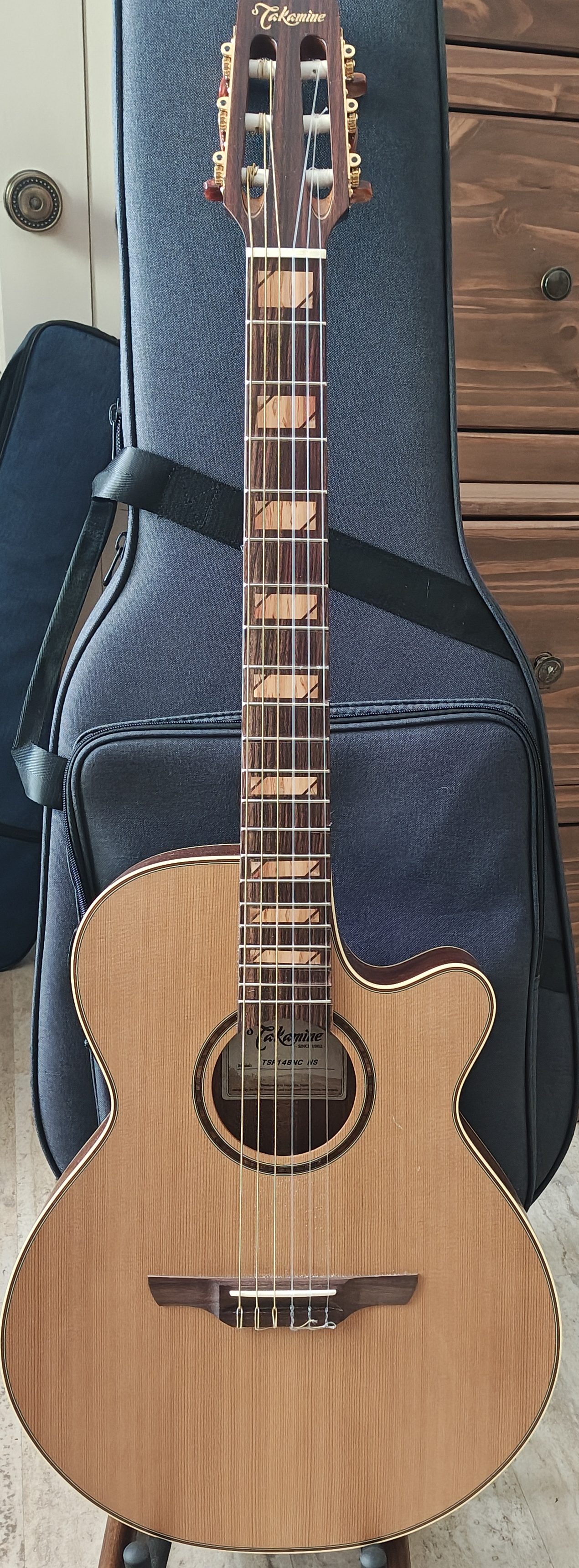
After a couple email back and forths with the designer, we came up with a good design and I applied the stickers. It looked great. If I ever decided to lay out the cash for actual inlays, I would take the guitar to luthier and say, “make them look like these stickers.”
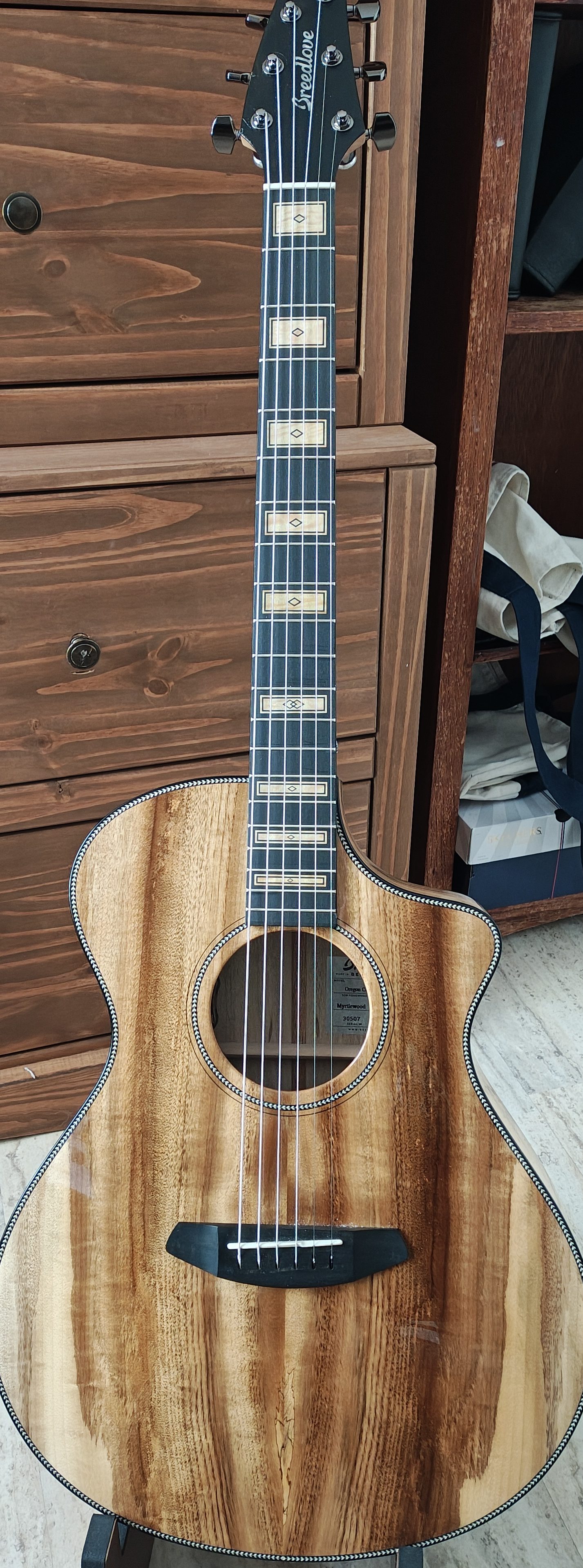 I was so pleased with the result, I ordered custom stickers for my Breedlove. This time, I asked for the wood tones to be the blonder wood tones of the guitar’s back and sides with a dark wood, in-set border. Breedlove Premier Series guitars have a diamond inlay pattern, so I asked Neck Illusions to incorporate the diamonds into the blocks. Again, I was pleased.
BTW I should not have worried about removing the Creative Cuts inlay stickers. They came off pretty easy with no damage to the Breedlove’s fretboard at all.
I was thinking about getting stickers for the Virtuo. I found Fretlook, another sticker company that also does custom work. I ordered stickers like the ones for my Breedlove but the wood tone should match the sapwood on the Virtuo’s veneer and no diamonds.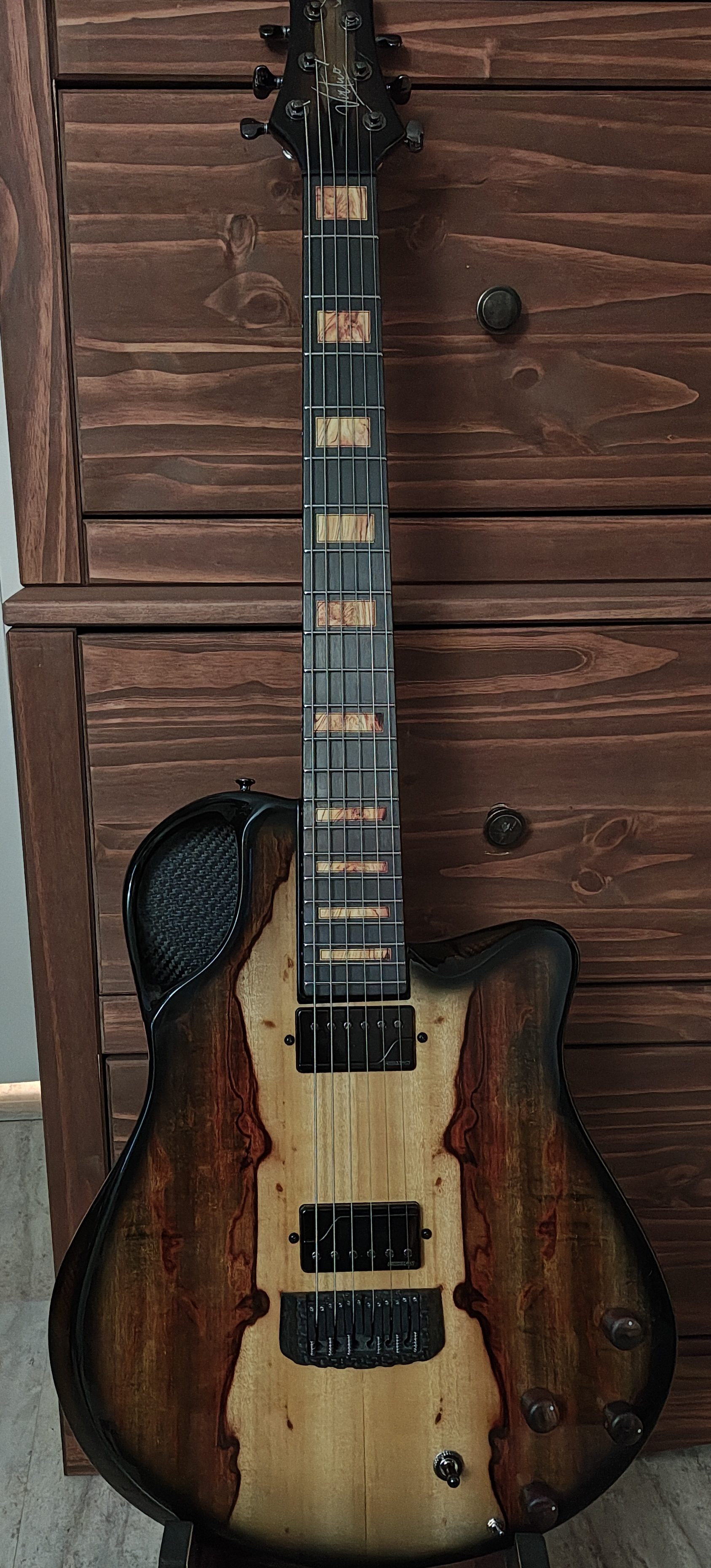
Like Creative Cuts stickers, Fretlook stickers need to be centered. My arts and crafts skills diminished in months between applying the fret marker stickers, but the result still makes me happy. The stickers enhance the woodiness of the carbon fiber guitar.
And that concludes how my love of Tom Bedell era Breedlove guitars lead to appreciating carbon fiber guitars and putting fret marker stickers on them.
My Fret marker Inlay Sticker Reviews.
Creative Cuts.
These are the thinnest stickers at 0.07mm. They have some great designs. The sticker is only as big as the image. I tried bending strings to catch an edge, but I couldn’t. They are that thin. In fact, they are so thin that there is no tactile feeling of their presence while playing. They will, eventually, wear. These are the only stickers I took off, and they came off fairly easily. All I needed was finger nails, rubbing with the fleshy part of my finger and standard fretboard cleaning.
The major downside to Creative Cuts stickers is the lack of custom ordering. They also claim to be “dot busters” without mentioning that they are not “offset dot busters.” They looked bad on my Breedlove because of the guitar’s offset dots.
You’ll need to take some time and care when placing these stickers on your fretboard. I cut out the stickers, roughly you need to leave generous boarders, and dry fit them before placing them on my fretboard. Do not let my results discourage you, if they graded arts and crafts at summer camp, I would have failed. The more meticulous and patient your are, the more successful you will be. Even a klutz like me gets pretty cool results.
In general, if you see Creative Cuts stickers you like and the pattern covers inlays (dots) already on your guitar, these are a great choice.
According to their website, they are located in California.
Fretlook.
Fretlook’s stickers are almost as thin as Creative Cuts. They are 0.08mm. Like creative cuts, their sticker’s are only as large as the image, so the same caveats about non-centered inlays applies.
Like Creative Cuts, you need to be careful with the stickers (copied from above):
You’ll need to take some time and care when placing these stickers on your fretboard. I cut out the stickers, roughly you need to leave generous boarders, and dry fit them before placing them on my fretboard. Do not let my results discourage you, if they graded arts and crafts at summer camp, I would have failed. The more meticulous and patient your are, the more successful you will be. Even a klutz like me gets pretty cool results.
My custom order cost $70. I described what I wanted. Fretlook gave me an approximate time for delivery. Their custom shop was backlogged when I contacted them. They met their delivery and produced acceptable markers/stickers. I would have preferred a wider inset boarder.
Again, if you want a look Creative Cuts doesn’t have, Fretlook customs are a good choice.
Neck Illusions.
Neck Illusions takes a different approach. They market their stickers as neck protectors. The adhesive is engineered to be removed and reapplied to allow for periodic cleanings underneath the stickers. I am still not certain why a covered neck would need cleaning, but it is mentioned on their web site. These are the thickest stickers at 0.011 mm but they do not interfere, at all, with fretting.
Since they cover the entire length and width of each fret, they are the easiest to apply. On occasion, I had needed to trim the stickers with scissors as upper fret stickers were too wide.
Neck Illusions shines the most when ordering custom stickers. They send mock-ups and encourage feedback until customers are satisfied with the stickers.