Somewhere in On Writing, Stephen King repeats trite writing advice, namely: Write what you know. He suggests that if you are a plumber writing science fiction, write it from a ship’s plumber POV (point-of-view). This is the type of advice that gives conventional-wisdom a bad name.
In a writer’s workshop, I read a section where my lead character waxed lyrical on his bicycle. As an avid cyclist, at the time, I knew which bicycle characteristics would help define his character. Overwhelmingly negative feedback. One writer related his experience writing about his lead character’s car. When he read that section to the writer’s group, they convinced him to cut that entire section. Several other authors related their experiences with enamored details of some of their favorite things. They agreed, the surest way to bore readers is to write what you know.
Stephen King does have plenty of good advice in On Writing. My favorite is to not bother researching topics while writing the story. Research can come later; the story comes first. Repeat: THE STORY COMES FIRST. Note: Obviously, Stephen King needs to research things which means that he strays away from what he actually knows. There are some great historical novels where authors add a section at the end delineating what in the novel is historical and what is not. “Why?” Because they love history. “Then why not just write it historically?” Because THE STORY COMES FIRST.
When readers crack open a novel, the readily suspend disbelief to give authors narrative space to introduce characters, build conflict and set their fictional world in motion. Suspension of disbelief may not last long. There is only so much belief readers are willing to suspend. Many things can pull readers back to disbelief.
In The Third Girl, my disbelief began in the first chapter when the first line from a police officer is, “OK, let’s go find Penelope. Think you can help us?” It read too unprofessional to me. I was previously irritated by the author’s choice to withhold critical details about what happened to Christina Johnson’s before her escape. In fact readers don’t get significant information until well past the seventy percent mark in the novel.
I’m a plodder when it comes to reading. Even after determining that a novel isn’t well written, I keep reading. There have been a few novels I never finished, but this isn’t one of them. Sadly, I don’t find most novels well written. What readers may not realize, is that writers fall into two categories: Plotters and Pantsers. Plotters map out every aspect of their story before sitting down to write it. In college Alex Haley spook. I missed the event, but read about it in the college newspaper. Haley described his extensive research process and likened his writing process to clerical work, filing 3×5 cards, cross referencing, jotting down notes and outlining. Pantsers (writing from the seat of their pants), Stephen King is a famous example, set the characters in motion and see what happens next. When I write fiction, I am mostly a pantser, the “mostly” part is due my practice of telling myself the story until I know where it will end. Once I have a destination, I pants out a beginning and keep writing until I reach the destination. I often overshoot my original ending as many things happen along the way and may require resolution.
The Third Girl reads like it was pantsed. One reviewer on Amazon wrote “Midway, the story line started to drag a bit then became implausible. The ending tried to quickly tie up the loose ends.” The author captures the havoc a severe traumatic experience wreaks. That was good, but the author forgot the lesson from Stephen King. The story comes first. THE STORY COMES FIRST. The novel reads like the author did not know the story. This is a good way to aggravate readers (me). Too often authors try play with readers’ minds by withholding crucial information when the story would benefit from revelation. Again, they forget that suspense does not come from holding back what has happened or what is happening. Suspense comes from knowing what is going on and the circumstances leave many possible, and divergent, outcomes.
When I finished the novel, I was convinced that this was the work of a bored housewife written during the hours between sending children off to school and waiting for them to return. The “about the author” section revealed something completely different. The author had careers both in law enforcement and as a lawyer.
It’s not that I doubt the author’s background. There were several instances of unprofessional police behavior including a chain-of-custody violation from a cold case that would send the whole police department back to POST certification training. The story is set in a small California town whose police are corrupt. The many instances of blatantly unprofessional police behavior may have been intended as emphasize the corruption of this towns police.
If the above supposition is true, it is a risky tack. In my case, it obliterated any suspension of disbelief. Even worse. Penelope, who the audience first believes was kidnapped along with Christina was actually staging the whole thing to escape her mother. When Christina is at the wrong place and the wrong time, she gets abducted in Penelope’s staged kidnapping. Penelope okays torturing Christina. The torture went on for weeks.
Twenty five years later, Christina finally discovers what happened and learns of Penelope’s involvement. Not only does the DA somehow not press charges. Since torture was a component of this, fictional, kidnapping, there is no statute of limitations. The novel did not mention any plea deal where Penelope turns evidence on her, now dead, conspirators/kidnappers/torturers. I can’t see how anyone with a law background would consider Penelope’s skating away from these revelations plausible. Readers, like me, can no longer believe anything we read in the story. It reads false. Disbelief in full effect.
There is enough wrong about this story that it is easy to believe the author claims both law enforcement and legal backgrounds to give potential novel buyers a reason to believe that the novel would be more authentic than one written by a former journalist, accounting clerk, orthodontist or bored housewife.
Diary of a Throwaway Kid was written by a North Carolina psych nurse. She wrote from a foster child’s point of view.
Writing in diary form carries many risks. The first is that they often read as “I am a writer.” Many unpublished writers create writer characters. I have read too many of these, and they read worse than amateurish. They read like the author has nothing authentic to say about life, so they pretend/fantasize about being professional writers. Perhaps this is the origin of “write what you know” advise.
In DOATK, Storm, the diarist/throwaway kid, tells readers that writing the diary was a therapist’s assignment. Instead of resenting the extra effort, Storm enjoys it, and she continues with journal entries long after she stops seeing that therapist. Here, readers get the feeling that the diarist is really a pretentious writer in disguise. DOATK rarely slips into pretentious author mode, so the novel should be commended for that
Writing in the form of a diary has other perils. One peril is that readers know that diarists tend to summarize conversations and other verbal encounter rather than write out dialogues, Anais Nin being a notable exception. Novelists know that dialogue is a great tool for character development. The diary form tends to take this tool, and character development of non diarist characters, away or risk reading like fiction, which it is, and less authentic. For the most part, the author maintains an authentic feel even when incorporating dialogue.
Slipping out of character is another risk inherent with writing in diary form, and there are several slips in DOATK. The worst instance comes when Storm (now Serenity) delivers a speech at a foster care conference in the state capital. Previously, while in a hospital psych ward, she lets out her grievances, and the nurses tell her policy makers need to hear what she has to say. After adoption, she gets her chance. Instead of repeating her past grievances, she relays a series of statistics and other boring information. The narrative should have included that adults helped her with that part, and it would have been bad help. Other, boring, adults can, and probably did, the statistical part. Her contribution, like her hospital outburst, should have focused on how it feels to be part of the statistics. In short, she gave a professional, adult speech. Completely out of character. Storm is a tempestuous teenager. Like most teenagers, she’s a bit impetuous and struggles with control issues. The person giving the speech, was nothing like this, and the novel does not seem to notice incongruities.
Character slips in DOATK point to bigger problems in the novel. Oooh … that previous sentence sounds ominous. So, to be clear, I recommend Diary of a Throwaway Kid. It is a good read, and it brings to light many issues facing America’s foster children. For readers familiar with these issues, it’s an interesting read. For readers unaware about the state of foster children in America, it’s a really interesting read, perhaps a necessary one. My beef with the novel is that author waves her hand at two major issues and doesn’t realize how much exclusion of a third harms arguments for reform. So, here we go.
First:
Storm finds herself in a good home, eventually her adoptive home, where she finally feels like part of a family. The children go to school. She finds her “sister” in the lunch room after her sister had been beaten by another student (female). Storm goes to her class room and lays a hospitalizing beating on her sister’s attacker. Storm is arrested, but, in the end, never faces criminal charges for this incident even though the victim’s parents want justice, not forgiveness, for their daughter’s assailant.
Storm is removed from her new family and sent to another hospital psych ward. This is unfortunate for several reasons: although juries in civil law cases can adjudicate two wrongs into a right, criminal justice treats each wrong as a crime in itself. Letting Storm skate, though it is a difficult skate, reads false to anyone familiar with criminal justice in America. This is also a lost opportunity to expose the foster-to-juve-pipline. Over ninety percent of foster children, nationwide, go through juvenile justice systems. Many end up in Juvenile Hall.
The novel gives readers plenty to contemplate on how youths, like Storm, find themselves reaching adulthood in Juvenile Hall instead of some form of non-penile home (foster home, group home or adoption). The novel would more authentic had Storm found herself in juve with other foster children.
Second:
In one psych hospital, Storm notices that a lunch table is often shared by some “trafficked” girls and rarely/never mentions it again (trafficking is never a theme). This, again, seems like hand waving over an important topic, and, again, missing an important opportunity. I heard of a high ranking county official trying to hold arrested teenage foster girls in police custody longer because he was tired of seeing them released to their pimps instead of their guardians/foster parents. This does beg the question of how good their group home guardians and/or foster parents are.
Through Storm, DOATK, shows why foster children learn to distrust the foster system and yearn for a family. Gangs often offer a “family,” exploit fostered girls and turn them into money generating sex workers. This is a major problem. I wished that DOATK would have explored it in greater depth.
Third:
In my state, between placement foster children do not spend time in psych wards. Specialized group homes handle foster children with behavioral problems. This practice was, probably, a cost saving. Specialized group homes are more economical than psych wards, but they are, by no means, cheap.
In DOATK, Storm spends a lot of her time in various psych wards, which is normal for her state. The author, a psych ward nurse, doesn’t seem aware of a taxpayer’s point of view. Psych ward hospital days are expensive. Several weeks of psych ward hospital days are really expensive. Tax payers have to pay for it. For the sake of tax payers, there has to be a better way.
When Storm became a ward of the state, she was assigned a guardian who must approve of all of Storm’s care. Storm, her foster parents, police officers and social workers are all frustrated by Storm’s guardian’s unresponsiveness. Her voice mail is always filled. She almost never responds to mail request, so Storm is facing a maze of public servants, and their demands, alone. Storm is unable to take advantage of promising opportunities because her state appointed guardian did approve of them (no response, not denial).
I always felt a little guilty for the amount of financial aid I received to attend an elite private college. Between Cal Grant A, Basic Education Opportunity Grant (BEOG), Supplemental Education Opportunity Grant and federal work study earnings, I was gifted several thousand dollars a year. Sometime after I graduated, I read that it cost more per year to incarcerate a prisoner in my state than a year at Harvard. Had I been caught and imprisoned for some youthful misadventures, the state, represented by an assistant district attorney, would have had to make a troubling call.
Economically, the difference between my income potential as a college graduate and my income potential as a juvenile hall graduate is immense. As it is, income taxes on the difference between my earnings and what I could have expected to earn without a college degree made all of the scholarship money a good investment.
In DOATK, Storm managed to end up in a good place, and she was well on her way to becoming a productive, tax generating, citizen. Many foster children face much bleaker prospects. Their lives often include incarceration as an adult. Economically, states are better off investing early and heavily in their wards. They may, like me, pay back all of the investments in higher income taxes, but the best reason for heavy investment in foster children is looming costs of failed adults, and the state would have no one to blame but their short sighted selves.
The economic argument doesn’t even get hand-waving treatment in DOATK because it was written by a psych ward nurse, and not an aspiring writer with an unhealthy interest in economics. Actually, I blame Ms. Tessari’s developmental editor. Writing is best when it’s a team activity, and someone on the DOATK team should have pointed out the economical costs of neglecting state wards. The conference near the end of the novel is a great vehicle for introducing perspectives Storm would have little knowledge of.
Overlooking lay perspectives is a great risk when author’s write about what they know. Few, if anyone, has familiarity with the author’s area of expertise. When writing about areas of expertise, best to step back and approach the area from outside, as if it were being discovered.
So, write-what-you-know is bad advice. Good advice should be write-about-what-fascinates-you. Let a character or two discover an area of interest. Odds are, if it fascinates you, your readers will find it fascinating as well.
Writers are well advised that characters are not mouthpieces. They have lives of their own and often do things authors never predicted for them. While working their characters through plots and fictional worlds, authors find that doing what they predicted would be out-of-character for their fictional characters. Readers distrust authors when their characters stray from what readers thought they understood. Sometimes, the deceit is intentional, but if it doesn’t serve the story, it detracts from the story and leads to negative reviews.
Many people think logic follows linear reasoning when, in my experience, it’s more akin to unraveling a tangle of chains of non-standardized links, and, so, this essay attempts to untangle how fret marker stickers are a result of my admiration for my Breedlove Oregon series guitar.
Feeling Jumpy.
This is going to be a long piece, so here is annotated table of sections with jump links.
A more formal review of three fret marker stickers makers.
Why I admire my Breedlove Oregon series guitar.
As explained in Breedlove Happenings, Tom Bedell era Breedlove guitars were made from certified sustainable woods. Breedlove made their Oregon series guitars from locally sourced Mytrlewood, which distinguished those guitars. Most guitars are made spruce, Sitka spruce is common, and dark wood backs and sides. Brazilian rosewood is highly desired, but it had been over harvested and became endangered. Many other hardwoods are also endangered. This makes Tom Bedel’s efforts to guarantee and certify each of his guitars’ tonewoods admirable.
There are other examples of locally sourced tonewoods in luthiery. I saw a video featuring Showalter Guitars made from Osage Orange which is, for them, a locally grown hard/tone wood. Perhaps the most relevant case is Taylor Guitars urban ash series which are made from ash trees that city governments need to remove due to age or damage. Talyor arranged to have the trees cut down and claimed the wood. The trees were planted, mostly, in southern California after World War II by real estate developers desiring fast growing shade trees.
Although Taylor guitars are highly rated, they are not hand voiced. Breedlove guitars, mostly, are, They use a sound optimization process which is like voicing. The difference is that guitars voiced by boutique builders, like Dana Bourgeois, are tuned to the luthier’s ear while Breedlove uses technology to tune their guitars to measured frequencies.
There are fewer fish in the sea.
I’ve noticed that many guitar manufacturers are using different tonewoods. I’ve seen an increase of guitar listings featuring backs and sides made of Indian Rosewood, Sapele, Okoume and Nyatoh. Although these might seem like more locally sourced for Asian production alternatives, they are mostly replacements woods for mahogany which has been over harvested and is slipping onto endangered lists.
This reminds me of fish choices at restaurants. Growing up, tuna, salmon and swordfish dominated menus. There was also Mahi Mahi (not endangered) and Whitefish. As governments limited their harvesting, Orange Roughy debuted on restaurant menus. Previously, it was considered a “trash fish.” Other previously undesirable fish like Pollack, Devil Fish, Skate Wing and Lionfish populate modern menus. No governments restrict harvesting many popular tonewood trees and luthiers are adapting to “trash” woods.
I really don’t care about what fish are on menus. Growing up, my older brother loved sea food, and I hated my brother, so I avoided sea food to the point I never acquired a taste for it. He played trumpet, so I picked up the guitar, and I enjoyed playing guitar. I care about the instruments I play, so I care how they are made. I want to make responsible guitar acquisitions. If I had to replace my Breedlove, I would probably choose between a Taylor Urban Ash five hundred series or an Emerald X20.
Is this really a problem?
In a Youtube video, a pair of classical and flamenco guitar luthiers (father and son) claim that there is so little actual wood in an acoustic guitar, that making one, even from exotic tonewoods, causes little to no environmental impact. They discussed consumer focus on locally sourced tonewoods from a historical prospective. Spanish luthiers used Spanish Cypress, Spanish Ceder (actually a mahogany) and European spruce for the majority of their instruments especially for flamenco guitars, guitars for working local musicians. For their wealthier clientele, theses luthiers would import more desirable tonewoods such as Brazilian rosewood and African ebony.
That was then, this is now. (or that was thoughtless, this is cliché). Today, over a million new guitars are produced each year. The world’s economy has produced enough surplus cash that guitar manufacturer’s can sell the majority of these guitars.
Post American Civil War, guitar making shifted from Europe, mostly Spain, to America. After the second World War, manufacturing shifted, again, from America to Asia. Japan started early, Yamaha, Takamine, Ibanez and Alvarez were common brands when I started playing. I find it amazing that many Japanese brands utilized Spanish sounding names. They are not alone. I bought a Cordoba C9 Crossover. Cordoba is based in Florida, but manufactured my guitar in China. In fact, many well known guitar brands make their guitars in China and Indonesia. Many Chinese made guitars use Sitka spruce (from the United States West Coast) Engleman spruce (again from the American West) and Indian rosewood (yep, from India; also Sri Lanka and Indonesia). The odds of buying a guitar made from locally sourced, sustainable woods is pretty low.
To be fair, most products available today, and several of their components, travel great distances. There really is little good reason to expect guitars to be any different. All the same, Tom Bedel era Breedloves stand out for actually making the effort to produce more environmentally responsible guitars (but still shipping them to their distributors).
The father and son luthiers offered another justification: guitars don’t use much wood. A typical acoustic guitar weighs about five pounds including tuning machines and strings. Solid body electric guitars are eight or so pounds. Multiply a guitar’s weight by a million, that’s five to eight million pounds, or, approximately, 1500 to 3000 trees per year.
Although luthiers, like most wood workers, endeavor to get the most out of each piece of wood. Guitar makers are particular about what wood goes into their guitars. They require quarter sewn cuts which yields twenty percent less wood per tree than flat sewn cuts. Much of this wood looses more mass through torrefaction, or drying out, which is needed to produce stable wood. Otherwise, the wood would shrink as it ages and guitars would suffer cracks and distortions. As with most wood working. Pieces are cut larger than needed and trimmed to fit.
In a video on sanding techniques, Chris Alvarado, of Driftwood Guitars, said that the statement, “ninety percent of guitar making is sanding,” is a lie. “It’s more like ninety-five percent,” he declared. While watching luthiery videos, I am often impressed by their efforts to re-purpose scraps. Chris often uses them for intricate inlays, back straps, neck heel caps and the like. Still, a significant amount of wood is lost on the way to make a five pound acoustic guitar.
I don’t watch many electric guitar making videos. In the few I’ve seen, pockets are routed out of the solid body to make room for electric components. Many electric guitars feature “chambered” bodies to lower their weight. Chambered electric guitar makers rout out guitar body insides and then add a new sound board like face. Some of these faces actually have braces like an acoustic guitar. Driftwood Guitars’ Tidalcaster features a chambered body.
Can I see your papers.
Despite a concerted effort to build guitars from sustainably sourced tonewoods, Breedlove makes limited numbers of guitars from Brazilian rosewood. My favorite is the Myrzilian commissioned, and sold by, Sweetwater Music (sweetwater.com). It features a Myrtlewood top and Brazilian rosewood backs and sides. It also comes with CITES documentation which allows the owner to carry his instrument across international borders.
Breedlove acquired a large stash of legal Brazilian rosewood in 2013. A Spanish church ornament supplier harvested the wood in the 1950’s and early 1960’s before any export bans (See this link). This is considered “guilt-free” rosewood. The wood is well documented, so Breedlove has no trouble obtaining CITES certificates.
In a video where Chris Alvarado, of Driftwood Guitars, describes a recent build as his most beautiful guitar to date, Chris’s choice of Ziricote was driven by his client’s location, Austalia. Chris’s Brazilian rosewood came from a bedroom set he bought from a private person in New Jersey. Unlike Breedlove, Chris has not, perhaps can not, certify his Brazilian rosewood, so he can not sell it to someone overseas.
Many luthiers go to great lengths to procure precious tonewoods. They aim to acquire a lifetime supply. Since furniture makers also use these same woods, luthiers often salvage wood from furniture. Tom Bedell acquired mahogany wood from “The Tree” by buying a large office table. The species, Swietenia macrophylla, is a CITES protected, but “The Tree” fell long before its species was put on the endangered list. When it fell, it slipped into a ravine and loggers could not get it out. Two decades later, loggers brought it out of the ravine in sections. Since the legend of “The Tree” was well known, it’s wood could be sold even though, by then, “The Tree”’s species could no longer be harvested. StewMac has several back and side sets available on its website.
The main point is, that highly desirable tonewoods are becoming scarce. “Trash” tonewoods are becoming more and more common in guitar builds, but these woods, like “trash” fish, can be over harvested as well. Some species grow in plantations. These include Honduran mahogany, Indian rosewood, Sitka spruce and maple. The appetite for guitars has grown dramatically the the last few decades, experienced a pandemic boom as people needed something to do when locked down, and has since leveled off a bit. The average guitarist owns four guitars, but many older guitarists tend to buy more. A friend owns over thirty guitars. He’s not a professional guitarist though he plays as well as any I’ve heard.
I previously limited myself to four guitars, ukulele and a bass. I donated the non-guitars to musicians who lost their instruments in a fire. Not an act of generosity. I made space for a fifth guitar, perhaps a sixth. Still limited. The proposition is: what I would replace my Breedlove with should I need to. The answer was either a Taylor Urban Ash guitar or an Emerald.
Emerald Guitars.
Emerald Guitars makes carbon fiber guitars. They are located in County Donegal Ireland.
While researching innovations in guitar making for a section of A Dumb Thing 2 Say that never made the page. Carbon fiber guitars was one of the innovations I was interested in along with sound modeling processors.
I saw a Youtube video comparing three guitars: McPherson wood guitar, McPherson Sable and an Emerald X30. Both the Sable and X30 are carbon fiber guitars. I was surprised that the Sable performed poorly compared to its wood counterpart. The X30 held its own and sounded better than the wood McPherson in many playing styles. The takeaway, however, is that both $4K carbon guitars were in the same performance class as a $10-15K wood guitar.
It’s hard to say which guitar is more innovative. McPherson guitars, both carbon fiber and wooden, feature offset sound ports and cantilevered fretboards (the end of the neck floats above the soundboard much like a violin’s neck). His innovations, though similar to the Kasha/Schneider classical guitar, were derived independently. Perhaps McPherson’s luthiery background influenced the Sable’s design. The guitar still has a neck heel and internal bracing. In many ways, a Sable is designed like Mcpherson’s wooden guitars.
Emerald guitars do not have a cantilevered neck. Like most guitars, the end of Emerald’s fretboards rests on the guitar body. Emerald guitars makes their guitar and neck in one molding. The joint is strong enough, that they do not need, nor have, a neck heel. They also layer their carbon fiber such that braces are not needed to add strength to their soundboards, nor for voicing.
When Chris Alvarado, of Driftwood Guitars, cut open a Taylor GS Mini for one of his reviews, he was surprised that the GS Mini did not have much internal bracing. Chris believes that the lack of traditional bracing allows GS Minis to produce far more sound than other guitars of its size.
To understand carbon fiber and its potential importance to guitars in a world where tonewoods become scarcer. It is important to discuss ….
Ch-ch-ch-ch-changes.
Changes are usually categorized into four levels: Revolutionary, Transformational, Evolutionary and Incremental.
The airplane was a revolutionary change. They are really nothing like hot air balloons, or automobiles, or bicycles or motorcycles or any other form of transportation.
Larger diameter engines allowing jets to fly just as fast and far with fewer engines and greater fuel efficiency can be seen as an evolutionary change.
Raked wing ends on the Boeing 787 is an incremental change.
Antonio de Torres Jurado helped define the modern guitar in the 1850’s. Though six string guitars existed, he added fan bracing which allowed for larger bodies, flatter backs and more resonant sound. This revolutionized the guitar. Thaddeus McHugh’s invention of the truss rod transformed the guitar by allowing for steel strings extra tension. For acoustic guitars, piezo pickups let them evolve from mic dependent stage performers to more independent performers (the electric guitar was another transformational change). Incremental improvements in acoustic pickups systems are, well, incremental changes.
CU@^ (or See You At The Top)
A good reason to advocate for carbon fiber acoustic guitars is that wooden acoustic guitars have probably underwent their zenith event where carbon fiber acoustic guitars probably haven’t.
For the most part, I am coining the term “zenith event.” Google searches immediately go off target, so let’s zero in on a definition.
Zenith Event refers to the occurrence of an object’s (or subject’s?) reaching it’s optimal form. Well, not exactly. The absolute highest form is not necessary, incremental changes can still occur, but no more evolutionary changes are foreseeable. So there can be refinements, but no substantial change.
Since many people believe that Stadivarius violins represent the pinnacle of violins, those people would say that violin making (note: violin makers are called luthiers, the same term for guitar makers) has seen its zenith event in the early to mid 18th century.
There are at least two problems with the 18th century violin making zenith event assertion. First, violin making has seen at least two innovations. Stradivari glued his necks to violins’ bodies. Most of the prized surviving Stradivarius violins have been modified to have longer, cantilevered finger boards. This was done, in part, to adapt to higher tension strings. Although lengthening the fingerboard should be seen as an incremental change, cantilevering the neck and redesigning the neck joint are evolutionary changes. So did violin making’s zenith event occur later in the 18th century, perhaps early 19th century? That is an intriguing proposition.
Several double blind tests revealed both violinists and audiences prefer modern instruments to 18th/19th century Italian violins including Stradivarius. I do not know enough about violins to say if modern violins incorporate any evolutionary changes. My guess is modern violins benefit from incremental changes, refinements, but violins’ zenith event occurred in the nineteenth century.
Truss rods, transformational in guitars, are not used in violins because violins’ shorter, thicker neck can handle string tension, roughly fifty pounds. Violin bodies can not handle much more pressure. There are carbon fiber violins, but I could not find any made to handle higher tension strings. Should high tension strings become a feature of new violins, that would mark an evolutionary change.
For violins, an incremental change is in tuning machines. Currently, most violins are made with tuning pegs which rely on friction to hold strings in tune. Some violins are made with machine heads, used on guitars, but they are rare and looked down upon by many violinists. There are tuners known as machine pegs, or geared pegs, which look like traditional pegs, but they contain mechanical gears internally, which have been better received, but remain uncommon.
Market Acceptance.
Evolution and refinement are a common and easily explained pattern. It takes a while for evolutionary changes to gain acceptance in markets. It is easier to market products that resemble similar products especially those the evolutionary, or transformational, product intends to replace, or disrupt.
Think of electric vehicles. Tesla is the market leader. Even though they have a distinctive curvy form, they still follow the Engine Compartment/Passenger Compartment/Trunk design. Since the engines are integrated with the axles, and electric engines do not require an air source (except for a little cooling), there is no need for an engine compartment. EVs benefit from aerodynamics to enhance range, especially highway/freeway range. The most aerodynamic shape is a teardrop (rounded front tapering to a rear endpoint). For ground vehicles a half teardrop with ground effects would produce enhanced range for EVs. Currently, the closest we’ve seen has be the VW ID Buzz which was inspired by the VW Type 2 Micro Bus, not aerodynamics.
Market acceptance helps explain why EVs haven’t taken a more aerodynamic shape by eliminating the unnecessary front engine compartment. Some vehicles, like the Chevy Blazer, put the engine in the engine compartment and utilize a more conventional transmission. Chevy might do this to leverage existing models (like the gas powered Blazer) rather than completely redesign a vehicle for EVs. Other manufacturers opt for either a frunk or, since frunks are mostly pointless, nothing in the front other than mechanical access to battery packs.
Basically, the market wants already known products, but with a competitive advantage. So, if you build a better mouse trap, the world will not beat a path to your door, but marketing managers will ask you to make it look like all the other mousetraps. Once the evolutionary (or transformational, or even revolutionary) change catches on, then incremental changes start. Restated: Once an evolutionary change gains market acceptance, competitors will offer similar products with refinements.
Limitations.
Limitations often set boundaries requiring evolutionary or transformational changes in order to be crossed.
Let’s go back to the violin for an example.
Unlike guitars, violins do not incorporate truss rods in their fingerboards. In guitars, the truss rod allowed guitars to handle higher, steel-string tensions and this transformed the acoustic guitar and paved the way to electric guitars.
Violins do not need truss bars because their bodies, not their necks, provide the limitation. String pressure, communicated through the bridge, to the body can produce overbearing force and damage a violin’s soundboard.
Guitar bodies also had difficulty with increased string tension. Guitars evolved from fan bracing in Spanish style gut string guitars (now nylon string guitars) to X bracing in steel string guitars. Some luthiers tried ladder style bracing, but X bracing produced better sounding instruments, especially in flat top, as opposed to arched top, guitars.
There are carbon fiber violins, and they have some acceptance, but they have not been widely seen. I’d say, they are less accepted than carbon fiber guitars. From looking around the internet, carbon fiber violins still use wooden, independent bridges. So, even if carbon fiber bodies can be made to produce a good sound with higher tension strings, it is doubtful traditional bridges can handle much more tension.
So, if we define a violin as an instrument with produces sound by transferring string vibrational energy to a small body via a bridge. Note selection is from bowing, sometimes picking, a string or strings (double stops) and varied by shortening the string by pressing on it on the fingerboard. This is basically the violins we see today. A main requirement is that it should be bow-able. Which means that there must be a waist in the middle so a bow can access any of the strings. Another requirement is that must produce concert level volume without electronics.
So, imagine a series of evolutionary changes.
1. With carbon fiber, the body can be structured to handle three times the current string tension or about 150 pounds. The three-to-one ratio is based on the truss rod’s impact on guitars. Nylon strings on guitars produce about 80 pounds of string tension. Steel strings are generally 160 pounds, but can go up to 260 pounds.
2. A carbon fiber bridge designed to transfer string vibrational energy up to 160 pounds. Unlike current bridges, carbon fiber bridges will probably be molded into the body.
3. A longer neck supported by a truss rod. This neck will increase the range of notes on each string.
4. Asymmetrical design. Different areas of guitar soundboards react to string vibration frequencies differently. Some areas are more productive, some barely make any sound. Many guitars, like the McPherson, already make better use of the sound board by offsetting the sound port. Many guitars also feature cutaways to enhance access to upper frets.
5. Move the sound ports. Traditional f-hole sound ports came from a period of discovery in the seventeenth and eighteenth century. Once they found a good size and shape, they pretty much stuck to it. The “f” shape works because of its interaction with wood grain directions. Carbon fiber weave is different, so different shapes and placements should yield superior results.
6. Higher tension strings would reek havoc on horsehair bowstrings. Carbon fiber bowstrings are, already, available. Higher string tension might require more durable carbon fiber bowstrings.
The resulting instrument would be an evolution of the current violin. As far as I know, there are no such instruments, mostly due to a lack of demand. There is not a swelling chorus of musicians demanding a more versatile, higher volume violin.
Although there may be more violinists alive today than in prior history, they account for about one percent of the global population. Guitarists are five to ten times as many. More importantly, popular music focuses on guitars (bass included), keyboards and drums. String sections are hard to deal with and expensive to bring on tour. Some popular acts work with local orchestras for each performance, but many more simply allocate string parts to a keyboard and modeling software. I can emulate a string section with my Roland GR-55 driven by my Emerald Virtuo. Keyboards/synthesizers can often do a better job at taking on string section pieces.
Most musical instrument innovations benefited from musical compositions written for them. Although, via population expansion, there are probably more compositions written for violin now, than ever, these compositions do not gain wide acceptance/marketability in the general population. Once again, most popular music, the type of music to propel a new instrument to popularity, is written for keyboards, drums and guitars. So, a new, improved violin would have a hard time gaining market acceptance and would likely drift from novelty to obscurity rapidly, living on, mostly, in infrequently visited wikipedia pages.
Expectations.
Should our high tension violin meet some success, it would likely target existing violin players which means that initial models would aim to sound like existing violins just louder, and it would likely fail to meet expectations.
This is similar to what is happening, now, with carbon fiber guitars. Many reviewers point out that carbon fiber guitars sound different. The most common differences, in the reviews, are, they have more of a shimmery sound, or that they are more balanced.
The latter comment is the most interesting. Acoustic guitars are mostly defined by the 1940’s era Martin dreadnought style guitars. In particular, the D18 and D28 guitars which are still in production. Compared to previous guitars (Note: nylon strings came over a decade later, so 1940’s era classical guitars had animal gut strings), Martin dreadnoughts were known, still are, for their scooped mids tone. Dreadnoughts have a large bodies with less pronounced waists. They produce deeper bass notes and crisper high end treble tones. The middle tones tend to get drowned out. Martin, and other brand’s, dreadnought guitars defined much of the sound of folk music, country/western and much of the popular music generations of Americans grew up with. They were louder than most other styles of guitars, so they were popular. In recording studios, sound engineers endeavored to cut down the bass and trebles, so recorded music offered a more balanced sound.
When comparing Martins to Taylors, reviewers frequently remark that Taylors have a shimmery sound, while Martins have a darker tone. An off hand coincidence, and perhaps nothing more.
The main point is that prior instruments attained their sound in a combination of trial and error, and pure accident. Sometimes, tone is sacrificed for volume and projection. Sometimes, volume is sacrificed for tone or range. Innovations are often marketed by misleading comments playing to customer’s perceived preference for change without real change or difference.
That is an odd conclusion. I’ve seen it in business, so let’s look at that. Often Information Technology directors describe a proposed new computer system as just like the old system, but faster. Inattentive business executives buy that kind of proposal. Business executives can be, and often are, stupid. Smart business executives, some do exist, know implementing a new business software will change the way they do business. They ask the question: How do we want to do business? What business process changes do we want to make? Can we buy or build software that supports the way we want to do business?
SAP, a well known business software supplier, offers a better approach. They market their software, in part, on their practice of only supporting “best practices.” They actually tell prospective clients, that if they do business in a way SAP does not support, they need to change the way they do business. SAP has a Best Practices committee that reviews business processes. If a business has a practice they want SAP to support, they can submit that practice to SAP’s committee. I witnessed one case that got their business practice past the SAP committee. I have also witnessed another enterprise insist on using SAP software without changing practices, make headlines as their problems lead to financial difficulties, and endured SAPs public statements that they are using SAP software incorrectly and should adopt best practices instead of continuing with ill conceived business practices.
Musical instruments design seems to progress more by applying new technologies to existing designs rather than asking how people really want to make music. The Saxophone was designed to hybridize woodwinds and brass, basically, the tonal qualities of reeded woodwinds with the projection of brass instruments. The tin drum, perhaps the last non digital instrument, was, initially, fashioned from 55 gallon barrels. More of leveraging a readily available material than sonic design.
Sorry for going far off field. The major points I wanted to get across is that violins and wood acoustic guitars have seen their zenith events: Violins in the mid 19th century, wooden acoustic guitars in the mid 20th century. Carbon fiber guitars, probably, have not seen their zenith event, but we will have to see. The main factors of material limitation and acceptance play a role.
The point of proposing a violin nobody wants was to show how musical instruments can still have evolutionary changes, but circumstances dictate whether evolutionary changes will gain acceptance. A lack of popular music written for violins and the use of modeling synthesizers (keyboards) to replace string section roles in popular music limit demand for violins to classical music most of which was written over a hundred years ago.
Although most popular music produced today use keyboards and electric guitars, a noticeable amount of new music features acoustic guitars, by and large wooden. There is still room for evolutionary advancement, but decreasing tonewood availability and well, snobbery, limit wooden acoustic guitar development.
The Snob Factor.
For once, this is not my favorite topic in sophomore economics regarding anomalies at the ends of the price/demand curve. This has more to do with wine.
For centuries, France dominated wine production, but not continuously. French viticulturists realized wars, weather and insects could wipe out centuries of advancements. As a precaution, they sent grafts to other wine producing areas, in particular, northern California. French vines flourished in several northern California climates. A hundred years later, Napa Valley wines out performed French wines in several competitions and published reviews.
French wines were marketed (labeled) by a complex appellation system, which I know of, but can’t explain too well. Basically, it is by region and producer. So, a wine labeled as Bordeaux has to be made of grapes in the Bordeaux region. There are also requirements for it the be Chateaux Lafitte, for example. Centuries of producing wines in the Bordeaux chateauxs lead to the chateuax’s wine having a certain, desirable, taste. A major part of the art of French wine making involved blending the wine with components of several grapes. The art and taste of each chateaux was passed from winemaker to winemaker. Each house had a notable taste year in and year out. Many connoisseurs could tell what chateaux he was drinking even though the label was covered.
California wines were marketed (labeled) on the varietal system. The species of the grape became more important than the house/chateaux where they were made. In California, seventy-five percent of the wine must be of the grape species to get a varietal label. The American Viticulture Association requires eighty-five percent of the wine be from the designated grape variety. Other producer associations have varying requirements.
Because of the prestige California wines gained over French wines, many french wines are now marketed by their grape species. The French rule is eighty-five percent. Many people who follow the industry often remark that batches of wine vary from pressing to pressing. Often a batch will benefit from more blending, but winemakers will stick their association’s rule rather than risk lowered market value by going under the varietal requirement.
In the case of wines, snobbery (expressed as insisting on varietal labeling) often leads to inferior product. In the case of wooden acoustic guitars, “solid wood” takes the place of “varietal” in wines.
Many bargain guitar brands laminated high quality tonewood veneers to lower quality woods for guitar backs and sides (especially sides). Although guitar backs (and especially the sides) do not have nearly the sonic impact of soundboards (tops) – lookup the Torres papier mache guitar, anything on a guitar that vibrates or suppresses vibrations has sonic impact, though perhaps not that much. High quality guitars were made with solid wood bodies. Over decades, the word “laminate” in guitars came to mean cheap and inferior.
While documenting the making of his 3000 year old guitar, Chris Alvarado staunchly defends his use of doubled sides. Technically, gluing any two or more pieces of wood together is considered a laminate. Chris explains that the doubled sides gives his guitars improved tone. The extra stiffness and strength helps the sides transfer soundboard energy to the back. Doubling the sides also replaces side braces which also transfer energy, but more importantly, reduce/prevent cracks in the sides.
Double siding is technically laminating the sides, but it is a high grade technique. Similarly, many classical guitars feature “double tops.” Like Chris Alvarado’s double sides, double tops are two thin, high quality tonewoods sandwiching a lighter material such as Nomex, a space age synthetic. Double top classical guitars often project much louder than solid top soundboards.
Advancements.
It is hard to say whether McPherson’s designs represent incremental or evolutionary advancements to guitar. It depends on adoption. Many luthiers have some models incorporating offset sound ports, though, as mentioned before, the Kasha/Schneider guitar predated McPherson’s usage. Driftwood Guitars (Chris Alvarado) offers a Da Vinci model that has a cantilever neck and takes the offset even further by moving much of the sound port to the side wall. All the same, most, and by a large margin, guitar models follow established designs. Greater adoption would establish the creation of the first McPhersons with these advanced features as a probable zenith event for wooden acoustic guitars.
Further advancements might include greater reliance on technology. Breedlove’s sound optimization process uses metrics and an algorithm programmed into a computer to aid their luthiers to voice soundboards and backs. Adding modeling into the algorithm would identify which pieces of wood would make laminates, or doubles, that outperform solid components.
However much media malign artificial intelligence (AI), I have seen documentaries where AI outperforms human experts. In simulated dog fights, human pilots fair poorly against AI, and it’s not just because AI does not blackout in high G maneuvers. Pilots interviewed in the documentary claimed AI used tactics they would never have thought of using, in part, because AI doesn’t worry about survivability as much as humans.
AI’s capacity to plumb previously unexplored solutions gives it a competitive advantage over humans experience and tradition. Both the Kasha/Schneider guitars and McPherson independently determined that traditional sound port placement underperforms offset sound ports. Ancient aesthetics emphasized symmetry which explains early musical instrument design and, in turn, became traditional instrument construction architecture. Modern analysis (including K/S and McPherson) shows that guitars, and many other instruments are naturally more asymmetrical. So far, guitars have taken greater advantage of asymmetric adaptations than most musical instruments. This is most evident in the cutaways developed in the 20th century and popular today. Of course many stringed instruments have asymmetrical bracing under the top such as the violin’s bass bar.
With AI’s proclivity to produce unconventional designs, it could utilize computer modeling to produce radically different wooden acoustic guitars. Should those designs, or even techniques, gain market acceptance, wooden acoustic guitars could experience a new zenith event, but I doubt it will.
Carbon Fiber.
Carbon fiber and wood have a lot in common. They both are strands of carbon threads (micro cellulose fibrils in wood) bound together by resins (lignin in wood). They both gain strength by layering fibrous material and resins. Trees add layers as they grow and form rings. Carbon fiber comes in sheets, but this is where differences between the two become distinct. Wooden objects, like musical instruments, get their shape by cutting, carving and sanding. Basically, by removing wood. Particular wood characteristics, such as grain, are selected and worked into the design, like using quarter sawn cuts for musical instruments. Carbon fiber is deliberately build up sheet by sheet. Different weave patterns can be selected and combined to achieve design parameters.
The main difference between carbon fiber and wood is that wood has to be worked while carbon fiber can be engineered.
Cyclists, such as myself, became fans of carbon fiber in the 1980s and 1990s. Early applications used carbon fiber tubing glued into aluminum bottom brackets junctions, head tube junctions and seatpost junctions. These tended to fail frequently. Road vibrations, shocks from striking/rolling over small objects and cement lips to driveways and such caused frays and small cracks. When carbon fiber weaves are compromised, they can fail catastrophically. In an on-line cycling forum, a rider reported an incident with a motor vehicle where the only damage was a deep scratch in the carbon fiber fork. Since the fork was not severely damaged (“It’s just a scratch”), the motorist refused to pay for it. The cyclist wondered if he should keep riding on it instead of shelling out ($500 at the time) for a new fork. The common response was something like “It’s your face, not mine. I wouldn’t do it.” Some went to explain about how compromised carbon fiber can fail completely and without warning.
Not long after these failed attempts, monocoque designs were developed, and shortly after that computer modeling helped refine the shape. Over a decade later, monocoque carbon fiber frames dominated Le Tour de France and has ever since. Another decade later, Pinarello introduced asymmetric frames which better adapt to uneven forces cyclists put on frames mainly due to the drive train having to be on one side or another (typically the right side).
Although metal bikes, in particular aluminum, adapted some of enhanced designs brought on by carbon fiber designs. One, in particular, proved difficult. Pirandello found asymmetric force being applied to the top tube. They lightened part of the top tube in areas and strengthened it others. The result, the bike rode straighter than symmetric top tubes. In cycling, if force does not propel bicycles forward, then it inhibits forward progress and is wasted energy.
Though there have been some changes in competitive road bikes. The zenith event was probably 2010’s introduction of Pinarello’s Dogma 60.1. This bike ushered in carbon monocoque’s dominance. Incremental changes since then include better aerodynamics and weight savings. Many frames now weigh less than two pounds.
The main limitation to road cycle development is a 6.8kg, roughly fifteen pound, minimum weight requirement imposed by Union Cyclste International, the governing body for road races and Olympic cycling events.
The main problem for road cycle designers was/is what to do with carbon fiber’s weight savings. In the early days, some riders preferred adding weight to the bottom bracket and chain stays to give the bike a lower center of gravity. Since riders, themselves, comprise most of the weight of a bicycle going down roads, an extra pound or two probably did not make much difference. Deeper rimmed wheels took up some of the weight and gave riders improved aerodynamics. Hydraulic disc brakes is another way to spend about 500 grams.
Many analysts consider cycling’s adoption of hydraulic disc brakes as bicycles last evolutionary change, and it may be. Disc brake systems now dominate new road bike production with 75-85 percent of new bicycles. About ten percent of new bicycles feature mechanical/cable disc brake systems. The remainder are rim brakes.
Some professional riders, and riders like me, still prefer rim brakes. Rim brakes can be tucked away behind front forks and just above chain stays. In these positions they loose a little stopping power, but who cares. Unlike F1 cars, bikes, for most corners, do not need to brake. Some high-speed, sharp corners may need braking and riders need to stop at the end of the race, but stopping is not a major concern, going fast is. Cyclists lean into corners. The idea is to not spill too much momentum.
Disc brakes have a minor aerodynamic disadvantage. Since road bikes have to spend weight to make the 6.8 kg minimum weight, the weight cost is not a factor. Although integrated hydraulic disc brakes were available since 2013, UCI did not allow them in road races until 2018, so I, grudgingly, have to move road bikes zenith event to 2013.
Specialized, a major bicycle brand and not an adjective, created it’s FUCI prototype bike. FUCI stands for F-F-Forget UCI. It incorporated features specifically forbidden by UCI such as asymmetric wheels with a 33.3 inch rear wheel rim which allows riders to adopt a more aerodynamic shape, a small fairing which aids in aerodynamics and a crank assist electric motor in the seat post which riders can deploy strategically on hills.
The FUCI bike shows how limiting factors inhibit product evolution. In bicycles, a regulatory agency, UCI, is the limiting factor. In musical instruments, market acceptance plays a larger role though CITES is also a factor.
Carbon fiber in bicycles changed competitive regulations and allowed for further evolutions in wheels and brakes. We have yet to see what carbon fiber in musical instruments will bring. Currently, carbon fiber instruments mimic their wooden counterparts.
The Tesla of Carbon Fiber Guitars.
Emerald Guitars is, at present, the dominant name in carbon fiber guitars. Emerald inherited the mantle from Rainsong Guitars. Rainsong failed shortly after transitioning to a direct sales model in 2023. Emerald transitioned to direct sales in 2016. Although Emerald is considered the dominant name in carbon fiber guitars, it may not be the largest seller. Other brands, like Enya and Lava, offer much more affordable instruments, but they are rarely mentioned as market leaders in articles. The main reason I consider Emerald the Tesla in it’s field is that they share similar market threats, but to understand that statement, we should look at the carbon fiber market.
The main players in the carbon fiber acoustic guitar market are:
Emerald Guitars ($$$$) – makes several models in various colors with optional wood veneers.
McPherson ($$$$) – makes two models, all black with a choice of one of three patterns. Mostly known for wooden guitars.
Klos ($$$) – makes a few models most of which have a bolt on neck that is easily detached. They offer a Timberline finish looks like wood and alters the tone. With the neck detached, the guitar fits in airline overhead storage.
Journey ($$$) – makes a few models including some wooden models. Many models have color options. Designed to detach the neck without tools and reassemble easily. Like Klos, the guitar with detached neck fits into airline overhead storage, some models easier since they are smaller.
LAVA ($$) – makes a few models with color options. Smaller, so they are easy for travel, but no claims to fitting easily in airline overhead storage. LAVAs are mostly know for their smart guitar capabilities.
Enya ($) – makes several models. Their thinner, more electric guitars, have color options, but their more acoustic guitars are only in black.
There are a few other makers, Composite Acoustics comes to mind, but these are the major players. Emerald leads the pack. All these companies have direct sales through their websites. McPherson also sells through Guitar Center and select dealers. Klos sells some of their guitars through select dealers. Both LAVA and Enya guitars are available through several distributors including Amazon.
With car sales statistics, there is a category called, “Non Tesla EV.” Tesla dominates EV sales at the time of this writing. Enya and LAVA probably have more monthly sales than Emerald. Emerald is considered a leader in design, build quality and recognition. Those are all subjective categories. Jeremy “Guitar Hunter” Sheppard reviews guitars and also performs professionally. He had a nice blue Emerald X30 for a while, but he thought it sounded too dark. He sold it and bought a McPherson Sable.
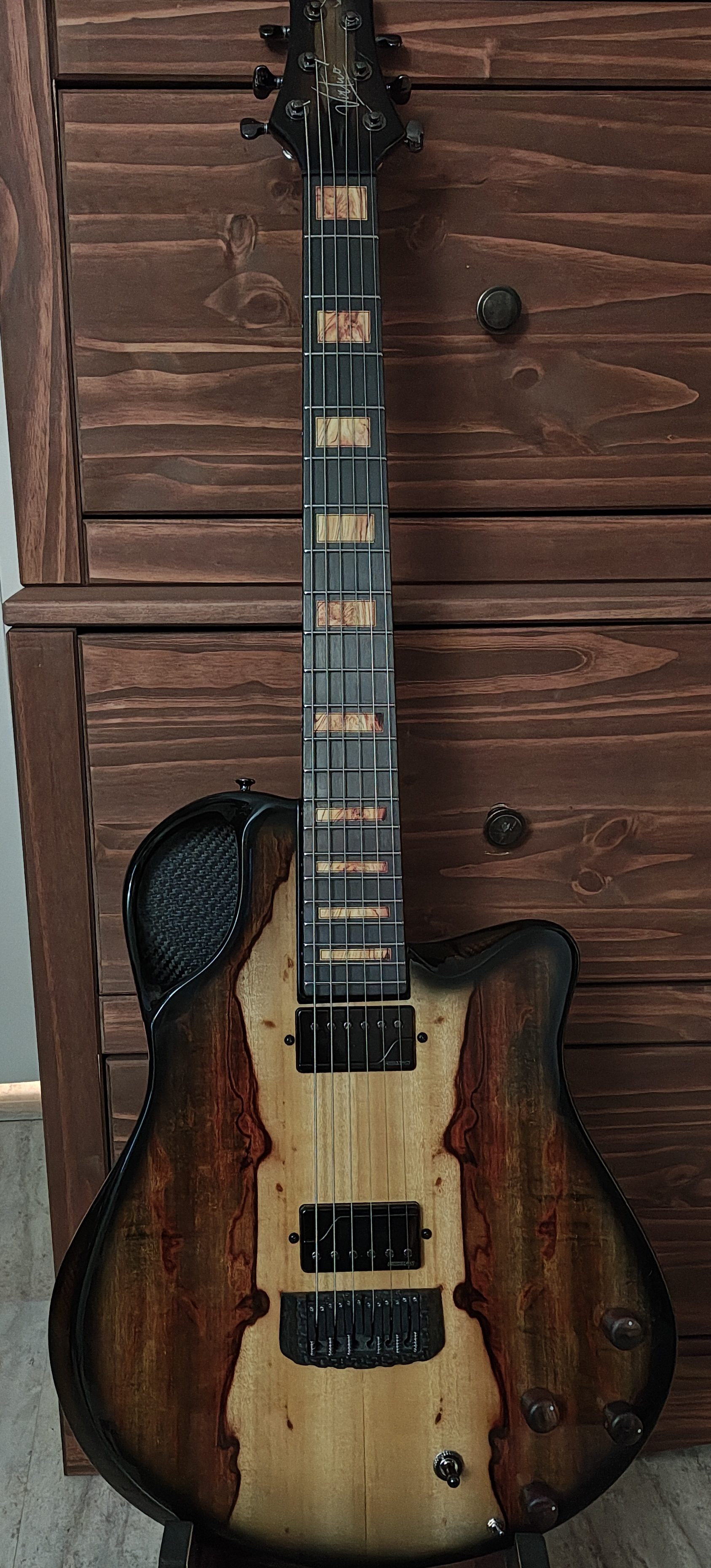
On several public forums, Emerald Guitars are noted for their ergonomics and for their look. McPherson, like many other carbon fiber guitar makers, produce only black instruments. A similar thing happened in cycling. At first, almost every carbon fiber frame was black with some highlight decals. In a few years, bicycle manufacturers started painting them. Emerald embraced colors early on, and then went one step further, they made exotic wood veneers an option for their guitar tops. Each wood veneer is unique, and customers can use a 3D builder app to view choices from a veneer library. The combination of color choice and the natural beauty of highly figured natural woods help Emerald guitars attain a look that’s hard to match.
McPherson offers a few different patterns of black carbon on their guitar faces. They also took an odd approach towards ergonomic concerns. Carbon fiber guitars are know to slip. Emerald added body conforming contours. McPherson added texture to their backs and lower waist. Jeremy Sheppard, and several other reviewers, claim this texture can grab sweater material and not let go, leading to damaged sweaters over time. Blue denim handles the texture just fine.
Another key difference between McPherson Sables and Emerald guitars is build philosophy. McPherson Sables utilize braces and have neck heels. In essence, they are simply carbon instances of the McPherson’s wooden guitar design. Emerald guitars use carbon fiber’s strength to eliminate braces and to eliminate the neck heel. Even though McPherson’s innovations make his design a possible evolution in wooden acoustic guitars, the Sable does not improve on those innovations. Emerald’s carbon fiber designs are designed as carbon fiber instruments first and take more advantage of the materials characteristics.
Unlike Tesla, Emerald is not considered the leader based on sales. Both McPherson and Emerald carbon fiber guitars are made with hand laid carbon fiber sheets where LAVA and Enya use injection molding which is considered inferior. McPherson’s design is innovative, but Emerald’s designs can be seen as a better use of cabon fiber’s potential.
Emerald and Tesla the same threat. Once bigger players in their field learn to make units (EV cars for Tesla, carbon fiber acoustic guitars for Emerald) their field dominance will fade away. Luxury makers Mercedes Benz, Jaguar and Volvo made serious entries into the EV market as early as 2018, but increased their efforts in 2023. Tesla exited the luxury EV market in 2026 withdrawing both the Model S and Model X.
So far, Martin, Gibson and especially Taylor have not put much, if any effort, into carbon fiber guitars. As premium tonewood availability decreases, they may explore the material. Martin has already produced guitars with backs and sides made of HPL (High Pressure Laminate) which Chris Alvarado, of Driftwood Guitars, calls “plastic.”
Limitations, revisited.
A key limitation to wooden acoustic guitars is wood’s variance. Tonewood is not a commodity material the way standardized (AISI/SAE) metals are. Every piece of tonewood has its own tonal characteristics. It’s not just that one piece of Rosewood is a little different from another piece of Rosewood; it’s that a piece of Rosewood can have different tonal characteristics than another piece from the same tree. Luthiers learn how to get better tones by addressing each piece of wood.
Breedlove’s Sound Optimization (a misnomer) shows how technology can help guide luthiers to make better use of each piece of tonewood. Further application of technology, namely modeling software, can further address tonewood variability and further aide luthiers to produce better instruments. Although double-topping, like McPherson’s innovations, might lead to the next evolutionary acoustic guitar change, merely using technology to make better tonewood usage would, at best, lead to incremental changes. Applied to current designs, acoustic guitars zenith moment will remain in the 1940’s.
Market acceptance has been acoustic carbon fiber’s main limitation, and that limitations can be expect to fade as premium tonewood availability decreases over time. So far, I’ve not heard that any major acoustic carbon fiber guitar manufacturer uses modeling software to look for evolutionary changes, but the major players can easily afford to do so.
In current market conditions, acoustic carbon fiber guitars are expected to mimic wooden acoustic guitar tones. As acoustic carbon fiber guitar market acceptance increases, manufacturers should explore carbon fiber’s tonal potential producing new tonal qualities and lead to an evolutionary change.
Timber!
Klos offers an interesting option for its full carbon models called Timber. Unlike their standard black carbon models, Timber uses unidirectional carbon fiber infused with nickel. When cured (the process of heating and solidifying resins in carbon fiber construction), Timber looks like wood grain and sounds more like wooden instruments. Consequently, Klos Timber guitars tend to be a little quieter.
Buying an Emerald.
Almost all Emerald guitars are custom made even the models available on their on-line shop. The possible exception is their Black Opus models which have no available options. All Emeralds are made in Donegal, Ireland. Customers, or Emerald staff, utilize their 3D Guitar Builder and choose options: Model, carbon type, color, wood veneers (or none), pickup systems (or none), fretboard style (unidirectional or quilted), nut width, fretboard radius, scale length, headstock type (slotted or paddle), and fretboard inlay (or none). Many options incur additional costs.
In shipping videos, Alistair Hay, the owner of Emerald Guitars, says he strives for a two to three month build time. When I ordered my Emeralds, the website page advised that builds can be three to four months. Add shipping time from Ireland, and that’s a long wait for a guitar.
Alistair says that he wants to see half of sales from custom orders, half from their online shop. There are usually eighty to one hundred twenty guitars available on Emerald’s online shop. Many of these guitars are located in America (Stuart, Florida) and can arrive in a week or so. Guitars located in Ireland can reach most places, but not America, in standard shipping times. Due to American customs enforcement irregularities, Alistair explained, they found it beneficial to ship to their Florida location via sea, and that could take a month or so.
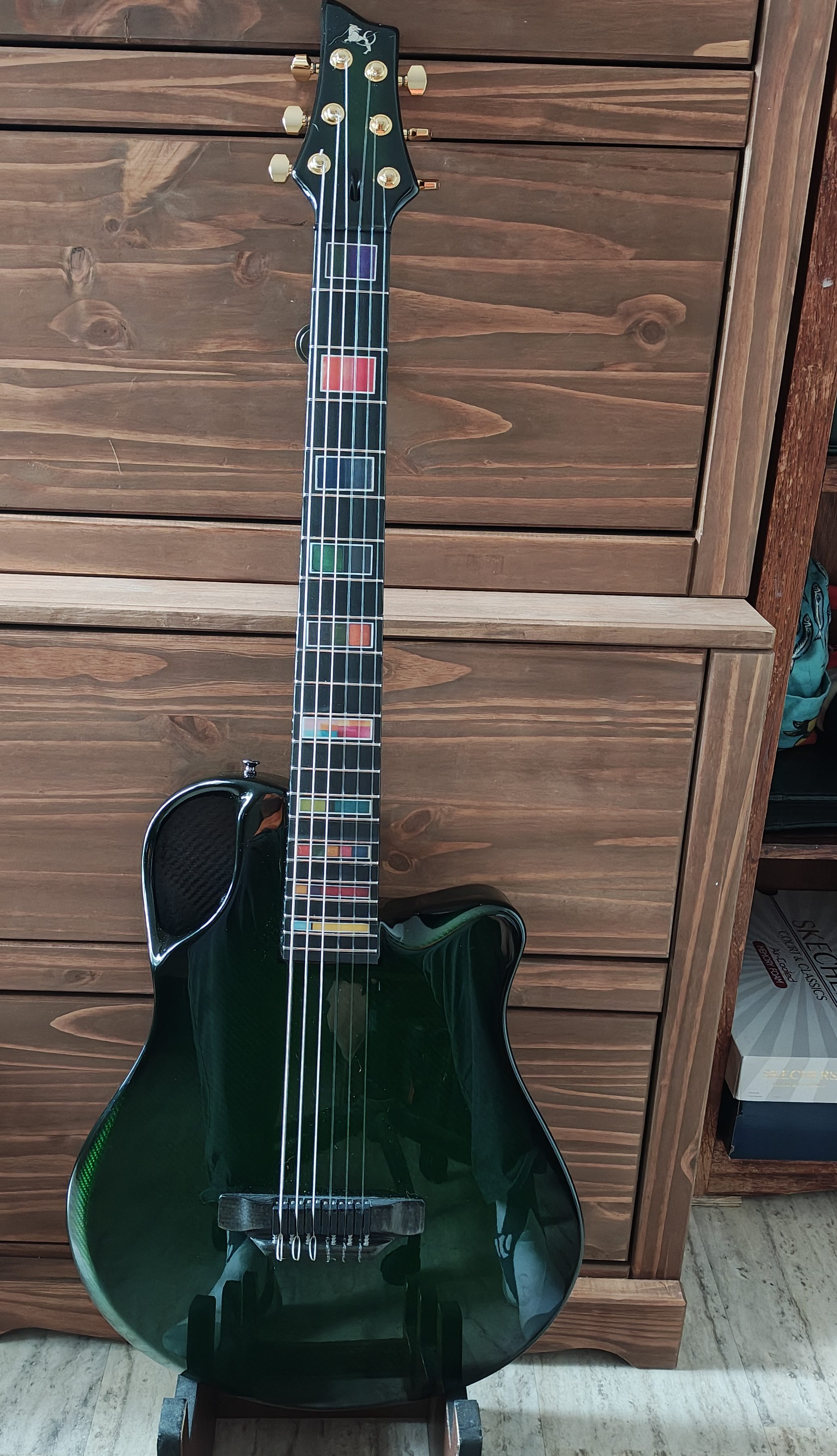
I bought my Emerald Virtuo guitar from the Florida shop. I wanted a wood veneer and thought about ordering a custom build with Candy Striped Padauk. The Virtuo is their electric leaning hybrid model, and there are very few options. The nut width is 1 11/16 inch which is 1/16th away from the 1 ¾ inch of my Breedlove Oregon Concert Thinline guitar, but the extra cost made the smaller nut width acceptable. Most of the other options dealt with inlay options. Since the shop Virtuo had an acceptable color (vibrant amber. I would have preferred regular amber) and a nice veneer (though I still liked the Padauk), I thought, close enough, and I was right.
For those seeking an Emerald guitar, I would say that ordering from the shop is more satisfying. Look for a guitar that is close to what you would have customized, and buy that one. If your desire for custom features is greater than your need for timely gratification, then, by all means, order a custom build.
I recommend watching a dozen or so shipping videos to see what other people choose. There are options not available on the 3D Builder. If you want something you did not know was available, contact the sales team and they will help you order your guitar.
I discovered undocumented options when I bought my Virtuo. I went into chat and asked what locking tuners were compatible. In the chat conversation, they told me that I can order locking tuners with a custom guitar for only $75 more. I recently custom ordered a X7 12 string with locking tuners ($150 more). I have seen custom paint jobs replicating Rosie the Riveter, a six string Amicus (which is sold as a 12 string model) with a custom headstock, and a 12 string X10 Slimline (normally only a 6 string guitar) and veneers with burnt out sections revealing carbon fiber weave underneath (but they painted the weave in a matching color). Emerald is, currently, a custom shop. If you want a guitar made with off book (builder) features, ask sales@emeraldguitars.com. They may build it for you. There is no harm in asking. Some forum members suggest first asking the online chatbot because the sales team seems more responsive to the chatbot follow-up than they are to email inquiries.
The last thing I would base ordering a custom Emerald on is inlay patterns. Stickers are an affordable and viable way to get images and markers on a fretboard.
Fret Markers.
Most steel string guitars come with white dot inlays marking frets 3,5,7,9,12,15, 17 and 19 (21 iff applicable. Most nylon string guitars do not. The assumption is that nylon stringed guitars are played by classical guitarists who know the fretboard by heart and have no need for inlays. There are exceptions. Ibanez TOD10Ns feature a Tim Henson designed Tree Of Death (TOD) inlay pattern. It’s, basically, a Tree Of Life design without leaves.
As a teenager, I admired the Alvarez 5056 “Tree of life” guitar. It was steel stringed and quite expensive. I saw it in the guitar store where I took my Fender Mustang for neck work. I always regretted never buying one. They only got more expensive.
I bought a TOD10N as a “condo guitar,” a guitar that I could play, unplugged, late at night without accumulating HOA fines. It was a good guitar, but its goth overtones made it one I could not see myself playing in front of other people. Just not my aesthetic.
I replaced the Ibanez TOD10N with a Takamine TSP148NC. To compensate for the guitars thinness, Takamine made the lower bout wider. I play guitar in the classical position with the lower bout between my legs and the waist over my left leg. The TSP148NC seemed to be designed for playing in the folk position with the waist over the right leg and lower bout dangling off to the side. Playing the Takamine in the classical position pushed the frets further to the left than I was used to.
The Takamine TSP148NC has ring inlays, but these were too subtle to be of use. While intending to play on the third fret (G minor), I ended up on the fourth fret. I thought better visual cues would help me finger the correct fret.
When I inquired about getting inlays for my Takamine, I found out that very few luthiers will do this type of work on already built guitars and those who do typically charge a thousand dollars, or more. That’s quite an outlay for a $1500 dollar guitar.
Sticking on Stickers.
Guitar inlay stickers are easy to find. Both eBay and Etsy have several offerings at reasonable prices. Creative Cuts, on eBay, had several attractive offerings for $20 apiece. I bought three just in case I messed up the first two attempts. They were different patterns.
I put the first set on my Emerald Virtuo because, I figured, its carbon fiber fretboard would less likely be damaged should I need to remove them. From Creative Cuts Paul Stanley collection, I chose a green and white (think jade and mother of pearl) set of inlays. It took a total of twenty minutes to put them on. The hardest part was placing them in the center of the frets. After letting the glue (sticky part) set for ten minutes, I pulled off the transfer tape and revealed the final inlay sticker. Despite my poor arts and crafts skills, it looked good. Not a great match for the guitar, I would have preferred more of a wooden tone, but it was comparable to Gibson’s factory inlays, just cooler.
I put the second set on my Breedlove Oregon Concert Thinline. Better results, my centering skills improved. This was more of an abalone tone with brown features. I would have preferred something that looked like the guitar’s Myrtlewood body, but still nice.
While preparing the third set, tiki inspired burlwood, I saw a YouTube video featuring Neck Illusions stickers.
Neck Illusions takes a different approach to their stickers. They think of their stickers as fretboard protectors. They cover the entire fretboard and they cut the stickers to fit the entire space between the frets. The stickers are made to be taken off once or twice a year to clean the neck, then re-applied. For those of us with marginal arts and crafts skills, this means a much easier application, no centering needed. The best thing about Neck Illusions is that you can order custom designs for fifty dollars if you supply the art work (given my lack of artistic skills, this wasn’t much of an option), or, for twenty dollars more, they will do art work (Yeah!).
For the Takamine, I asked them to make a blocks design incorporating a figured wood similar to the guitar’s cedar top, but to use a complimentary wood tone to form blocks that looked like Takamine’s blocks on the TSP178, my guitars steel stringed big brother.
After a couple email back and forths with the designer, we came up with a good design and I applied the stickers. It looked great. If I ever decided to lay out the cash for actual inlays, I would take the guitar to luthier and say, “make them look like these stickers.”
I was so pleased with the result, I ordered custom stickers for my Breedlove. This time, I asked for the wood tones to be the blonder wood tones of the guitar’s back and sides with a dark wood, in-set border. Breedlove Premier Series guitars have a diamond inlay pattern, so I asked Neck Illusions to incorporate the diamonds into the blocks. Again, I was pleased.
BTW I should not have worried about removing the Creative Cuts inlay stickers. They came off pretty easy with no damage to the Breedlove’s fretboard at all.
I was thinking about getting stickers for the Virtuo. I found Fretlook, another sticker company that also does custom work. I ordered stickers like the ones for my Breedlove but the wood tone should match the sapwood on the Virtuo’s veneer and no diamonds.
Like Creative Cuts stickers, Fretlook stickers need to be centered. My arts and crafts skills diminished in months between applying the fret marker stickers, but the result still makes me happy. The stickers enhance the woodiness of the carbon fiber guitar.
And that concludes how my love of Tom Bedell era Breedlove guitars lead to appreciating carbon fiber guitars and putting fret marker stickers on them.
My Fret marker Inlay Sticker Reviews.
Creative Cuts.
These are the thinnest stickers at 0.07mm. They have some great designs. The sticker is only as big as the image. I tried bending strings to catch an edge, but I couldn’t. They are that thin. In fact, they are so thin that there is no tactile feeling of their presence while playing. They will, eventually, wear. These are the only stickers I took off, and they came off fairly easily. All I needed was finger nails, rubbing with the fleshy part of my finger and standard fretboard cleaning.
The major downside to Creative Cuts stickers is the lack of custom ordering. They also claim to be “dot busters” without mentioning that they are not “offset dot busters.” They looked bad on my Breedlove because of the guitar’s offset dots.
You’ll need to take some time and care when placing these stickers on your fretboard. I cut out the stickers, roughly you need to leave generous boarders, and dry fit them before placing them on my fretboard. Do not let my results discourage you, if they graded arts and crafts at summer camp, I would have failed. The more meticulous and patient your are, the more successful you will be. Even a klutz like me gets pretty cool results.
In general, if you see Creative Cuts stickers you like and the pattern covers inlays (dots) already on your guitar, these are a great choice.
According to their website, they are located in California.
Fretlook.
Fretlook’s stickers are almost as thin as Creative Cuts. They are 0.08mm. Like creative cuts, their sticker’s are only as large as the image, so the same caveats about non-centered inlays applies.
Like Creative Cuts, you need to be careful with the stickers (copied from above):
You’ll need to take some time and care when placing these stickers on your fretboard. I cut out the stickers, roughly you need to leave generous boarders, and dry fit them before placing them on my fretboard. Do not let my results discourage you, if they graded arts and crafts at summer camp, I would have failed. The more meticulous and patient your are, the more successful you will be. Even a klutz like me gets pretty cool results.
My custom order cost $70. I described what I wanted. Fretlook gave me an approximate time for delivery. Their custom shop was backlogged when I contacted them. They met their delivery and produced acceptable markers/stickers. I would have preferred a wider inset boarder.
Again, if you want a look Creative Cuts doesn’t have, Fretlook customs are a good choice.
Neck Illusions.
Neck Illusions takes a different approach. They market their stickers as neck protectors. The adhesive is engineered to be removed and reapplied to allow for periodic cleanings underneath the stickers. I am still not certain why a covered neck would need cleaning, but it is mentioned on their web site. These are the thickest stickers at 0.011 mm but they do not interfere, at all, with fretting.
Since they cover the entire length and width of each fret, they are the easiest to apply. On occasion, I had needed to trim the stickers with scissors as upper fret stickers were too wide.
Neck Illusions shines the most when ordering custom stickers. They send mock-ups and encourage feedback until customers are satisfied with the stickers.
Singing in the shower again, thought I’d write down the lyrics.
Enjoyin’ my ride, flying down Westlake Avenue. Nowhere to be, thought I’d enjoy the view. Wasn’t looking for anyone, caught a glimpse of you. It’s not like there’s something better to do, flying down Westlake Avenue.
Knew I’d be late for dinner, by the time I got home. Don’t matter now, I’m dinning out on my own. Saw the message you left me taped to the telephone. So I grabbed the keys, I’m going alone flying down Westlake Avenue.
Life can get expensive on Westlake Avenue. Dinner at Jakes can set you back quite a few. But that ain’t nothing compare the mess I got into Enjoying my ride, flying down Westlake Avenue.
This entry is based, substantially, on watching guitar related YouTube videos, so Fact(mostly) as much as YouTube videos can be a source of facts.
Some revealing information about me.
A decade ago, I became fascinated with the History Channel’s Forged In Fire reality TV series. Watching real people turn raw materials into practical blades seemed incongruous in a world where Amazon.com customers put a premium in reducing price often at the cost of quality and authenticity. I also followed car restoration shows like Counting Cars, Bitchin’ Rides, Iron Resurrection and Texas Metal.
I started playing guitar again and hunted YouTube for guitar tutorials that I could actually master. Several luthiery videos popped up in the right hand column. The most interesting of these featured Chris Alvarado of Driftwood Guitars cutting a guitar in half as part of his review.
The right hand column also offers other gear reviews and informational videos. So, I must have viewed dozens if not hundreds of guitar related videos of all sorts. Add to this total, musician and music related documentaries, and there is the knowledge base for this blog entry.
What did Chris say?
Chris Alvarado of Driftwood Guitars is opinionated, sometimes unabashedly, but his opinions seem genuine and well informed from years of luthiery experience. In a review of a new Martin guitar, I thought I heard him say that no-one needs a Fender Acoustasonic. I owned an Acoustasonic, so I was taken aback about the statement. I went on a hunt to find a YouTube video where Chis shares his reasoning for such a statement.
Guitars on YouTube …
… come from tonnes of uploads and hundreds of contributors. I’ll refer to some of these, in the following sections, in perhaps familiar terms, like Chris, though all I know about them is from a few videos. Nonetheless, a cast of characters might be helpful.
Chis Alvarado and Matt Miller of Driftwood Guitars make dozens of luthiery videos and quite a few guitar industry and review videos. They review “Factory Tour” and other promotional videos from several brands like Taylor, Takamine and Breedlove. Most impressively, they buy guitars for review and cut them in half to examine their workmanship. Now that’s thorough.
Rhett Shull contributes on-line guitars lessons (haven’t checked them out) and YouTube product reviews. Chris and Matt gave him one of their Tidalcaster electric guitars and they accept his evaluations. They also reworked his “law suit era” Takamine dreadnought in part as an experiment to see if it was cost effective to buy a cheap used guitar and rework it. Initially, Rhett brought it in for a neck reset.
Paul Davids contributes product reviews, guitar tutorials, interviews and offers on-line guitar lessons (haven’t checked them out).
Mary Spender contributes informative videos, life experience videos, performance videos, product reviews and offers on-line guitar lessons (noticing a trend). She’s quite a good singer and I like her thumb thumping finger style guitar playing. She labels herself a “creative,” and I hope she writes a hit song. Since that is unlikely (her style of music has long passed from public popularity. Okay, so has Ed Sheeran’s, so anything is possible. ), it’s worth checking out her YouTube channel.
Messenger Guitars has only released one luthiery video which has any interesting premise, and it contains a wealth of good information. I don’t remember if the luthier introduced himself.
What Chris actually said.
My hunt for Chris’ review of Fender Acoustasonic guitars proved fruitless. I did find Rhett Shulls’ review of a Fender Acoustasonic Player Telecaster (FAPT) where he starts with, “I hate these guitars,” and concludes with, “Does anyone need this guitar.” Rhett and Chris are friends, or at least well acquainted. It makes sense that Chris would share Rhett’s opinion.
I went to find the video that sparked my concern, and couldn’t. I did find a video where they reviewed Martin’s promotional video of the GPCE Inception (https://www.youtube.com/watch?v=vFIYOxXfgFA&list=UUxCp0SN53j6SIx9z8uWbg-w&index=31). Near the end of the video, Chris says something about how the Martin GPCE should have stayed as a memo. Matt then includes Fender Acoustasonics in this category and Chris states that “no-one asked for an Acoustasonic,” a pointless phrase.
Aside: Common and useful products abound even though they were never explicitly asked for. I’m sure no one asked for a weak glue whose only virtue is that it doesn’t leave much residue, but once discovered, it became Post-its, a very useful product. There are many examples of innovations by accident including penicillin, microwave ovens, Velcro, Teflon, Kevlar, vulcanized rubber, chocolate chip cookies, Slinky, and safety glass. Many useful products result from the application of discovered entities which are not well understood even during product development. They are just a “cool” idea developers hope will pan out.
I think Chris meant to echo Rhett’s sentiment that Fender Acoustasonic guitars are not very useful guitars. While Chris chose the pointless, “no-one asked for,” form, Rhett chose the arrogant, “nobody needs” statement. And they are wrong, and must have known so. They both follow the guitar industry. They should have known that Fender Acoustasonics posted impressive sales and has signature versions for Finneas and Jack White (admittedly, they likely receive financial compensation). Just after making his “nobody asked for” comment, Chris seemed to realized that he overstated his opinion. He reaffirmed that he stating an opinion, but did not apologize for the statement. Somehow, discussing the statement lead to Matt saying, “You can’t kill me because I’m already dead inside.” That seems like an odd acknowledgment of expected backlash to an outlandish opinion.
I’m FAAT. I’m FAST! I’m FAPJM?
Before discussing why I think Matt, Chris and Rhett are wrong, it would be nice for readers unfamiliar with the guitar industry to know what a Fender Acoustasonic (FA)is.
It is an acoustic guitar, mostly, that depends on electronics to achieve its potential. Fender achieves this by routing out a hunk of mahogany to form the guitar body’s back and sides as well as pockets for electronics. They fit and glue in a braced Sitka spruce top (soundboard) with a sound hole in the traditional place, under the strings and between the bridge and end of the fretboard. There is an odd cylindrical piece of wood on the back of the soundboard down about an inch or so, but there is gap between the cylinder’s bottom and guitars back. The cylinder, bracing and chambered body form what Fender call the Stringed Instrument Resonance System (SIRS) which, to a large extent (not a great or complete extent) works.
Unplugged, my FAAT produces a distinct resonant sound with good sustain. Almost all reviews I have seen criticize its unplugged sound. The other reviews say it’s good enough for practice, or it’s a good couch guitar. I bought the guitar for its unplugged performance, but more about that later.
FAs come in three body styles based on their popular electric guitars: Telecaster (T), Stratocaster (S) and Jazz Master (JM). They also come in three trim levels based both on features and place of manufacture: The American(A) is made in Corona Californian and has 10 tone models; the Player(P) is made in Ensenada Mexico and has 6 tone models; and the Standard(S) is made in Indonesia and only has 2 tone models. Fender suggests that the naming order is always Fender Acoustasonic (FA, like its own brand name), Level (A,P,S), Body style (T,S,JM). I own a Fender Acoustasonic American Telecaster or FAAT which I bought used at a local Guitar Center for under $1000. Rhett Shull reviews a FAPT, Mary Spender reviewed both a FAAT and FAAS, Paul Davids has reviewed several models, but I will be writing, mostly, about his FAAJM review. Several giging musicians reviewed the FAST.
There is more to say about the differences. Only the American level has the body sensor pickup. All levels have an under-saddle piezo pickup. The Tele/Stratocaster have a “noiseless” single coil pickup, while the Jazz Master has a dual coil humbucker style pickup. The Standard version uses nyatoh for the chambered body instead of mahogany.
A Fishman “Acoustic Engine” takes input from the pickups and models them to different guitar models, both acoustic models like a Spruce/Rosewood dreadnought, and electric guitar like a Telecaster. The tone models come in pairs. Musicians select tone pairs using a blade switch. Within a tone model pair, a blend knob allows, well, blending between the two tone models. Since the Standard level only has two tone models, there is no blade switch.
So, what, exactly, is it?
Even with all the details above, that is a very good question. And there are several approaches to the answer.
An Alamo Guitars video comparing a FAAJM to a Taylor T5z (https://www.youtube.com/watch?v=nP8rjODOY3s) provides a useful first step. They characterize both guitars as hybrids which can produce both acoustic and electric guitar tones. Their comparison summarizes to something like
FAAJM
Taylor T5Z
Looks
Like an Electric
Like an Acoustic
Sounds
Mostly like an Acoustic
Mostly like an Electric
Strings
Acoustic
Electric
Intended for
Electric Players looking to add acoustic sounds to their performance
Acoustic players looking to add electric sounds to their performance.
To restate their observations: Fender, known mostly for their electric guitars, developed a hybrid guitar focusing on acoustic sounds but looking and feeling like an electric guitar and targeted to electric players; Taylor, known for their acoustic guitars, developed a hybrid guitar focusing on electric sounds which looks like a flattened archtop acoustic guitar and feels like a hybrid.
From the video’s I’ve seen, The T5Z’s electric tones are more desirable than the FA’s, and some reviewers prefer it’s acoustic tones to the FA’s.
I think Alamo might have got it wrong. The FA may seem like a hybrid, but it operates on a different philosophy, or at least it tries to.
What’s that sound, tell me what’s a happening.
Sorry for mixing up the lyrics, but copyright law is somewhat vague, so directly using song lyrics for section heads might get me in trouble.
To better understand hybrid guitars, a basic knowledge of guitars might benefit readers who are not guitarists. In particular, it is important to know where the sound comes from for both acoustic and electric guitars.
On both styles of guitar, string vibration generates the guitar’s tonal output. On acoustic guitars, tapping, knocking, slapping and otherwise hitting guitars produce percussive sounds. There is a style of playing known as “percussive guitar” and Mike Dawes describes his style of percussive guitar pretty well but this is a subject for another blog entry. This entry is concerned with tonal output.
Acoustic guitars are the more interesting of the two. It produces tonal sounds several ways. The primary source of sound is the top of the guitar also known as the soundboard. Strings vibrate against the saddle which rests in a slot on the bridge which is glued onto the soundboard. To be clear, string tension holds the saddle in it’s place not just firmly, but forms a solid connection (not much energy loss there). There is, of course, more to it than that.
While playing my steel string acoustic guitar, I can feel vibrations where the upper bout presses against my chest; the neck feels lively. In fact, the whole guitar feels alive. It isn’t, but many pars of an acoustic guitar contribute to its sound. String vibrations transmit to the nut and cause the neck to vibrate. Well constructed guitars transmit these vibrations through the neck joint to the guitar’s body. The soundboard doesn’t just project sound waves out, but it also produces sound waves inside the body. Lastly, the sound board is braced to handle over 220 pounds of string tension (light acoustic steel strings generate 160 pounds; heavy 220 pounds. Nylon string guitars produce 60 – 100 pounds of tension.) The braces transfer vibrational energy to sides; the sides transfer energy to the back which produces sound waves as well.
All of the activity inside the body creates resonance which gives acoustic guitars their rich and complex tone. Although sound waves are echoing and interacting inside a guitar’s body, the guitar top’s and back’s role are more like large trampolines with lots of people jumping on it as opposed a sonic mirror reflecting sound waves.
For electric guitars, strings vibrate in the pickup’s magnetic fields creating induction waves in the pickups’ coils and the electricity goes to the electronics, usually a pre-amp, effects pedals, amplifier and, finally, speakers.
Acoustic electric guitars typically have an under saddle piezo pickup which reacts to pressure in much the same way as old record player needles translate bumps in records grooves to produce sound. Basically, it captures string vibration and some resonance. More advanced acoustic/electric guitars add pickups. The most common is a body sensor usually attached to the soundboard. My favorite is the L.R. Baggs HiFi Duet which combines under bridge transducers to pick up string and soundboard vibrations and a small microphone which captures internal resonance.
Most acoustic/electric guitars have built in pre-amps which allow musicians to shape a desirable tone from their guitars. More input sources allow them to find good combinations.
FAA level guitars have an under-saddle piezo pickup, a body sensor and a magnetic pickup. The Player and Standard levels do not have the body sensor.
String me up.
Since FAs come with acoustic strings, specifically Fender coated phosphor bronze, it’s a bit of a wonder that the magnetic pickup works at all.
The thinner guitar strings (high E and B) are made of high carbon steel. The G string on electric guitars are high carbon steel as well, but acoustic G strings are made with a steel core and wound with another type of wire, typically bronze. The thicker D, A and E strings are also wound: Acoustics primarily with bronze, electrics nickel.
The choice of material (bronze or nickel) is to solve different problems. Acoustic guitars need more vibrational energy transfer, which bronze based strings provide. They tend to be higher tensioned. Bronze in non ferrous and does not interact with magnets well. On the guitar, they are harder to bend. Nickel strings react better with magnetic pickups giving them better performance on electric guitars.
Cole Clark, an Australian guitar company, came up with a solution to this problem for their hybrid guitar. De-power the pickups on the E and B strings. At normal power, unwound strings dominate the sound. To balance the sound across all strings, they toned down the unwound string magnets. I guess Fender did something similar. The pickups still get some, though far from optimal, reaction to the ferrous string cores.
You mock me.
In a promotional video, a Taylor Guitars representative states that the Taylor T5z is not a modeling guitar, but its tone controls, which allow guitarists to either boost or cut trebles and basses, give the guitar an ability to mimic other guitars. He demonstrated this by putting the guitar into acoustic mode and boosted both the treble and bass and mentioned that dreadnoughts tend to have a scooped mid sound he displayed a graph that looked like a “U.” He played a bit to demonstrate the dreadnought sound before cutting both the treble and bass, showed a frown looking graph and explained that parlor shaped guitars have pronounced mid-range and a very articulate sound. That is how a Taylor T5z can mimic typical acoustic guitars. It is even better mimicking electric guitars like the Telecaster (position 3 – bridge pickup, boost treble 75 to 100 percent), Stratocaster (position 4, same boost options as Telecaster) or Les Paul.
Fender claims that the FA uses Fishman designed “Acoustic Engine” to produce 10 tone models. A five position blade switch lets musicians choose between paired tone models (FAAT choices):
4 – Alternate Acoustics – Englemann Spruce/Rosewood Small Body & Sitka Spruce/Mahogany Dreadnought.
3 – Percussion and Enhanced Harmonics – Sitka Spruce and Brazilian Rosewood Dreadnought & the same thing but with added body sensor input to allow percussive body sounds.
2 – Acoustic/Electric Blend – Sitka Spruce/ Mahogany Dreadnought & the same but with a semi-clean electric bridge pickup.
1 – Electric – Fender Clean Electric & Fender Fat, not-so-clean, electric sound.
Since FAs target specific models of guitars (Engelmann Spruce/Rosewood parlor), many count FAs as modeling guitars.
This Year’s Model.
In a documentary, Rick Wakeman described playing a Mellotron, a keyboard that drags an eight second magnetic tape samples of instruments across a magnetic tape head (reader) when a corresponding key (think piano key) is pressed. When the key is released, a spring brings the tape back to it’s starting position. Rick Wakeman stated that when he held the key too long, he had to wait for the tape to reset.
Initially, they recorded orchestral strings (violins, cello’s and the like). Tape, being tape, can record anything. Keyboardists could model any instrument, practically any sonic combination. Mellotron sold two units to the BBS Radiophonic Workshop for sound effects.
In the late 1980’s, an apartment mate had a Korg synthesizer. Each key had 16 levels of sensitivity (it might have been 32, but I think it was 16). Each level of each key sampled a different sound. Most often, the levels of sensitivity utilized samples of the same instrument just played a little harder. Like the Mellotron, sound libraries were not limited to musical instruments. My apartmentmate enjoyed waking me up with screaming roosters. When I inquired, he invited me to his room and played his newly composed “Barnyard Sonata.”
Solid state electronics continued to shrink circuitry. Though Casio keyboards used tone control to approximate other instruments like flutes and guitars in the 1980’s, they switched to PCM which utilized digital sampling. In 2002, Line 6 (known for guitar pedals featuring solid state amp modeling and effects) released their first Variax guitars. By turning a knob, musicians can choose to emulate several different guitar models from electrics like Telecasters and Les Pauls to acoustics like Martin D28s and Gibson J200s. They could even choose banjo and sitar.
The Variax uses individual piezo pickups on each string known as a hexaphonic pickup to feed information to onboard modeling electronics. Later models also had standard pickups, but the modeling was based on the piezo pickups.
Line 6, owned by Yamaha since 2014, canceled the Variax guitar in 2023. A year before Rhett Shull’s review of a FAPT. I could not find a Rhett Shull review of a Variax, though he does have an upload (unwatched) about a Line 6 Helix pedal.
The Thick and Thin of it.
In the mid 1990’s, Object oriented programming was taking root and many companies were developing core business applications for use over the internet. Telephone modems had seen a dramatic rise in speed from 9.6k baud to 28.8k in just a few years. Many business leased fractional T1 lines to speed things up, and with the added speed, computer applications were no longer completely text bound. Visual objects like buttons, sliders and icons were new and cool. Although a company’s data remained on servers, the application, in particular the presentation layer with which end users actually interacted, could reside on the server as well. Transmitting graphics (buttons and icons and the like) slowed down presentation.
Computer systems designers debated whether their applications should be thick-client (the code for the user interface resides on and runs on the end users PC) or thin-client (the code resides on the company’s server and mostly runs on the server as well). Thick-clients ran much quicker. Only the data needed to travel back and forth. Thin-clients could be easily updated and upgraded (almost on the fly) without work interruptions. They required much less user support. With thick-clients, not all workstations would update or upgrade at the same time. Many workstations ran old/incompatible versions of the program causing support staff nightmares until each individual users’ PC based thick-client software updates.
If all of a company’s workstations are on an Ethernet connection, thin-client applications were an easy choice. Companies relying on phone based telecommunications, leaned toward thick-client based applications.
Thick-client systems are, now, nearly extinct. Broadband telecommunications like DSL, Cable and 5G gradually became ubiquitous.
In computer terms, the Line 6 Variax is a thick-client modeling guitar. FAs also adopt a thick-client approach. I do not think Yamaha canceled the Line 6 Variax because it is an old tech approach. Most electric guitars are based on 1950’s technology. The ¼ inch jack is ubiquitous still today. Almost every electric guitar on the market today has a ¼ jack as their only connection. A ¼ inch cable does not carry enough information for true modeling.
Thinking of the Taylor T5z again. It takes a thin-client approach to approximating tones of guitar models. Musicians need to select the best pickup configuration and then set the tone equalization knobs. For example: A quick Google search returns that the best settings for a T5z to emulate a Fender Telecaster is switch position three boosting treble EQ around 75 percent and cut the bass a little. The same EQ settings but switch position four should emulate a Fender Stratocaster. Google searches return T5z setting suggestions for several makes and models of guitars.
However interesting, the point is that FAs take a thick-client approach to emulating different types of guitar tones. Other hybrid guitars accomplish the similar, some say better, results, but through a thin-client approach
CADGAD.
FAs do not have adaptive modeling. Very few modeling instruments do. I followed another YouTube experiment by changing the Fender coated phosphor bronze strings with D’Addario coated phosphor bronze strings. The D’Addario strings felt livelier and easier to play. I liked them; the FA acoustic engine, not so much. Plugged in, they did not produce tonal qualities as well as Fender strings.
In a YouTube review of the Variax, a musician was thoroughly unimpressed with the guitar modeling. Another control on the upper bout did impress him. It allowed 11 alternate tunings on-the-fly including Open D, Blues Open G, Drop D, One Down and DADGAD.
You’ve seen the concert videos where a guitarist slings off his guitar and holds it out. A roadie (sometimes called “the guitar tech”) delivers another guitar, and the guitarist gets back to performing. Guitarists can change their guitars for many reasons, but changing to alternate tuning is a key one.
Joni Mitchel had a preference for Open D tuning. Brian Jones of the Rolling Stones taught Kieth Richards Open E and Open G tunings (source: the film Brian Jones and the Rolling Stones). Many Rolling Stones songs are played in Open G.
In a YouTube interview with Paul Davids, Mike Dawes stated his preference for DADGAD tuning (standard tuning is EADGBE) He likes DADGAD because it is already a chord and new chords are easier to play. He demonstrated how he came up with version of Gotye’s Someone I Used to Know. He started in DADGAD and worked out some of the percussives, bass and rhythm. He plays most of the melody with right hand fretboard fingering (the bass and rhythm are produced by hammering his left hand fingering onto the fretboard). He needed a C note and the easiest way to achieve it was to detune the lower E string another full note, now CADGAD, and using the twelfth fret harmonic.
I wonder how the Variax would handle CADGAD. Unlike a FA, the Vairax knows where on the fretboard a guitarist is. The hexaphonic pickup can tell what string is being played and an algorithm can determine the fret from the note played. Since Mike Dawes gets his C note from the harmonic, no actual fret is played. The DADGAD modeling may simply translate the D note (E string tuned down one step) to a C, or it may figure out that it was the twelfth fret and force the note to D.
The main thing here is that FAs are not true modeling guitars, or they are, at best, modeling lite. They do not care what string guitarists are playing. The Fender/Fishman acoustic engine is most likely a DSP (Digital Signal Processor) similar to a solid state multi effects pedal. In this case the pedal would have several selectable voice pairs and a voice blend capability. Each voice has preset equalization (think of the Taylor T5z’s bass and treble controls) and some preset effects like reverb, chorus and sustain to emulate resonance characteristics of different types of guitars.
A better description of FA might read something like: A slimline, SIRS chambered, acoustic, DSP with selectable tone model pairs and the ability to blend between selected tone models.
Musicians
For the next point, it will be useful to make some arbitrary distinctions about types of musicians. Remember that Rhett Shull and Chris Alvarado seemed to express that no-one needs a FA. Most people don’t play or own a guitar, so I’m pretty sure, all the ones who would be interested in a FA would be a musician.
There is an old philosophy joke that goes, “There are two types of people: Those who categorize others into two types of people, and those who don’t.”
Okay, for the purpose of showing why Rhett and Chris are wrong, here are the categories.
Home Musician – The vast majority of guitarists only play at home, They may get together with other musicians and play at one of their homes (think garage).
Local Musician – Will travel an hour or two by car to play in a public venue. Think of a home musician, with or without his garage friends, going to a local bar for an open mic night or to their church, perhaps a high school auditorium. The main distinction is that these musicians can easily transport gear in private transportation. I noticed a bass player every Friday night on the bus. He’s still a local musician, so the private transportation is not a true requirement. It just shouldn’t be a tour bus. A band-mate’s van is a bit of a gray area, but if a musician or a band buys a van or large vehicle, they upgrade to “Touring” status.
Giging Musician – Like a local musician but travels more. Giging musicians can not rely on private transportation to get to their performances. Really good gigging musicians travel from gig to gig before coming home.
Touring Musician – travel from concert to concert for extended times. Although many giging musicians tour extensively, they only count as “touring” if roadies take care of their instruments from performance to performance.
Studio Musician – records music at a recording studio. Most studio musicians live where their work is, so, like local musicians, they can load up their personal vehicle with gear they need. Even when a studio musician needs to travel to a recording studio, they, most likely, do not need to bring their guitar. Most recording studios keep a selection of guitars.
Traveling with your guitar …
… is harder than you may think. Jeff McErlain, a giging musician, offers some good advice (https://www.youtube.com/watch?v=EUHzhndH_r4). His first rule is no acoustic guitars. Acoustic guitars are, in general, more prone to critical damage. The second rule is no Gibsons. Gibson guitar necks are also susceptible to critical damage. A few luthiers on YouTube remark that repairing Gibson necks provides pretty steady income.
Other advice is that a well padded or styrofoamed gig bag is preferable to a hard case. Chris Alvarado and Matt Miller admit in a video that their prejudice against gig bags (actually it was expressed more as pro hard case) was ill founded. Initially, they shipped their Tidalcaster electric guitars in hard cases and many of them were damaged in transit. Mono gig bags performed much better, Mono manufactures some of the best gig bags, and they are some of the priciest ones. Many musicians swear by them. A well made gig bag is not only easier to carry, but is likely safer for your guitar.
Many gig bags fit in the overhead storage area if you get there first. That’s a risk. A gigging musician might end up missing the flight, and a paying gig.
Musicians can buy another ticket for their guitar and put it in the seat next to them. It’s more expensive. Unfortunately, flight crews can forbid carrying your instrument on the plane even if it has it’s own assigned seat. Jeff considers this a smaller, but significant risk.
The only sure way to fly with your guitar is to put it in an ATA approved instrument case. These tend to be heavier, bulkier and less pleasant to carry than hard cases.
Many electric guitars have bolt on necks which are easily removed and put back on. Some musicians put inserts into the necks which allows them to use machine screws, as opposed to the wood screws manufacturers used. They quickly disassemble and re-assemble their guitars. They may need to shim the neck or adjust the truss bar, but this is a reliable hack. With the neck detached, a guitar can easily fit into a standard suitcase or bag and fit into the overhead storage. A sturdier suitcase can be used for checked-in luggage.
Journey Instruments (journeyinstruments.com) makes several guitar models with easily detachable necks. They come with cases designed to fit in airline overhead compartments. They also sell their cases separately. Although their carbon guitars are more expensive, carbon guitars are less susceptible to rapid climate changes.
FAs have bolt-on-detachable necks. They are very sturdy and feel solid. Paul Davids remarked that they can take a beating. I think Jeff McErlain might make FAs an exception to the no-acoustics rule for FAs.
It’s in the engineering
Apparently, it is hard to mic an acoustic guitar correctly. Microphones often need tone equalization, and the overall sonic presentation benefits from a little reverb effect or some chorus. Amp and pedal makers often refer to these added effects as “acoustic reverb” and “acoustic chorus.” I think they either don’t want to scare away acoustic players looking only to enhance their guitar’s tone a little, or they don’t returns from electric guitar players who won’t get the hard rock sounds they seek with effects designed for acoustic guitars.
Acoustic guitars are naturally resonant. Electric guitars, much less so. Some musicians acquire specific amplifiers and pedals to help their guitar achieve a specific sound.
Some local musicians often load up their vehicles their equipment, arrive early, set up a bunch of equipment, make adjustments for the space and then perform. Some venues, however, have their own PA system, so unlike an outdoor birthday party at some kids home, much less equipment is necessary.
Giging musicians may take along a few pedals arranged on a pedal board, but some gigs don’t allow much set-up time. They often rely on a venue’s PA system and in-house sound engineer.
Touring musicians have roadies to setup all the equipment. At least one of these roadies is a sound engineer who knows how to mic the guitars and configure all the amps, pedals, soundboard and other equipment.
Sound engineers understand how microphone and amplification systems work. They know how to produce tones and sounds out of various equipment. In recording studios, producers rely on their expertise to get the “right sound” for each track. For live events, they can tune all the equipment to match the venue.
As a teenager, I attended my first concert. Many groups formed that day. I remember Foghat and was impressed by The J. Geils Band (bought a few of their albums the next night). Most of the day, however, reinforced why I waited so long to go to a rock concert. It was a large arena event and the PA system blared, very harsh tones.
Peter Frampton headlined. The day already turned dark, but I doubt that the night air made the PA system sound better. Foghat’s encore sounded just as harsh as previous bacnds well after sundown. I thought that the sound system was tuned for Frampton and everyone previous turned up their amps too high, but it makes more sense that the headliner had better sound engineers. The long gap in time before Frampton came on stage wasn’t due to his arrogance or taking a few more totes of his favorite intoxicant. His sound engineers needed the time to set everything up just right. Where the other performer’s amplifies yelled their music at us, Frampton’s sound sang.
The reviews are in.
Rhett Shull starts out his review with “I hate these guitars.” He’s in a guitar shop and buys a used FAPT. He plays it and makes it sound pretty good. Admittedly, the FAPT’s electric tones suffer. Rhett A/B demo shows an FA’s electric tones don’t even come close to a real Telecaster. He does not bother to mention that the FA has acoustic strings and has to try to accommodate for that.
Other YouTubers string their FAs with nice electric guitar strings and demonstrate that it improves the electric performance, but not nearly enough. The N4 pickup was designed ( probably by weakening B and high E string pickups) for working with acoustic strings. They go on to show how FA’s acoustic performance diminishes with electric strings.
These YouTube reviews do not explain why, but it is pretty easy. In the Messenger Guitars video, the luthier explains that acoustic guitars need to find a good balance between using high string tension to produce sound and support of the bridge to structurally handle the tension. Light tension strings produce about 160 pounds of tension, heavy strings 220 pounds or more. To increase sound production, luthiers sand down soundboards and shave away some of the bracing. They risk making the guitar too weak to handle string tension.
Luthiers struggle with this balance point. Thinner materials produce bigger sound unless they require more bracing which deadens that sound. Major guitar manufacturers, like Fender, don’t struggle. According to Chris Alvarado, they overbuild their guitars at the expense of sound because warranty returns eventually eat too much profit.
Paul Davids also demonstrated the poor electric performance of a FAAJM. He made the guitar sound mostly great by adding loops of all the different tone models to the loop and showing how they, mostly, work well together. Even the electric tone modes fit into the mix except the distorted electric part.
Paul went on the A/B demo the Spruce/Rosewood tone model against a real Spruce/Rosewood guitar, and the FAAJM paled. Paul did say that it would be an unfair comparison as the real S/R guitar costs over $4k implying that a $2k S/R guitar would pale as well. He then A/B another of the acoustic tone model against a comparably priced real guitar and the FA fared much better.
For the electric tone models, Paul demonstrated that the distorted tone model suffers even more with distortion pedals. He did not show how the clean electric tone model benefits from distortion effects. It does. I’ve done it.
Paul Davids is a musician who probably did not follow the 1990’s client/server debates, so I doubt that he was thinking in terms of thick vs. thin client applications. FAs are thick client DSP modeling (modeling lite to be honest) acoustic guitars. It figures that their worst application would be a heavy metal lead guitar gig.
I’ve seen two of his FA reviews: the FAAJM and an FAAS unboxing and preliminary review. He concludes each of them by saying that he would not but the guitar. He points the multitudinous guitars hanging on his wall and states that if he wants different tones in a mix, he pulls them off his wall. To his credit, Paul does not say anything dumb in these reviews. Since he is not a luthier, he probably doesn’t put much thought into the challenge of making an acoustic modeling guitar. I am a bit surprised that he did not compare the FA to alternate hybrid guitars like the Taylor T5z.
Mary Spender considers herself a “creative.” Like Rhett and Paul, she offers online music lessons. She is also a gigging musician and she recently completed a documentary on Dire Straights. Her YouTube channel features musical performances, product reviews and personal observations. I like her performances. Mary’s review of the Lava ME has surpassed five million reviews. She liked the Lava ME and still plays it.
Mary also looped her FAs (so far, I’ve seen her reviews of a FAAT and FAAS). At the end, she crinkled her nose and declared, “Not for me.” In another upload, Paul Davids challenges Mary to perform with a busker (https://www.youtube.com/watch?v=6kFqlrnsjak). She met one in Barcelona and sang Isn’t She Lovely. Not only did she generate some tips, she gave the struggling busker what looks like a FAST (possibly a FAPT).
Two things of note:
I.) It seems that many YouTube guitar critics seem to know each other.
2.) Fender gives equipment to these YouTubers in hopes that they will upload positive reviews.
Obviously Paul Davids and Mary Spender did not give very positive reviews. Paul’s review was balanced and only slightly negative. Mary’s review was non-committal before it became dismissive. I’m not sure why Rhett Shull did not review a free FA. Chris Alvarado, whose reviews include cutting the guitar in half to reveal any workmanship issues, opts for integrity. He never accepts manufacturer supplied equipment. Chris uses money from his Patreon subscriptions to buy guitars, usually from Sweetwater (a good choice). Perhaps Rhett also opts to maintain his integrity.
The guys at Casino Guitars provided an interesting perspective. In the five-years-later review, they admitted their initial distaste for the FA might have been unfair. By this time, FAS guitars were available, and FAs had become a useful tool for gigging guitarists. They then introduced a gigging guitarists (Zooming in from Memphis, but I’m not sure where he was). The guest played a FAST and explained that he liked it for gigs because he can plug into just about any PA system and sound good. Although the FAST allows a blend between acoustic and electric tone models, he said he doesn’t even bother with the electric tones.
Other gigging guitarists on YouTube relay similar sentiments. They prefer the FAST for it’s lower price point. They praise the guitars plug and play ability, and they stay in the acoustic tone model.
After Rhett posted his upload on the FAPT, several gigging guitarists left comments that they like and use their FAs. FAS guitars were not available at that time.
I looked for the Casino Guitars negative reviews of FAs, but could not find them, so I do not know know the basis of their apologetic tone. I did find one where they A/B tested a FAAT against a Taylor 814. The 814 sounded much better. Paul Davids would call this an unfair comparison as the Taylor 814 costs nearly twice as much. A Taylor 414 would be a better comparison and would, probably, also sound much better than the FA.
One of the more interesting comments the guys at Casino Guitars made was that they should have realized that FAs should not be directly compared to other guitars, like the Taylor 814, they are a thing on their own. They still hate these things, but they tell us they still have a good relationship with Fender. Even though they do not carry any FAs in their current stock, they’d be happy if FA seekers ordered one through them (A dumb thing to say).
The reason that’s a dumb thing to say is that FAs are usually in stock at your local Guitar Center. My local Guitar Center has over 20 FAs for sale including new and used ones. I bought a used FAAT there. If, for some reason, someone doesn’t live near a Guitar Center, Sweetwater is usually the smarter website to order a guitar.
Despite their proclaimed dislike for FAs, Casino Guitars’ video tells us that every time they get some for sale, they sell out quickly. In 2019, their first shipments sold out before they could even get a model into the sales room.
The pace of sales has slowed considerably. There are lots of FAs on sale on Ebay and Guitar Center has several used FAs on sale at very affordable prices (used FASs are not discounted much, but used FAPs and FAAs can be found at good prices).
Casino Guitars’ conflict over FAs and their notion that FAs should be looked at in their own way leads me to ask again …
What are these things?
Fender promotes FAs as a ground breaking acoustic electric hybrid featuring the Stringed Instruments Resonance System (SIRS) and an acoustic engine that uses classic analog and “future” technologies (quotes added). They also tout it’s comfort (arm and rib-cage bevels), the electric Telecaster style neck and the three pickups noting that “The Acoustasonic Noiseless pickup is designed for hum-free Fender electric tone and can be played solo…” A typical webpage is: https://www.fender.com/articles/instruments/5-key-features-of-the-fender-acoustasonic-telecaster-you-need-to-know
On the web page they are careful to avoid the word “model” opting for the more accurate “digital signal processing.” On other pages where they describe the effects of each blade position setting, they use, “tone models,” but fall short of outright declaring the FAs to be modeling guitars. Google search results for modeling guitars does bring up FAAs and FAPs, and there are several sources.
Before discussing whether FAs live up to their hype, I feel compelled to tell my FAAT story.
A Condo guitar.
I started playing guitar again after twenty-plus years of not playing. I am that old. I prefer nylon string acoustic guitars. I replaced my old Alvarez guitar with a Cordoba C9 crossover (long boring story) with the intent of playing both nylon and steel string guitars. I planned on buying an Ovation because a college friend had one (in the late ‘70’s) and I liked playing it.
As with most plans, life got in the way. Contemplating old age, yard work became an issue. We moved to a condo. In our own house, I could play, fully, at 3:00 in the morning in the back room with the doors closed and not wake up my wife. Cool. I doubt my condo neighbors would appreciate my Oh Dark Hundreds creative explorations. As soon as escrow closed on our old house, I bought my first condo guitar, an Ibanez TOD10N. I then started looking for a condo safe steel string guitar.
The TOD10N played loud enough unplugged to satisfy me. It shines plugged in. I bought a small 10 W practice amp which filled the back bedroom/study just fine. I still use the Positive Grid Spark Mini, but I also have a Fender Champion II 50W.
Ovation makes their guitars in several depths. Their mid depth bowl is their most popular, though the deeper bowls sound better unplugged. Ovation also makes a SSB (super shallow bowl) which would have been a candidate for a condo guitar.
My local Guitar Center did not have any SSB Ovations, but they had a used FAAT for under $1000. I had hoped for a FAAS, but they were at full price. I played the FAAT and the SIRS sounded passable. People playing other acoustic guitars drowned it out, normally a bad sign but great for a condo guitar. The lithium-ion battery was drained, so all attempts at playing it electronically failed. Guitar Center has pretty good warranty and return policies, so I figured I could come back should anything be seriously wrong.
One video from a guitar sales site (I forget which, but it may have been Sweetwater) stated that a FA would make a good campfire guitar. I doubt that. A good campfire guitar drowns out enough of the bad singing to make singing songs around the campfire enjoyable for everyone there. Other videos (note multiple) characterize FAs as good couch guitars, guitars that give enough sound for practicing, working our riffs and songwriting without waking up the kids sleeping in their bedrooms.
FAs ultra slim-line design and low, but sufficient, unplugged output make them good couch guitars and excellent condo guitars.
The four guitar problem.
Our condo has over fifty percent more area than out house did. Had we stayed in the house I would own two guitars (1 nylon string acoustic, 1 steel string acoustic) stored in hard cases in the living room and played in the bedroom behind closed doors. I have space in the condo for a small guitar rack. The rack could hold three full bodied (five inch depth) acoustic guitars or two acoustics and two electrics.
FAs fit into an electric slot, so did the Ibanez TOD10N though I replaced the TOD10N with a Takemine TSP148NC (long boring story). The Takemine, at a depth of two and a half inches easily fits into an electric guitar slot. The Cordoba C9 crossover is four inches.
This winter, Breedlove sold their Oregon and Premier series guitars at fire sale prices. I chose the Oregon Concert Thinline, in great part, for it’s mere 3.62 inch depth. I regret this choice, somewhat, a full concert shaped body is only three quarters deeper. I think I could even fit a concerto shaped both at five inches deep.
Researching guitars for this blog entry lead me to look at carbon fiber guitars. I wanted to write about innovations in guitar building. Although Rainsong were well revered, they ceased production in 2023. The McPherson Sable is an all carbon fiber guitar made by a well respected boutique guitar manufacturer.
I saw a YouTube video that tried to answer whether carbon guitars could sound as good as wooden guitars. The video featured a McPherson Sable (roughly $4000), a McPherson wooden guitar (roughly $10-12,000) and an Emerald X30 (roughly $3-5,000). I was surprised that the Sable fared so poorly to the wooden guitar, but the X30 not only held it’s own, it often sounded better than the McPherson wooden guitar.
I decided to get an Emerald guitar and see for myself. It would have to replace one of my existing guitars, but which one. The logical choice would be the Breedlove that I bought just a month before. Although I may regret the Breedlove I bought, I really like the guitar. Once I put D’Daddario silk and steel strings on it, it played well. It is made of Myrtlewood and I like the idea of a guitar made, primarily, of locally sourced and sustainable woods.
The Takemine TSP148NC was, and still is, my least favorite guitar. The replacement would have been an Emerald X10 Slimline Nylon, but that model was discontinued a couple of months before. There was still a couple in stock, but they used post tuners. Since nylon strings stretch way more than steel strings, it seems more likely than possible that the strings would come off the posts or, at best, double wrap (slippage problems included). By the time I discovered that locking tuners could be a solution to the nylon-strings-on-post-tuners problem, all X10 Slimline nylon guitars were sold.
Two options remained: Replace my favorite guitar (Cordoba C9 cross) or replace my FAAT.
When I looked at the FAAT, I saw the only steel string guitar that I really needed. Among it’s many good qualities, the neck’s comfortable feel stands out. The Breedlove and my nylon string guitars, however, had me desiring a wider nut. I had already researched a custom 1.75 inch nut neck from Warmoth. I had planned on having a luthier install inserts on both necks so I could easily switch between the necks, or just make it more of a travel guitar.
Emerald had an X30 nylon on sale. I think it was returned. The X30 nylon, like the X10 Slimline nylon, had been discontinued. When they re-added it to their shop inventory, they may not have been able to add it as a nylon guitar. Had I found it under nylon guitars, I would have risked spending thousands on a guitar that may not have performed as well as my Cordoba.
Spared that decision, I opted for an Emerald Virtuo which would replace my FAAT. I was concerned. Virtuos are made from the same body as the X10 slimline. The main difference being that the Virtuo, like the Taylor T5z, is intended to be an electric guitar, and they, both, ship with electric guitar strings. I was afraid that the Virtuo may be too loud, unplugged, to be a condo guitar.
The guitar rack, mentioned above, replaced a three level guitar stand which my house cleaners completely misunderstood. It seems that every time they cleaned, at least one guitar fell on our tile floor. My FAAT took several falls, but FAATs, and all FAs, are sturdy and easily survive all sorts of abuse. They are rugged. Had the new Virtuo proved too loud, I would violate the four guitar rule and keep my FAAT.
No worries. My new Virtuo is way quieter that my FAAT. Fender’s SIRS is real. Adding higher tension electric strings helped the Virtuo. I still have not played a Taylor T5z for comparison, but Fender’s unplugged performance, considered a weak point by many reviewers, remains impressive in hybrid guitar comparisons.
So are Fender Acoustasonics marketing hype?
I’ve already discovered good reasons to believe the SIRS is real and deserves some credit. Unplugged, it is a good couch guitar and a good condo guitar. It’s unplugged performance would be insufficient for small coffee houses and even accompanying campfire singalongs may be a stretch.
All claims that the guitar is groundbreaking/revolutionary should be treated as hype. Godin had been making hybrid guitars decades before the FAAT and the Taylor T5 series beat the FAAT to market by fifteen years. Even the T5z came out five years prior to the FAAT. More importantly, the Line 6 Variax was in production and then discontinued long before Fender launched their Acoustasonics. Most of these guitars took a distinctively electric guitar route, but both Godin and Line 6 offered their guitars with acoustic strings. Line 6 offered acoustic Variax’s. Godin Multiacs even offered nylon string hybrids, some with hexaphonic pickups.
Fender’s thick client, DSP, Acoustic focus does offer some market differentiation, but not enough to justify and ground breaking or revolutionary claims. These are hype.
It is hard to evaluate any claims about FAs advanced or future technologies in regards to its application of Fishman/Fender’s acoustic engine. The acoustic engine is what makes FAs thick-client guitars. DSP seems like a step backwards compared to the Line 6 Variax. Many FA reviewers point out the acoustic engine output rarely matches the output of actual wooden acoustic guitars. This leads to a more important discussion of the role of tonewoods in acoustic guitars (below).
In general, I think FAs fail to meet up with Fender’s marketing, so this is hype. Remember, gigging professionals seem to prefer FAS guitars which utilize minimal modeling, and they seem to not even bother with the electric tone models. So, for what is looking like the primary user group, the hype does not matter.
The N4 noiseless pickup seems, at best, to be a bad idea poorly implemented. This may be overstated. The acoustic engine relies mostly on the piezo pickup. Big mistake. Better modeling makes use of multiple signals. The L.R. Baggs HiFi Duet pick system in the LR Baggs AEG1 is a good example of getting good acoustic sounds out of slimline guitar. FAAs have a body sensor pickup, but only uses it in one tone mode. Again, big mistake. The worst decision is expecting to get good electric performance from acoustic strings. It seems the best way to do this is to de-power magnetic fields for the B and treble E strings. Moreover, acoustic strings don’t bend as well as electric strings.
Fender does tout FAs comfort and low weight. FAs come with a highly touted gig bag and they are very transportable.
Everybody Wants to Rule the World
I used to believe the answer to all life’s problems could be found in the lyrics of popular songs. That belief did not extend to believing that all lyrics were true, so Stevie Nicks, thunder can happen independent of precipitation. More over, Tears for Fears, I never wanted to rule the world, at least not for very long. After just a little thought, ruling the world just seems like a lot of work. Moreover, there’s no room for slack. A tonne of effort would be required to maintain that rule since a lot of people may also desire to rule the world and put some effort into wresting the reign away.
“Everybody wants to rule the world” falls into the category of universal generalization. Most of us have been warned against universal generalizations since middle school. More often than not, they are downgraded to overgeneralizations and their purveyors downgraded to grandiose simpletons or just plain jerkwads.
In my more common role of reviewing novels, I could have written about the intentional use of overgeneralizations in character development, and I would be sure to point out instances where the payoff would be insufficient to justify their usage. In those cases, the overgeneralization would come off as author intrusion and call into question the author’s writing.
There is a well known academic anecdote I first heard in freshman philosophy class. In the version I heard, a well known linguist (sometimes J. L. Austin is identified, but not when I heard it) is presenting a paper at an academic conference in Philadelphia. A philosopher known for coming up with great counter examples (Google says Sidney Morgenbesser though, in truth, I had forgotten the name), decides to sit in on the lecture.
The linguist says:
In English, a double negative forms a positive. In some languages, such as Russian, a double negative is still a negative. However, there is no language wherein a double positive can form a negative.
The philosopher stands and says “Yeah, right.” In a loud, sarcastic tone. The audience erupts in laughter, and the linguist is floored.
The power of this counter-example, beyond its wit, is that it comes from the linguist’s native language which highlights the linguists lack of thoughtfulness.
Rhett Shull doesn’t just state his opinion, he gets it wrong in a way that a person as knowledgeable of the music industry, as he purports to be, should not. In his video, he acknowledges that FAs are popular and have many proponents. He does not criticize these proponents as Fender’s paid mouthpieces. I might.
Many, like Casino Guitars, have a financial interest in promoting Fender products. I became aware of FAs at the time Finneas was promoting his signature version of the guitar. I saw a video where a music producer (I don’t remember the guy looking like Finneas) touts the FA for its ability to dial in the acoustic tone he looks for without a sound engineer. This guy purports to be q major producer working with major talent. With a little thought, his claim seems dubious. In the majors, sound engineers would be de rigueur. His narrative would make more sense if he claimed FAs were valuable when he is working on smaller projects that could not afford a sound engineer.
Most of the rebuttal comments on Rhett’s upload come from self-proclaimed gigging musicians, though I suspect many of them are local musicians in my categorization. Their motto might be something like, “show up, play, get paid and move on.” FAs thick-client approach and ease of transporting support this motto.
Were Rhett Shull a gigging professional or in the sector of the music industry where he’d come in contact with gigging musicians, he would understand that, or at least mention that. Paul Davids mentions it in his review, and he, obviously spends a lot of time in his own studio and has all the guitar tones he needs hanging on his wall, as Mr. Davids points out in his FAAJM review.
My best guess is the Rhett felt to need to make a controversial video. He makes a point of spending his own money for the guitar, but this point is disingenuous for at least two reasons. First, as his review of the Fender Triplecaster shows, he could easily request a FA for review and Fender would supply it, Second, he buys enough guitars to know that they are easily returned. Basically, he reviewed the guitar for free just as he did with the Triplecaster.
A few times in the review, Rhett states that he, “just does not understand” the FA while acknowledging that many other people seem to. Rhett doesn’t seem to understand that, in saying this, he supports the logical conclusion that he’s probably not that good at understanding things in general. It’s another dumb thing to say and it calls into question Rhett’s general intelligence. Keep saying dumb things, and it’s fair to call you dumb.
I do not think Rhett is all that stupid. I think he makes a series of videos in the “I hate this guitar, so I bought one” category without really thinking through what he is saying, but fully understanding his YouTube audience enough that he keeps getting enough hits and sells enough advertising to supplement his income.
I could not find the video where Chris Alvarado states his reasons for his dislike of FAs. The video I saw was about a guitar Martin promotes as innovative. Chris was making a point that innovation without actually advancing performance of acoustic guitars results in a product that is more hype and more profit but not a good consumer option.
There is a lot to fault Fender with in their FAs, but before doing so, there are a couple more guitar and economic concepts that should be addressed.
Are Tonewoods Important?
In July of 2024 Paul Reed Smith, luthier and owner of eponymous guitar company, declared that tonewoods are important to solid body electric guitars. PRS electric guitars can be expensive, so critics decried that Mr. Smith was just trying to justify the price of his guitars. Their main point is that solid body guitars make their sound via magnetic pickups, so acoustic properties of the solid body do not matter. Smith’s declaration sparked another round of the tonewoods debate.
At the start of another luthiery YouTube upload, the uploader mentioned the incident and made his position clear. Of course the construction materials of solid bodies matter, just not that much. He then proceed to demonstrate a few guitar repair techniques.
The importance of his statement highlights something non-luthiers, like myself, tend to take for granted. Sound/tone/music is made from vibrations. Anything about a guitar that vibrates or effects vibrations will alter the instrument’s tone for better or worse.
In the case of solid body electric guitars, the sound is, indeed, sourced from strings vibrating in the pickup’s magnetic field. The pickups are mounted, one way or another to the guitar’s body. Most modern electric guitars feature direct mounted pickups which means the pickups vibrate as string vibrations are transmitted though the bridge and nut to the wooden body.
In acoustic guitars, tonal properties are more important.
As a teenager, while waiting for a neck setup on my Fender Mustang, I eyed an Alvarez “tree of life” acoustic steel string guitar. The shop owner came over. In the discussion, the owner said he likes to have two of each guitar model because people will choose one over the other and would likely make a purchase. With only one guitar available, people tended to walk away.
The shop owner was coming from a proprietor’s point of view.
In the Messenger Guitar’s video, the luthier sets out to see if tonewoods are a myth. He builds two guitars in the same shape. One guitar is built with traditional tonewoods: Sitka spruce top and Indian rosewood back and sides. He makes the other guitar from “bad” woods: Wormy chestnut and barn door oak. While preparing tops, he shows how he uses a formula from luthier Sam Guidry to sand the soundboards to their best thickness. He will also brace the soundboards differently so that each soundboard will perform at its best.
Many YouTube luthiers point out variance in tonal performance not only from different tree species, but also from board to board even if the boards were cut from the same tree. Major manufacturers tend to think in assembly lines and treat each piece of wood as a swappable component. This is why many guitarists prefer guitars from boutique builders and why many boutique made guitars cost more than factory built guitars.
Some luthiers, including Chris (I believe), liken guitar shopping as looking for the manufactured instance (in this case a factory made guitar) where, by chance, the process produced an exceptional performing guitar.
The luthiers may not be entirely correct here. Major manufacturers do not produce fine sounding instruments by random chance. They have learned over the years which manufacturing process work well and which do not. They have geared their processes to likely produce good guitars, and, indeed, modern guitars perform pretty well. Chris would say that they are, all of them, overbuilt, and do not sound anywhere as good as they could. This would include Taylor guitars who are known for leveraging Computer Numerical Control (CNC) machinery to a greater extent than everyone else. They are also known for a more shimmering sound.
Variance, however, still plagues major guitar manufacturers. The exception would have been Breedlove guitars, but their American made guitars should be counted as boutique built. Despite the overall good build qualities available today, major guitar manufacturers think of tonewoods as a commodity while boutique manufacturers seek to optimize each piece of wood as an individual challenge. Each top and back are sanded to their best thickness. Boutique builders test the boards throughout the building process.
Some manufactures like to confuse hand-braced with hand-voiced. FAs are hand-braced.
Rewind.
Acoustic guitars need to balance several factors. String tension is a major factor in sound generations. String tension, unchecked, could rip the bridge off a guitar, destroying it. Braces add some strength back into the soundboard with the trade-off of sound.
Note: A lot of guitar enthusiasts, some of them luthiers, like to make videos to answer their own questions. The Messenger Guitars upload answers the question, “Are tonewoods a myth?” Answer, no.
In one video, a guitar enthusiast explores whether bracing is necessary. He compares two guitars: Taylor 812ce versus a Taylor 812ce-N nylon with an added tailpiece and steel strings. The tailpiece transfers some string tension away from the bridge and onto the end block. Nylon guitars, including Taylor 812’s, use fan bracing as opposed to steel string guitars X bracing (or Taylor’s V bracing). Nylon strings exert far less tension, so nylon guitars are braced much lighter than steel string guitars.
All the same, the guy could have omitted the tailpiece. The body would have distorted, but the bridge would probably hold for a week or two.
The result of the sound test was predictable. The lesser braced guitar produced much louder sound. The guitarist was proud of his cleverness.
To my ears, the sound from the steel stringed nylon guitar was horrible. It sounded muddled and confused. It was not well voiced.
All bracing affect tone. Some braces are known as tone bars. They add some strength, but their main purpose is to voice the guitar. Most tone bars are added to the treble side of the sound board. In theory, higher pitched notes travel along the treble side of the soundboard more than they travel along the bass side, visa versa for lower pitch notes. Higher pitches benefit from a tighter soundboard and lower pitches benefit from a looser soundboard.
The main point, however, is that a luthier can voice the soundboard by adding tone bars. Another luthier control is to lighten braces (structural and tone bars) by shaving away some of the braces. Lighter braces loosen the soundboard which improves bass notes, but also allows greater flexibility which, in turn, lets the soundboard vibrate more increasing the guitar’s amplitude.
Back to our point (already in progress)
Many braces are lightened by “scalloping,” removing sections on the ends and middle making the brace resemble a suspension bridge. Major manufactures often feature scalloped braces, but these braces are pre-cut. Boutique guitar builders will scallop their braces based on testing, usually tap testing. Major manufactures may scallop their bracing by hand either before or after gluing them into their guitars. They often advertise their guitars as “hand-braced.” Boutique builders often claim guitars are “hand-voiced.” Boutique made guitars often out perform major factory made guitars even they are made of the same woods and have scalloped bracing because hand-voicing gets more performance out of each soundboard.
Breedlove guitars built in Bend, Oregon are hand voiced. They tap test their boards, but use microphones to measure the frequencies the board produces as opposed to Chris Alvarado who uses his ears and years of experience to voice his sound boards.
The guitar back also benefits from hand-voicing. String vibrations can travel from the neck to neck-joint to the sideboards and guitar back. Everything that can vibrate or absorbs vibrations effects a guitar’s tone. When the soundboard vibrates, some of those vibrations produce sound waves inside the guitar. Those sound waves produce vibrations in the back and sides which, in turn, produces sound waves which, in turn, vibrates the soundboard. Everything that can vibrate or kills vibrations effects a guitar’s tone. And so on …
Kasha ain’t no side dish.
Michael Kasha was a physical chemist at Florida State University. In the early 1960’s he bought his son a cheap classical guitar. He was appalled/fascinated with how inefficiently the instrument transferred string vibrations to sound. In collaboration with luthier Richard Schneider he redesigned the classical guitar.
They made several modifications. Most notable of these was moving the soundhole to the treble side of the upper bout. The discovered that this was the least productive part of the sound board. Many of today’s guitars feature either a Venetian (rounded) or Florentine (pointy) cutaway. Taking, or cutting away, a section of the treble side of the sideboard loses little, if any, sonic performance.
Kasha/Schneider addressed their soundboard asymmetrically. They sounded the bass side of the soundboard thinner tham the treble side. This loosened the bass side more. They also made their bridges asymmetrical with greater mass on the bass side. They also designed the bridge to move different.
Most of their work involved a radically different bracing system. They employed a more radial design. “Flying” braces are, perhaps, the most striking feature. Most braces are glued in and shaved. Kasha braces arch, barely touching the soundboard. This allows the soundboard to react to vibrational energy more.
Another aspect of the Kasha guitar is the treatment of the back. Almost all luthiers sand down backboards and voice their bracing. Most guitars are made with the backs and sides of the same material. This is not anywhere near universal. Often guitar backs are made from solid wood and the sides are made of laminate wood.
Chris Alvarado seems to have two minds on the guitar sides. At times he sides with Torres who in 1862 made a guitar’s back and sides out of Papier Mache to demonstrate the relative unimportance of their contribution to the guitar’s sound. At other times, he is critical of the materials he finds in a guitar’s back and especially sides. In particular, Martin guitars have made the use of HPL (High Pressure Laminate) in guitars like their GPCE Inception. Chris calls this material “plastic.” It was during their reaction to Martin’s promotional video that they made their comments about FAs.
This is highly reminiscent of the tonewoods-in-solid-body-electric-guitars debate, and the answer is much the same. Yes, the materials in guitar backs and sides matter. Everything in a guitar that either vibrates or absorbs vibrations has an effect. The magnitude of that effect should be measured, and I do not know what those measures are.
The Kasha design flies in the face of the Torres assertion. Luthiers have known of the Torres experiment for almost a hundred of years before Kasha started his redesign. I believe the dominant theory of the backs and sides were that they reflected internal sound waves creating resonance. Kasha’s designs treat the back more like a drum skin.
LR Baggs is now known as a major provider of acoustic guitar pickup systems, but he started out as luthier. He recently announced his own line of guitars called the AEG1 (Acoustic Electric Guitar one). They are made by South Korean factory. In his promotional video, he relays his story of making a guitar for Ry Cooder. When Ry went to Japan, Takamine offered to remake his guitar but with their electronics. Takamine was, as is, well known for the integration of electronics in their acoustic guitars. LR complained, and Takamine offered to sell LR pickup kits so he could make better guitars. Ironic, huh?
While discussing the AEG1’s design, Baggs makes a point that thinline guitars, such as the AEG1, benefit, almost need, a back that vibrates as much as much as the soundboard. This reflects Kasha’s thinking. AEG1 backs are thinner and braced in much the same way soundboards on conventional guitars. Although all guitar makers voice their backboards, they seem to do so in the reflection manner, using much denser woods.
Points, lines, curves and contours.
It’s an oversimplification, but people tend to think in terms of points, lines, curves or contours of the Mandlebrot set.
The point mentality are people who prefer to “stay in the moment.” Although good for actors playing out scenes, this is bad investment advise. It is also a, somewhat, false understanding. Humans get sensory data at different speeds. Auditory information is the quickest. This is why alarm clocks are so effective. Taste and smell information hit the brain much later. We are always processing sensory data. Our brains put it all together for us into seemingly coordinated experiences, but that is mental trick.
The next time you are in a conversation, take a moment to observe what you are doing. Most of us form responses to what we hear while the other person is still finishing their sentences. An actor, “in the moment,” recalls and shapes his next line, or response, well before the other actor finishes his line or action. Making it seem to an audience that their character’s responses are in the moment is a skill few of us master.
Most of us think in terms of lines. If A happens followed by B, we predict C will happen on the linear path determined by A and B. When analyzing data, we tend to draw a best fit line and determine where the line will lead us.
Economists tend to think in terms of curves. Freshman econ courses usually include supply/price and price/demand curves. Other famous econ curves include the Lorenz curve, the Kuznets curve, the Phillips curve and the misused Laffer curve during the Reagan Administration.
In sophomore econ classes, students learn that curves are rarely smooth. There are curly ends to the price demand curve. At higher prices some commodities (like automobiles, art, wine and musical instruments) experience higher demand. In economics, this is often referred to as “the snob factor.” At the other end of the curve, reduced price leads to less demand, or said in practical terms, at a low enough point reduced price indicates fakery, forgery or worthlessness. Consider the story:
The man as a real smooth talker. He got me to but a diamond ring for only ten cents. Too bad the diamond ain’t worth a dime,
Further looks into the shape of these popular curves reveal bumps and steps and general irregularities.
In his book, Chaos, James Gleick recounts an encounter of Benoit Mandlebrot observing a chart of historic cotton prices in Harvard economy professor Hendrick Houthakker’s office. Mandlebrot recognized the shape of the (not so curve shaped) curve as a contour of the Mandlebrot set. The dominant theory, at the time, characterized the actual price of cotton as random. Mandlebrot saw the prices as merely chaotic and that they tend to follow the contour of the Mandlebrot set, which means, if they can be mapped onto the right contour, they should be predictable.
Many day-to-day stock trading algorithms apply chaos theory to stock trading. If they correctly map a stocks trading pattern to a contour of the Mandlebrot set, they can make predictive profits by either making short-term (day trade) purchases and sales. They can also predict when to sell a stock short.
Mapping a sales graph to the a useful contour of the Mandlebrot set is not an easy task. The Mandlebrot set yields very complex contours, the complexity increases the closer you look at it. I once bought a video of a journey of Mandlebrot contours set to Moody Blues music.
My reason for bringing all this up is that guitar manufacturers seem to think in terms of lines. Ibanez released their TOD10N (an ultra slimline nylon string electric/acoustic guitar) in 2022. It sold out quickly. To meet high demand for ultra slimline nylon string guitars, they released the FRH10N in 2023. I saw one in March (long boring story). I moved into our condo in May, 2024. At that time, there were no TOD10Ns or FRH10Ns to be found except some damaged ones on eBay. By July 2024, Ibanez shipped new batches of TOD10Ns and FRH10Ns. Ever since then, there is always more than one TOD10N and FRH10N at my local Guitar Center and plenty more on-line. I bought mine from Guitar Center on-line.
Although Ibanez still sells a lot of these guitars, they seem overproduced to me. In economic terms, these guitars have achieved market saturation. There was a pent up demand for them, but once that demand is satisfied, sales flatten out. A large part of that demand was from local and gigging musicians who wanted to add nylon sounds with a light, durable, affordable plug-and-play guitar.
FAATs experienced a similar fate in 2019-2020. The FAAS met a saturated market in 2020. Despite, in my opinion, better acoustic modeling, it did not sell nearly as well. Fender had ramped up production. They later added the Player versions which were more affordable and less feature rich. Fender has since introduced the Standard series with even less features and a much lower price.
As I write now, there are dozens of used FAAs available on line at less than a $1000 and hundreds of used FAAs available at less than $1500. It is amazing that any new FAAs sell at all. The FA market seems well saturated.
Takamine’s release strategy seems better. They release new models in limited runs. When I decided to replace my TOD10N, I decided to try the Takamine TSP148NC. It was introduced in 2019 and the last production run was in 2022. When I wanted one in late 2025, there were only a few available online, and most of those were in Japan.
Five Things I would change if I were Fender.
I saw a video listing five changes the uploader would do to improve FAAs. He had figured out a way to holster an external battery to his guitar strap, and offered to sell his invention to anyone interested.
Unlike the lower FA series, FAAs have an internal lithium-ion battery. Many reviewers who like their FAAs urge Fender to update the micro usb charging port to USB-C, a good recommendation.
The YouTube uploader with the guitar strap battery holster wants Fender to drop the internal battery and go back to a 9 volt transistor battery. I disagree. To me, the 9 volt battery is 1950’s technology and should be designed out of guitars. I feel the same way about ¼ inch plugs and jacks.
Needless to say, I do not agree with his other recommendations as well, but I do share the YouTubers concern that FAs will soon be filling up bargain bins at guitar shops around the world.
First, Fender must address the Acoustic Engine. Most gigging musicians on YouTube don’t care about FAAs or even FAPs versatility. Casino Guitars seems to get it right; FAs are a thing on their own. Most positive reviewers on YouTube seem to pick their favorite tone model and stick with that selection. Since there are, now, several ultra slimline (body depth less than two inches) acoustic/electric hybrids available, keeping the Acoustic Engine might offer a degree of market differentiation. Should Fender decide to keep the Acoustic Engine, they should solve some of its problems.
The first problem is that the Acoustic Engine is a non-adaptive DSP. The Acoustic Engine’s performance could be improved by making the body out of carbon fiber. Wood has a noticeable degree of variance from instrument to instrument. Carbon fiber can produce much more consistency which will allow for better modeling. Alternatively, use a process like Breedlove’s Sound Optimization to achieve more consistency in FA’s soundboards. Between the two, carbon fiber offers a better platform for non-adaptive DSP modeling.
Switching from a standard piezo pickup to something like a Graph Tech Ghost system which produces individual string responses. This allows for real modeling and would let Fender include on-the-fly nonstandard tunings such as Open-G, Open-D and DADGAD. With the Line 6 Variax out of production, this would all FAs to dominate thick-client modeling. Okay, with the Line 6 Variax out of production, FAs already dominate thick-client modeling, but smart guitars like the LAVA Me and Yamaha TransAcoustic are competitors, and Mary Spender kept and still uses her LAVA ME.
Another advantage to a hexaphonic pickup system is that Fender could incorporate a 13-pin “MIDI” port. This would be somewhat contradictory because the best thing to do with 13-pin cable is to plug it in to a Roland GR-55 or Boss SY-1000. Allowing 13-pin output might relegate FAs to thin-client guitars. Since most gigging musicians do not care about FA’s thick-client modeling, just the thick-client ability to plug and play into just about any PA system, decoupling the modeling capability would be a good marketing feature. Fender could also develop a MIDI processing pedal for FAs.
Add pickups. LR Baggs Hifi Duet gets great performance by blending underbridge transducer pickups with a silo microphone. Taylor T5Zs get nice performance out of an underneck humbucker and a body sensor. Many YouTubers prefer FAAT tones with the piezo combined with the body sensor. Imagine blending in a LR Baggs style microphone with the piezo and body sensor. The additional input sources would allow the Acoustic Engine to produce much better acoustic tones.
Make hybrid strings. Fender makes many, some say all, of the strings sold under their brand. They should be able to develop hybrid strings, strings with enough tension for acoustic performance and enough ferrous content for good magnetic response. GHS markets their White Bronze strings as hybrid strings. They outperformed Fenders phosphor bronze strings in position 1 (electric tone models) and did not loose much in the acoustic tone models. All the same, GHS WB could use a little more of each. Most electric strings use nickle or nickle plating. Fender, or anyone else wanting to capture the hybrid guitar string market, could come out with high tension nickle strings with something like Elixir’s nanocoating.
With better strings, use a better electric pickup. Some reviewers say the FAxJM’s Shawbucker pickup is better than N4 pickups in FAxTs and FAxSs. With higher ferrous content, or other method for increased magnetic response, true electric pickups can be used.
Add a second electric pickup. I understand that adding another pickup to the soundboard would decrease acoustic performance, a possible reason Taylor placed their second pickup under the neck. Like Taylor, FAs would benefit from more electric performance.
Put the lithium-ion battery in every level of FA. I can’t believe guitars are still reliant on 1950’s technology. Yes, I am also against the ¼ inch plug technology which is also from the 50’s. I can’t believe we are not having guitars produce a digital signal and connecting with USB-C cables. That said, ditch the USB-micro and start using the USB-C. It’s the connector almost everyone uses for their cell phones, it’s what FAAs should be made with.
FA sound holes are in one of the more productive places on soundboards. FAs performance, both plugged and unplugged, would benefit from moving the soundhole to upper bout, perhaps the bass side of the upper bout like McPherson guitars.
Add inserts to the necks. By making the guitar easy to split and put into a case that easily fits into airline overhead compartments, FAs can capitalize on their ease of transporting feature. It will also allow guitarists to choose which neck they want. It woiuld be great if Fender made several neck profiles, nut width and radius combinations. I was willing to buy a second neck for my FA, I’m sure there is a market for replaceable necks. Adding inserts to these necks would facilitate that market. There are enough FAs out there now to justify it.
My biggest problem with my FAAT was that the volume knob was right in my strumming stroke. It may be just me, but I like where the Taylor T5z’s first generation knobs were located, bass side upper bout.
FA bodies are routed out of a solid mahogany block. This accounts for FAs’ sturdiness, but it may hamper the sound. Both the Kasha guitar and the LR Baggs AEG1 open up the back and gain much more volume and tone. Fender should make a much more vibrant back much like the AEG1.
Some parting comments.
Rhett Shull’s overgeneralized criticism of the FAPT could have been addressed as another example of a common mistake people make when attempting to communicate. They end up sounding both ignorant and arrogant, but I wanted to write about guitars, so I went much further afield than my usual novel reviews.
In particular, Rhett seemed ignorant of gigging musicians needs, which FAs satisfy well. He also seemed ignorant of the market response to other similar guitars like the Taylor T5z and Ibanez TOD10N/FRH10N. There are now even more competitors like the LR Baggs AEG1 and Emerald Guitars X10 and Virtuo. Most importantly, he failed to take into account that many people do not have in home studios. A lot of us live in condos and apartments. We really like a guitar we can play late at night, as hard as we want and without headphones.
Paul Davids seemed to like playing his FAAJM, but he mostly plays at home in his own studio. I think Rhett does much the same. It makes sense for them to not care much for a FA. They have all the guitars and tones they need at home where they record their guitar lessons. Paul Davids acknowledges that FAs would be good for gigging musicians. It was surprising that Rhett, and for that matter Chris, did not, though, as mentioned previously, I could not find the exact reason Chris dismisses FAs.
I imagine that Fender might respond to several of my suggestions with something like, “Fender Acoustasonics were designed and developed with an acoustic priority.” I would add a sarcastic, “hence the name ‘Acoustasonic.’” This approach explains why they did not develop hybrid strings. Most hybrid guitars, like the Taylor T5z, focus on the electric side of hybrids. Notable exceptions are the LR Baggs AEG1 and Emerald Guitars X10 and X10 Slimline.
Fender went out of their way to make FAAs versatile, FAPs somewhat affordable and FASs more affordable. Each new series stripped away versatility and gained a wider audience.
Thinking of studio musicians, I came up with a potential saying: Studio musicians need a FA like master chefs need a Swiss Army Knife.
A Swiss Army knife can be a handy tool, but it is almost never the best knife in a kitchen for any cooking task. FAs can be a handy guitar, but their versatility I not their strength. Strangely, their thick-client approach makes them more of a plug-and-play guitar than many other hybrid guitars which require more setup time. FAs ruggedness and transportability add to its usefulness as a gigging guitar. All the same, I think Fender should consider FA versions that sacrifice some ruggedness for better tone as an acoustic guitar.
Should Fender pursue versatility, I think they should achieve that as an add-on. By switching to a hexaphonic pickup system and introducing a modeling pedal, they can let consumers purchase a base guitar, expand its capabilities and still keep set up time low.
Opinion (mostly), speculation and some facts thrown in.
“Something’s happening at Breedlove” breedloveguitars.com website now begins. Last year Pete Mroz, a former The Voice contestant, and Shannon Pollard, a businessman, bought Breedlove guitars. At the end of 2025, many guitar models went on sale. Fantastic prices. There are still a few of these deals at Sweetwater.com (perhaps the best online guitar site) and many more at guitarcenter.com and musciansfriend.com.
I bought an Oregon series Concert Thinline at Sweetwater because I needed mine shipped in a non-standard way and I knew Sweetwater could accommodate me. They have dedicated sales consultants and they are good at handling unusual requests. While discussing my order, I mentioned that one reason why I’m happy to get this guitar is that the Breedlove website just changed to their “Something’s happening” temporary version and I could be buying one of the last of it’s type.
I was right. A few weeks later, just as NAMN was getting started, new Breedlove guitar models showed up at Sweetwater. A week or two later, they were on other sites, The Oregon series was out. If you want one, buy one now (NOW!).
From the beginning, Breedlove focused on locally sourced, sustainable woods for their guitars. Myrtlewood only grows in the Pacific Northwest region of America and Breedlove is based in Oregon. Typical high end guitars are made with Sitka spruce and Indian rosewood (very high end guitars use Brazilian rosewood). Okay, Sitka spruce comes from the Pacific coast, but it is in high demand from other guitar makers, so using Myrtlewood is almost unique to Breedlove (Taylor tried some, but then developed its urban ash program, pretty cool).
It’s not just the Oregon series. Breedlove prides itself on using sustainable woods for the vast majority of their guitar models including those manufactured oversees. Though altruistic motivations probably guided Breedlove to this business model, it also fits into marketability, and they use it for marketing as well. In economics, its called Market Differentiation. The idea is that in a crowded market (high end acoustic/electric guitars) a differentiated product has a competitive advantage.
Another market differentiation aspect of Breedlove guitars is their “Sound Optimization” process. Although most boutique guitar shops use various forms of custom voicing, Breedlove uses the tap frequency and adjust method. While watching Breedlove’s video of their “sound optimization” video, Chris Alvarado, of Driftwood Guitars, remarked that Breedlove’s process was heads and shoulders above the process most guitar manufacturers employ even though he doubted Breedlove’s claim to using a “scientific” approach.
To explain some of this, Chris Alvarado, who makes several YouTube louthiery videos, often remarks that factory made guitars are made as much to avoid returns and warranty repairs than for sound, at least optimal sound. They tend to make soundboards thinker than they should, and their braces are thicker and taller. Their increased robustness incurs a tonal quality cost. Chris sands his soundboards thinner and shaves his braces to lighten the soundboard, allow it the react more to the strings vibrational energy. He often says that inside every factory made guitar is a great guitar wanting to get out.
Chris’s doubts about the “scientific” claim seems both unfounded and accurate for differing reasons. He and his business partner, Matt Miller, were critical of the Breedlove’s tap technique. They seemed to want more standardization especially in the distance to the microphone. They should know better. The video clearly said they are measuring frequency. An “A” note is 110 hz at six inches, and it’s the same at six feet. Another luthier on YouTube (https://www.youtube.com/@MessengerGuitars) used a similar technique. He found the technique passed to him by Sam Guidry. Basically, tap the wood in four places( tonal nodes), and put the measurements into a set of formulas along with a couple other parameters, and the formulas inform the luthier on the best thickness for the wood.
On the other hand, Breedlove seems to be confusing the application of technology (computer application, microphone, oscilloscope) with science. Later in the video, they (Breedlove employees) said they use the “sound optimization” process to achieve consistency. They target certain frequencies. Although “consistency” and “optimization” have markedly different meanings, Breedlove’s process should not be trivialized. Guitar building is an art. As I noted earlier, another luthier found a formula for tap testing a piece of wood in a handbook. Chris tap’s his wood and listens for several characteristics during his process.
All the same, none of these processes have been shown to produce optimization. Perhaps a piece of wood would benefit from one type of bracing (let’s say “X” bracing) and another piece of wood benefits most from another bracing pattern (lets say “V” bracing. Few tone woods come from trees wide enough to make guitar soundboards. Most often two pieces of wood are glued together. Most luthiers bookmatch the pieces so the grain on each piece meets in the middle and the top and bottom almost mirror each other. Bookmatched soundboards are visually appealing, but an asymmetric soundboard might allow for looser grain near the bass strings and tighter grain near the treble strings. A friend in college build his own guitars and swore that asymmetric soundboards produced a better sound.
Even accomplished luthiers, like Chris Alvarado, build their guitars based on preconceived designs and assumptions. They employ lessons from centuries of guitar making, gathering information from previous generations and passing it to the next. Guitar making is steeped in tradition, but the 20th century saw at least two significant departures. In the early part of the century, cutaway guitars were introduced to give musicians easier access to higher (numbered from the nut to the bridge) frets. Although “f” style soundholes (emulating soundholes in violins and other orchestral stringed instruments) had been around for awhile, especially in archtop style guitars, the latter part of the century saw offset soundholes in the upper bout of acoustic guitars. McPherson guitars are a notable example. Chris Alvarado’s Driftwood Guitars offers a Da Vinci model with the soundhole in the side board and part of the upper bout.
For centuries, master luthiers past along the traditional design, and they instructed apprentices about soundboard importance. For centuries, young guitar builders failed to ask, “If we want the sound board to vibrate as much as we can, why do we weaken it with a soundhole in the middle of the upper bout?” or they accepted lame answers about strings vibrating above the soundhole contribute significantly to the guitars tonal quality, or, and this is my favorite, those who did not accept the lame tradition where kicked out of the workshop and denied access to guitar making tools.
But, back to what’s happening, or seemingly happening at Breedlove. As I was writing this, the new website became available, and the first thing it says is, “We’re planting a flag for tradition. No Compromises. Unapologetically American. Designed and built in our Bend, Oregon Shop. Welcome Home.” We’ll come back to this in a few paragraphs.
Before 2026, Breedlove was a small manufacturer with oversees operations making quality affordable guitars and high quality, “sound optimized” guitars made in Bend, Oregon. Breedlove prided itself on sustainably sourced wood for all of it’s guitars. In particular, they used locally sourced Myrtlewood. I would add, that building pin-less bridges help differentiate their guitars.
In late 2025, Breedlove ceased their oversees production. This dropped them to more of a Boutique status due to decreased production and number of employee’s.
My biggest complaint about their product line was that almost all of their guitars looked like Taylor 414s, but in four different sizes (Concerto, big; Concert, not as big, Concertina, parlor; Companion, travel sized). They did offer a few “square shouldered” (not cutaway) models in their higher end guitars, but if you wanted a non-cutaway, affordable (or semi-affordable) Breedlove, you were out of luck.
In market terms, Breedlove positioned itself as competitors to Taylor guitars, and that ain’t no easy fight.
The new line-up of guitars has only one model (Roots Concert) that looks like a Taylor 414 series. All the rest are square shouldered and look like Martin guitars (Dreadnought, D18, D28; Concert, M18, Shop 18; Parlor, 0 or 0M).
Well, Breedlove kept the pin-less bridges, but this is definitely a step back to more traditional designs. In terms of market strategy, they are now up against Martin, one of the biggest, best known guitar manufacturers in the world producing 130,000 or so guitars a year (Breedlove might make 2000 guitars or so a year). They kept their “sound optimization” which is a good thing.
It’s not a bad market strategy. Martin has grown so large and it is so well known that it can, and many believe it has, put a premium price on their guitars. Chris Alvarado often stated that you pay for the name with Martin and Gibson guitars. Dropping locally sourced Myrtlewood reduces market differentiation, but they are matching Martin tonewood for tonewood in the premium guitar department. Yep, it’s traditional tonewoods versus traditional tonewoods, traditional body shapes versus traditional body shapes (although Martin offers several other traditional body shapes). Breedlove is now price competitive. A Roots series Dreadnought (Sitka Spruce/Rosewood) sells for $3200. A similar Martin D-28 sells for $3500.
For me, in a guitar shop, the pin-less bridge would seal the deal. At home, researching on the internet, Breedlove’s sound optimization process would lead me their way. In truth, three hundred dollars out of three thousand dollars would not sway me. If it were not for the convenience of the pin-less bridge, FUD (fear, uncertainty and doubt) might steer me to the Martin especially if a sound and feel comparison were close.
Breedlove’s real competitors are other boutique brands like Bourgeois Guitars. Breedlove tends to be price competitive in this arena.
I was right. My Myrtlewood (no longer made) Concert Thinline (the thinline is not in the current lineup) may be one of the last of its kind.
Update:
In August 2026 (some time before the 9th), Breedlove reintroduced Myrtlewood guitars (Yeah!). Looking through their website, There’s a Roots Parlor with Red Cedar top and Myrtlewood back and sides in a Tumalo Honey burst finish, a square shouldered Roots Concert with Sitka Spruce top and Myrtlewood in a Tumalo Honey burst and an all Myrtlewood Roots Concert cutaway in a Tumalo Honey burst finish. Myrtlewood usually features attractive figuring, so I prefer natural finishes instead of stained finishes, but this is a step towards guitars I admire.
The world probably doesn’t need to know how much I dislike this novel. I say that for a couple of reasons. I don’t like much of what I read. Writing is difficult, at least for me. The number (admitted ruff estimation here) of ways to muff a good fictional concept far exceeds ways to finish it satisfactorily. The other reason is that my blog has received a few dozen visits from non English speaking countries around the world. I sometimes wonder if WordPress hires economically disadvantaged people to jack up the hit count on scarcely visited blogs.
The Next Big Thing received many positive reviews and won the 2025 Discovery Editors’ Choice Awards along with three other novels. I like literature inspired by, or at least infused with music, so this might have been an enjoyable read. It started out as an interesting novel about a mid grade musician’s life of drugs, sex and rock’n roll (why does the music always come last?).
The novel starts with Danny, first person narrator, riding a wave of somewhat success and enjoying all the benefits that level of success brings, namely enough income to afford an excessive cocaine habit and women willing to have sex with him. From there it is all downhill for him. A steady drone of paranoia, despair, inflated self esteem, derogatory observations about modern life, increasing drug habit, decreasing lack of sexual self control yawn, yawn yawn. This is what earned a negative review.
There was an interesting aspic to the plot. Danny, as observed above, led a life of excess. At the beginning of the novel, the lead guitarist, Si, writes a song that becomes a hit. He writes more songs which the label loves and may produce more hits. It’s at this point, the start fame, Si starts drinking and doing drugs. He starts living a life of excess. After his death, Em, the bassist, writes a tribute song which becomes a big hit and then writes so many songs that Danny’s songs get squeezed off the set list. Em starts lighting incense in the green room, takes long walks before shows and dictates healthy fare in the green room. In a new-agey sense, succumbs to extreme.
The notion of ‘success breeds excess’ could have guided this novel and that would make it a better read. Instead, it reads like a dropped theme and missed opportunity.
The pivotal point in the novel is when Danny snaps a shot of Si and Em having sex and posts it in social media. Previously, Danny characterizes Si as middle class and in a committed relation ship with Olivia. Si takes his own life as a result of the exposure.
Em, for her part, owns the relationship. No one blames her for her part in Si’s demise. On the other hand, many people blame Danny even in the absence of evidence.
Eventually Danny writes another song. Like Danny, it is mostly crap. I thought it may be better for Danny to write his own tribute song, so I wrote this:
I’m just gasoline; you’re the fire.
You set your life ablaze; I fanned the flames.
Those were my dreams to which you aspired.
You were the one caught on film; I’m the one everyone blames.
Birds put their feathers out, pluck’em.
They start feeling clingy, chuck’em.
They hunt you down in the pub, duck’em.
Don’t let them get too close, —-’em.
I saw you with her in the photograph.
I just wasn’t you, so I had to laugh.
When the whole world saw, it wasn’t a gas.
All you worked gone for a piece of ass.
The girls get too hot, chill’em.
Give all you got, thrill’em.
They make too much noise, still’em.
They block your path, kill’em.
The life I lead takes more than you can give.
You need to let water roll off your back to live
An excessive life of sex, drugs and rock and roll,
So even without a push you’d crash into a pole.
You did it all for’em.
Gave it all you got for’em
It cost you a lot for’em.
Think of all you lost for’em.
Okay, it isn’t very good, but it’s a start.
Danny, the lead character and first person narrator, is a grade above mediocre musician, but just one grade. He led his band to some success, and he is recognized in public by fans but not so much that he needs/has an entourage to keep fans at bay. He identifies as a working class Brit. In my mind, he looks like Billy Idol but sounds like lead singer of Cage the Elephant (even though Matt Shultz is an American who moved to England).
The novel starts with Danny at the top of his career. His guitarist wrote, recorded and submitted a song tho their label, and the music execs loved it. From there Danny spirals down as Si(mon)’s star rises. Just before the pivotal point in the story, Si tells Danny that Em(ily) is writing songs which they should record.
Previously, Si had been described as middle class, bland, and stable. He has a female partner with whom he plans to marry. Here he is drinking heavily, doing drugs, and later
Danny takes a picture of Si having sex with Em.
For me, this is a screeech as a needle-lifted-off-a-vinyl-record moment. Si is not behaving as Danny described. I think it is more a lapse in writing than an unreliable narrator thing.
Later, Danny discreetly leaks his photo and Si doesn’t react well to the publicity. His girlfriend leaves him and keeps sinking into depression before taking his own life. Not only does Danny feel guilty for Si’s death, several people want to blame him. The police even investigate, looking for the photo’s source. Emily, for her part, owns her involvement with Si and no one blames her for any part of Si’s death.
Danny continues to spiral down. Up to Si’s death, the novel seemed slow paced and afterwards, the pace slows further still. There is simply too much description and too little interesting action. Important plot points, like Danny’s dismissal from the band, aren’t just foreshadowed, they are overly foreshadowed. One or two references pulls readers, like me, into the story. Five or six references feels like a waste of words and my time.
This novels reads like a singer stuck on the same note. Occasionally the song moves on, but mostly it sounds like stretching one good lick till it bores its audience.
After reading several novels promoted on Reedsy Discovery, I thought I’d treat myself to a well written book. I chose The Night We Lost Him by Laura Dave. It was an Amazon Editor’s choice and it was on sale at just three bucks.
Mistake. It was better written than most self published efforts on Reedsy Discovery, just not by much. In fact, it shared a lot with A Reluctant Spy by Roselyn Teukolsky. Both novels feature a heroine who solves a murder. They are also written in the first person present tense even though they spend a tonne of their present tense narration revealing past events. In both of these works, I kept flipping back pages to see what tense the chapter started in.
I am currently reading The Next Big Thing by Andrew McLinden, a third book in a row written in first person, present tense. In this book, however, the use of first person reveals the workings of Danny’s, the main character, mind. When past events are introduced, they are in direct support of Danny’s current fixation. I’m only a few chapters in, but so far Danny’s first person narration is a great way to show what a complete ass Danny is.
As stated, The Night We Lost Him is better written than many self published works. The chapters featuring Liam and Cory are written in the third person past tense and the way the novel plays out, it would have been better if the whole thing were written in the same manner. Writing in the present tense to describe, explain or reveal past events seems like a poor use of present tense narration.
The present tense is great for pulling readers through fast paced current events. In The Night We Lost Him, neither the pace nor the current events benefit from the immediacy present tense narration provides. To be fair, somewhere around sixty percent through, Nora, the heroine, actually makes some progress. Then she goes to a music recital and dwells on a past relationship which has little to do with the solving a murder. A murder which seems disconnected to the stories focus, but
The past, in storytelling, is important. A friend of mine tries to distinguish her writing by keeping backstory off the page, but even she relinquishes. I used to say that backstory provides needed traction to stories. This was a response to the dreaded chapter two backstory dump which authors tend to fall into.
I’ve read a lot since then and developed a new theory: Backstory enhances character motivation. Imagine a character stalks redhead, loud-mouthed waitresses. Why? Perhaps his mother was a waitress, perhaps his father had obsession with Flo from the seventies sitcom Alice, and passed that obsession to the protagonist. In fiction, there needs to be a reason for characters’ actions, otherwise readers will believe the novel’s plot is based on random events. It’s characters engage in unusual behaviors for no good reason.
In typical novels, authors try to hook readers by putting their characters in high stress, and often action packed, situations and reveal their character’s main trait in the way manner in which they handle that situation. Thrilling, but meaningless. If the action or situation is interesting enough, it grabs readers attention. Then what.
Authors want to build on their character’s traits, but they can’t simply replicate the first chapters action or stress. Readers need to gain a deeper understanding of the character. Too often, authors indulge in a backstory dump in the second chapter. This technique gives readers needed character information allowing authors to further entangle their characters in plot events, but a simple backstory dump can lose readers. Let’s face it, backstory can be, often is, boring.
In both A Reluctant Spy and The Night We Lost Him, attention to past events through long narrative passages dulls the story and turns off readers. In both cases, the first person protagonist seems isolated in the world. They both have work and families, but they don’t have friends. Reading their long narratives seemed odd. Why wouldn’t their authors give them friends?
One reason is that friends have lives too. This means widening the story to incorporate more characters who must deal with their own problems needing more backstory which, in first person narration, means more long, boring passages about topics the first person is unlikely to know about.
I reject that logic. The great thing about friends is that you know them and they know you. You can talk through, and often do, issues both present and past. Had these protagonists had good friends, they could have gotten together over lunches, drinks, movie nights, or whatever and discussed what’s happening in their lives. In these discussions past events can be related to current problems and long narrative backstory passages could have been avoided.
I write this knowing that in my last novel, Bote Manchas Metro, my main character (actually in this novel, it is hard to identify a main character), Ralph Botogne, is a misanthrope who does not have any friends. In his chapter, I resorted to long narrative passages to give his backstory.
None of my beta readers complained. Their usual complaint centers on my overuse of dialog. Yep. I try to get backstory in by putting characters together, often in groups of four or more, and getting them to talk, a lot.
Although I may rely on dialog to reveal past events too much, I think doing something like that would have made both of their novels a better read. The technique fits in better with first person present tense than long narrative passages which invariably slip into the past tense or feel like that present tense is overly focused on the past.
Some characters leap off the page with their first thought, action or words. We know exactly what type of person they are because few people would do that, say that or think that. Often authors will play against their audiences prejudices and develop their character enough to allow complexity. Those are major characters. Most characters, especially main characters, need development.
I recently read Only the Pretty Ones by Nikki Keith. It has a great cover and an interesting title. I’ll append the review below. The main problem I had with the novel was that the main character builds into a stereotypical teenage girl. This was an unfair comment. Most teens aren’t quite that petulant and show more logical thinking. They also have interests and hobbies. The main character, Everly, works as a waitress in a diner. She is also trying to get a boyfriend. Besides that, she really doesn’t do much. I think her old boyfriend dumped her because she was just that boring.
As I mentioned in my review, Everly has no hobbies, interests, or activities other than waitressing. She has no favorite class at school, song, or movie. See why her ex-boyfriend dumped her. In the novel, Everly’s ordinary looks, as compared to her half-sisters half Filipina and physically attractive characteristics. Everly uses her sister Lani’s photo to catfish a guy she’s interested in. This highlights the ordinary versus attractive girl proposition. Nonetheless, this is offset by her having a desirable boyfriend and attracting a sexually aggressive boy at Lani’s party. An interesting point: Lani throws Everly a party, but none of Everly’s friends are there. The implication is that Everly has no friends of her own. She’s just that dull.
Many author’s, myself included, follow a minimalist approach. There are details we give readers full license to fill in themselves. If a room’s wall color (or colors) is not important to the story, let readers imagine the room any way they want. Readers are free to envision the room in any way they like. I usually imagine them as white. If a character falls out of his lover’s bedroom window, it probably does not matter what type of lawn is beneath. It could be bluegrass, fescue, or Saint Augustine. Unnecessary detail, more often than not, detract from the story rather than add to it.
Perhaps the author intended Everly to be a tablua rasa character. The idea is that readers will project themselves into the character and form a bond, an identity with them. Readers often do not get to know every detail of a character’s past, so we substitute our own. Our first grade teacher, becomes theirs. Our first triumph on the kickball field, sometimes even our first romantic kiss becomes the characters firsts as well. The tabula rasa character becomes, in most ways, the reader except in the ways the author specifies.
Using tabula rasa/reader identification is, at best, risky. It can, and often does, fall apart quickly. In this case, I had friends in my teenage years. I found it difficult to relate to a main character who didn’t. Everly’s only close friend was Lani while I hated my older brother. The main difference between Everly and me is that I would employ logic and knowledge to determine the identity of the serial killer. Everly uses only raw emotion and senseless action.
This brings up another risk of tabula rasa characters. They come off as underdeveloped, and in this case, severely underdeveloped. Readers want to understand character’s actions. Random people doing random things won’t do. It is better than characters acting out of character, but not by much. Authors need to develop characters so readers know who they are, and more importantly, who they are not. Main actors should have motives, skills, knowledge, and resources. These elements give readers a sense of what characters can do and what they can’t. Most importantly, they show what is difficult for them.
While reading Only the Pretty Ones, a friend asked me to review one of his screen plays. His story was based on the South Korean film Lady Vengeance. Nonetheless, his adaptation highlighted a critical issue. American law enforcement has a disproportionately low investigation and conviction rate for murders of women of color (any color).
In Lady Vengeance (I haven’t seen the movie so I’m using the plot synopsis in Wikipedia), Lee Geum-ja knows Mr. Baek is the killer because she was his unwitting accomplice/fall guy for his murder of a five year old child. She serves thirteen years in prison for the crime. My friend did not incorporate those plot elements into his story. Instead, his heroine gets her information from a character known only as Mystery Man.
Side note: In Only the Pretty Ones, Everly gets her relevant information from the serial killer himself. So, in both my friends story and Keith’s novel, neither heroine actually uncovers anything themselves, or through their efforts. I think stories that point out the injustice of inattention to the disappearance of minority women (many of which are presumed murdered), deserve more serious treatment than these two efforts. They should also include the common police response: Your (daughter/sister/friend) is either a runaway or a prostitute or both.
One of my first recommendations was to drop the Mystery Man (MM) and source information leading to the killer’s identity by actually having the lead character do some actual investigation. He responded by saying that MM is actually a frustrated FBI agent. A ridiculous proposition that would, at best, need it’s own backstory scenes, but I think the audience would still reject it.
My friend tends towards cheap story telling. To him, making the informant “mysterious” adds details to the story while saving screen time (note: in film, time really is money). For my friend, mysterious characters are better than tabula rasa characters, or, maybe, the ulrimate tabula rasa characters. Reading the script, however, keeping the informant unknown makes the information unreliable. I needed to know MM’s motivations in order to evaluate his actions. Unlike Everly (in Only the Pretty Ones), we are not meant to relate to MM. We are asked to trust him. Why? There is no good reason except that the heroine trusts him and, conveniently, his information turns out to be correct or helpful. From my reading, it was all too easy and felt like cheap plot devices.
Readers and audiences deserve better than these two works,
Here is my review of Only the Pretty Ones:
Inside the mind of a bland teenager is a boring place to be.
This novel addresses racial bias in America’s judicial system. From dismissive law enforcement to disproportionate conviction rates, minorities are under served and over prosecuted. SCOTUS may not be convinced by the statistics, but I am. In this novel, the deaths of five minority women/girls by a trophy taking serial murderer goes almost unnoticed until a sixth victim’s body is discovered. Even then, real action does not start until the district attorney’s daughter (half Filipino) dies. This is a serious topic and I applaud writers who broach the topic. Well written stories, both fictional and real, can help raise the issue and spark meaningful discourse. Unfortunately, I doubt this novel will have much impact.
Readers want to be told a story. They give authors suspension of disbelief to allow story tellers to present their story. It’s up to writers to create compelling stories that keep readers engaged. This story found several ways to allow disbelief so seep back.
Told in the first person through Everly, a sixteen year old daughter of Graybury’s attorney (assumed District Attorney). Everly had recently been dumped by her boyfriend and seeks to start a new relationship to keep pace with her ex. The problem is that Everly is an under developed character. She has no interests, no hobbies, no specific or defining traits, and she doesn’t have any close friends. All she has is self centered raw emotion and far too much of the narration delves into this. She does not mention her favorite class in school, nor a favorite TV show or podcast, or anything really. No wonder why her ex dumped her. She’s dull, Dull, DULL.
Perhaps the author, like me, has had enough of cheerleaders turned detective, or valedictorians turned detective, or computer nerds turned detective, or Dungeons and Dragons players turned detective or the most (fill in the blank) kid in school turned detective. Maybe the author intended Everly to be a tabula rasa allowing readers to fill in details from their own teenage experiences. It could work, but in this novel, Everly comes off as simply underdeveloped. This becomes problematic when she sets off to solve the murders of minority women and girls. She simply does not have much to draw on to solve the mystery, just raw emotion, persistence and a bicycle. Of course, her instincts are wrong and her actions are thoughtless.
She could have tapped her public attorney mother and Sheriff (in another town) father, but she has strained relationships with her parents and, as teenagers oft do, decides she can do this herself. I found reading her misguided attempts tedious. Things picked up around the sixty percent mark in the novel. Basically, the killer does all the hard work for Everly. What she takes, at first, as taunts turns out to be the killer’s attempts to inform and educate her.
Inattention to details also leads to readers revoking their suspension of disbelief. The author often refers to Graybury as a town policed by a sheriff and having a single public attorney. In most states, sheriffs are the top law enforcement officer in a county. There are three known exceptions: Connecticut (where state marshals perform these duties), Hawaii and Alaska. I didn’t get either a Hawaiian or Alaskan vibe from the story, and there were no mentions of state marshals, so Graybury doesn’t fit. For the most part, sheriffs are elected officials. The exceptions are Hawaii and Connecticut where they are appointed. When the author tells us that her father went to another town to be sheriff, I wonder how that happened. It seems unlikely that a campaign from someone outside the county would be successful.
The same lack of detail applies to her mother as some sort of public attorney. Somehow, she is the only public attorney. Again, most District Attorneys (also known as state attorneys, prosecuting attorneys or county attorneys) are elected. They rarely try cases themselves because they can lose an election while in the middle of case. They supervise assistant or deputy district attorneys who handle cases.
After Everly’s sister’s body had been discovered, the sheriff removed Everly’s mother from the investigation/case. If she really was the only attorney for the town, who would prosecute the alleged killer when he was caught? No matter, Everly’s mother reasserts herself into the investigation after Everly receives her second taunt.
Perhaps the author based her town on The Andy Griffith Show where Sheriff Andy Taylor rarely enforced the law outside of the town of Mayberry (note the county in TAGS is also called Mayberry). In the show, Sheriff Taylor also acted as prosecutor and judge; very little crime in Mayberry.
Another possibility is that the author, writing from the perspective of a self centered sixteen year old and masked the real situation because she didn’t want the character to seem too knowledgeable. If so, I understand the sentiment, too often teenage narrators seem to know much more than real life teenagers unless they are Teen Jeopardy contestants. Setting up an unreliable narrator introduces even more problems, and in this case, reintroduces disbelief.
Awhile ago, I read an article where publishers encouraged first time novelists using DeepPOV to stick to the he/she (third person) version because publishers are wary of the “I” overuse. This novel doesn’t employ DeepPOV, but any first person narration should be wary of I/me/mine overuse. This novel is guilty of this, and it added both annoyance and tedium to reading the narration. Better narration and a quicker pace might have kept me in the story and earned some leeway in logical gaps.
Most murder mysteries involve a twist where a formerly introduced character turns out to be the killer. I rooted for the rookie sheriff’s deputy. Without resorting to a spoiler, I will only say that when the twist (technically the first twist since there are two) was revealed my reaction was “Nah.” After a moments reflection, “No way.” Upon deeper reflection, “Absolutely not.” The more I thought about it, the more the story fell apart. Better writing might have produced a more positive experience.
Perhaps the author believes that the explanation for the serial murders enhances the spotlight on murders of minorities, but the more I think about it, the more it seems like a detraction, making the murders of those women more of an afterthought, a side activity. It refocuses the prior ninety percent of the novel. It’s that big of a twist. The second twist reinforces the first.
Woke up from a weary sleep And I feel the winds of change. Blowing through hometown streets Oh, I wonder what will remain.
Large crowds rally in Chester Park. I hear the winds of change. For them the future is the past. But nothing remains the same.
I hear the sounds of change. I fear the sounds of change. This was once a peaceful place. Oh, I wonder what will remain.
Protester’s signs stream before my eyes. I see the winds of change. This community was peaceful once. Now, neighbors shout epithets, standing in a pouring rain.
My curious tongues explores split lips. I taste the winds of change. Salty minerals trickle over my chin Or down my throat, another place to drain,
Baseball bleachers burn in Chester Park. I smell the winds of change. Megaphoned voice provided the spark Then claimed he was not the one to blame.
I smell the winds of change. I fell to the winds of change. This was once a peaceful place. Oh, I wonder what will remain.
Large crowds rally in Chester Park. I hear the winds of change. For them the future is the past. But nothing remains the same.
I hear the sounds of change. I fear the sounds of change. This was once a peaceful place. Oh, I wonder what will remain.
I fell victim to another musical fantasy and wrote another song. In this fantasy, I was playing guitar in Palm Springs. My, well, it’s a long story, so let’s just say half-sister, winters in Palm Springs. Our mother left her for adoption before I was born, and she had been trying to connect with her blood relatives for decades. A couple of years ago, she reached out to me and my siblings. She had also been wintering in California every year, so it’s natural to meet-up in Palm Springs. My other half-sister (my mother’s first child, she kept this one, but that’s another long story) taught me guitar.
As it turns out, all three of us learned at least some classical guitar. Two of my three guitars are nylon stringed. I prefer nylon to steel.
Anyways, in my fantasy, I’m playing guitar in some public place. My siblings are there. I quickly exhaust the songs I practiced and decide to play House of the Rising Sun. For guitar students of my generation, House of the Rising Sun is the second song we learned.
I can’t remember the name of the first song we all learned to play. I call it Oh, Gee Cee Dee. Literally dozens of songs can be performed with just these three chords from Leaving on a Jet Plane to Sweet Home Alabama and so many more.
Since Oh, Gee Cee Dee is the first song we learned, we pretty much just strummed the chords. Down-Down-Up-Up-Down. Two bars of G, one bar each of C and D. Over and over again. Playing the same chord (G) twice through sounds a little off, so many players through in a Joe Walsh hick-up so it sounds more like Cha-Chum-Down-Down-Up-Up-Down.
Many guitarist continue playing Oh, Gee Cee Dee. It becomes a right hand thing where they experiment and play differing strumming or picking patterns.
Most of us saved right hand experimentation for the second song, House of the Rising Sun, Am C D F, Am C E7 E7, Am C D F, Am E7 Am. I’m one of those guitarists. I have my own picking pattern, a variant of that pattern, a semi-classical interpretation for the second C and the third E7 and a full blown classical playing of the second E7 and the last Am.
In my fantasy, I play through the chords my way. My family is intrigued. I play though the chords a few more times to make it a full song’s worth. Somehow, Joe Walsh overhears it and tells me he never heard House of the Rising Sun played that way. He asks me to play it again and he plays lead guitar over it. Remember this is a fantasy. I have no idea where his electric guitar and amp came from. He wants to record this version. I agree, but think new lyrics should be used. I penned the lyrics above.
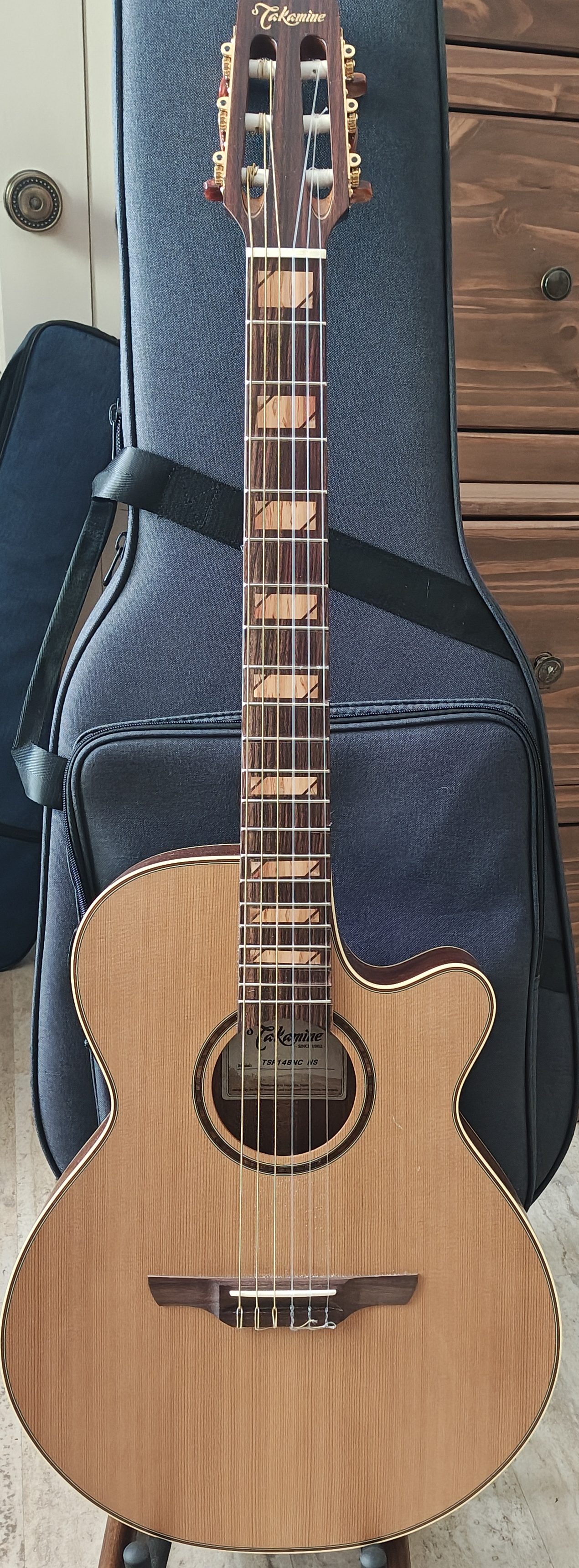
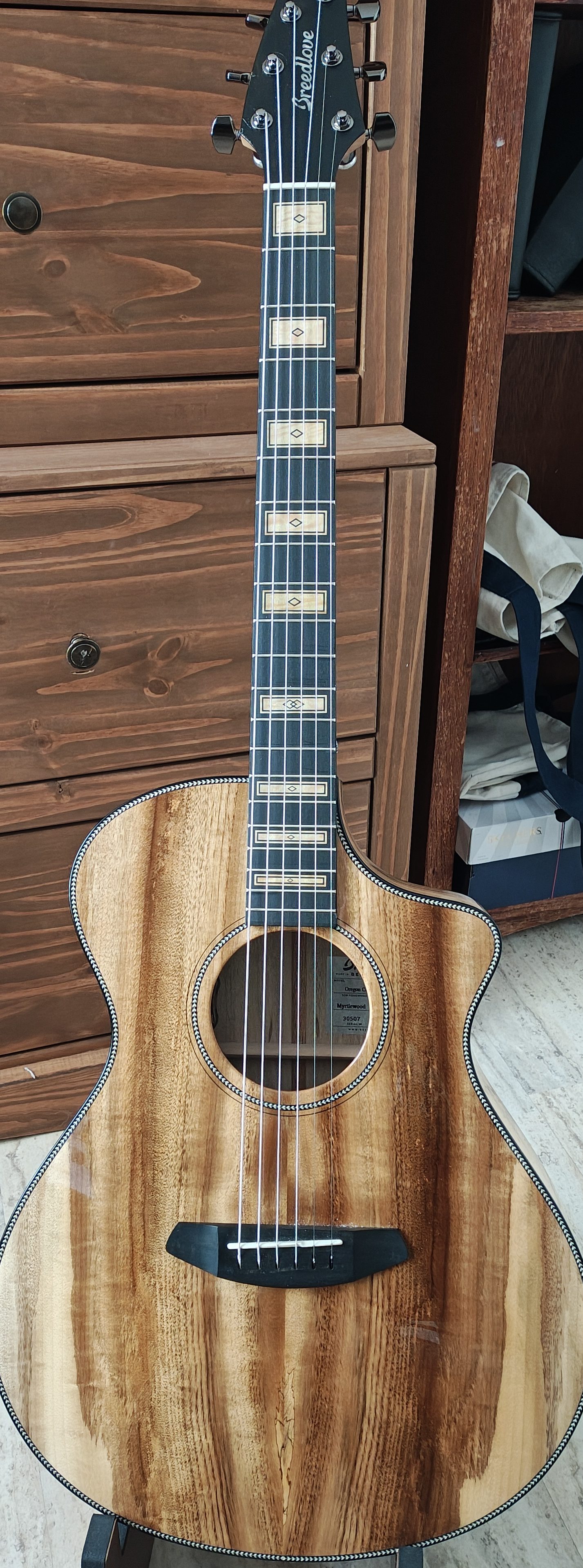 I was so pleased with the result, I ordered custom stickers for my Breedlove. This time, I asked for the wood tones to be the blonder wood tones of the guitar’s back and sides with a dark wood, in-set border. Breedlove Premier Series guitars have a diamond inlay pattern, so I asked Neck Illusions to incorporate the diamonds into the blocks. Again, I was pleased.